With the ElektroG4, which took effect on January 1, 2026, new and stricter obligations apply to manufacturers and retailers. Here is an overview of the most important FAQs regarding photovoltaic compliance.
Q: What is the ElektroG4, and why is it relevant to the solar industry?
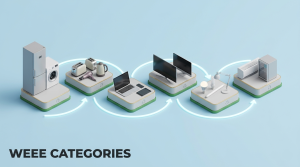
A: ElektroG4 is the third amendment to the German Electrical and Electronic Equipment Act and has been in effect since January 1, 2026. PV modules have fallen under the scope of this law since 2015 and are legally classified as electrical equipment in collection group 6. For manufacturers and importers, this entails specific registration, reporting, and take-back obligations.
Q: Do PV modules need to be registered with the EAR Foundation even if they are sold exclusively to commercial businesses?
A: Even if PV modules are sold to a commercial entity (e.g., for a solar farm) in a specific case, the EAR Foundation almost always classifies them as B2C (business-to-consumer) devices.
Reason: PV modules are “dual-use” devices. Since they could also be installed on private residential roofs with the same design, they are legally considered devices that can be used in private households.
Because of this classification as B2C devices, PV modules must be registered with the EAR Foundation.
Q: What financial guarantee must manufacturers provide?
A: Manufacturers must provide the EAR Foundation with a insolvency-proof guarantee to cover future take-back and recycling costs. Registration is not possible without this guarantee. The amount of the guarantee is based on the quantities placed on the market and must be updated regularly.
Q: What specific changes does the ElektroG4 bring for PV manufacturers in the online retail sector?
A: The requirements for the visibility of return information are being significantly tightened. In distance selling, mandatory information must not only be visible, but also visible and easy to find – for example, via a search function or directly on product pages or during the ordering process. A note in the footer, the legal notice, or buried deep within the terms and conditions is no longer sufficient.
Q: What will change with the new recycling symbol starting in July 2026?
A: The labeling requirements for collection and return points will be expanded as of July 1, 2026. A new standardized label for collection and return points will be introduced. In brick-and-mortar stores, the symbol must be displayed prominently in the entrance area (at least A4 size). In online retail, it must be displayed directly on the product pages or, at the latest, integrated into the checkout process.
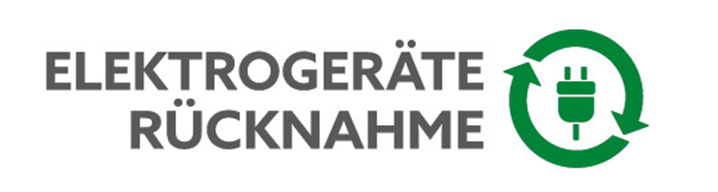
New symbol for the return of old devices
Q: What is the counter model, and does it also apply to PV modules?
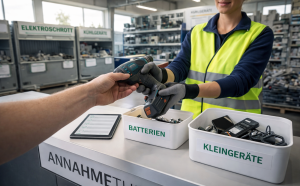
A: The counter model applies primarily to battery-powered devices (collection groups 2, 3 and 5) and stipulates that waste electrical and electronic equipment may no longer be placed directly into containers at recycling centers by the public, but must instead be accepted by trained staff.
The supervision model applies to PV modules. This means that citizens or deliverers may place the modules into the container (e.g., a pallet or rack) themselves, but only under the active supervision of staff to prevent damage (broken glass panels) and improper disposal.
Q: What happens if the EAR issues a collection order?
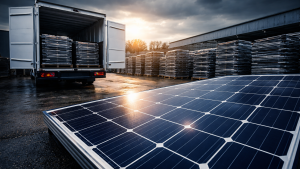
Based on legally required volume reports, the EAR Foundation knows which manufacturer is responsible for which share of the take-back. As soon as discarded PV modules accumulate at a public collection point, a pickup order is issued directly to the manufacturer. The modules must be picked up from the recycling center within 72 hours.
Q: Are commercial customers allowed to drop off old solar panels at the recycling center?
A: No. Public collection points (recycling centers) are primarily intended for waste equipment from private households (B2C). Commercial quantities (B2B) – such as those from large solar farms – must be disposed of through take-back systems established by the manufacturer.
Q: What is the ZEREZ requirement?
A: As of February 2025, the use of the Central Register for Unit and Component Certificates (ZEREZ) is mandatory for new photovoltaic systems (PV systems) in Germany. This applies to operators, installers, manufacturers, and grid operators in order to simplify and accelerate the grid connection process.
Without a valid ZEREZ ID from the manufacturer, grid operators are increasingly refusing to commission and connect new systems to the grid. While the WEEE number (Stiftung EAR) is the environmental requirement, the ZEREZ entry is the electrical requirement for grid connection in Germany.
Q: EPR obligations in other EU countries: What should be taken into account?
A: Any company that distributes PV modules not only in Germany but throughout Europe must comply with the Extended Producer Responsibility (EPR) requirements in effect in each country where the products are sold. Registration, reporting of quantities, and warranty obligations vary significantly from one member state to another. National registration with the EAR Foundation is not sufficient for EU-wide distribution.
Q: Are PV manufacturers required to actively provide information about collection and recycling rates on their websites?
A: Yes. The ElektroG4 clarified manufacturers’ information obligations under Section 18(2). Manufacturers are required to provide information on their websites regarding compliance with collection and recycling rates. This mandatory information must be clearly displayed on the relevant product pages – not just in the legal notice or in general privacy policy texts.
Q: What are the rules for foreign manufacturers selling PV modules in Germany?
A: Foreign manufacturers not based in Germany must appoint an authorized representative in Germany. This representative assumes all registration, reporting, and warranty obligations toward the EAR Foundation. Without such an authorized representative, legal distribution in Germany is not permitted.
Contact us for comprehensive advice on your compliance issues relating to electrical and electronic equipment, packaging, batteries, and PV panels.
 www.ecopv-eu.com/en/contact/ |
  E-Mail: info@ecopv-eu.com
 Supported over 20,000 customers with EPR compliance
Rated 5.0 on Google
Contact
We look forward to your message!