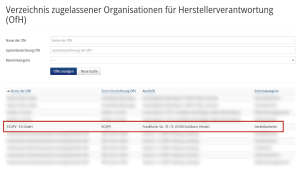

The German Packaging Act places obligations on manufacturers and online retailers. Anyone who places packaging on the market in Germany for the first time must ensure that it is properly registered and licensed. Errors in this process can quickly lead to warnings, fines, and sales bans on marketplaces such as Amazon or eBay.
Strategic error prevention in the Packaging Act
1. Missing or late LUCID registration
Without valid registration in the LUCID register of the Central Agency Packaging Register (ZSVR), there is a legal ban on the distribution of filled packaging.
- Challenge: It is often mistakenly assumed that logistics service providers or upstream suppliers will take care of registration for their own companies.
- Solution: Registration must be completed under your own tax number before the product is first placed on the market. Proactively submit your LUCID number to all relevant trading platforms.
2. Lack of system participation (licensing)
Simply registering with LUCID is not sufficient. You must also conclude a contract with a dual system to finance recycling.
- Challenge: Participation is agreed upon once, but the annual quantity report or confirmation in the LUCID portal is neglected.
- Solution: Sign a participation contract and reconcile the data annually. Ensure that the material categories reported in the system match exactly with the information in the LUCID portal.
3. Discrepancies in the quantity declaration
The reported weights (paper, plastic, glass, etc.) form the basis for the license fees and must be precisely documented.
- Challenge: Different data sources from purchasing, logistics, and sales lead to discrepancies. Gross weights are often reported instead of net weights, or export quantities are not deducted correctly.
- Solution: Create a central database (“single source of truth”). A quarterly comparison of inventory data with system reports helps to identify the need for corrections at an early stage.
4. Failure to update regulations
The Packaging Act is regularly amended, for example, to include new labeling requirements or expanded documentation requirements for marketplace operators.
- Challenge: A purely static compliance approach leads to new legal deadlines or formats being overlooked.
- Solution: Assign clear internal responsibility for monitoring. An annual “health check” – ideally before seasonal peaks – ensures that all contracts and notifications are up to date.
Quick diagnosis: Is your company legally compliant?
Check your status using these criteria:
- Is your LUCID number active and linked to the correct legal entity?
- Is there an active contract with a dual system for each type of B2C packaging?
- Do the reported material weights match the actual deliveries of the last 12 months?
- Are the distinctions between B2C packaging subject to licensing and packaging subject to deposit or B2B packaging documented?
Conclusion: Compliance as a competitive advantage
Consistent compliance with the Packaging Act is an integral part of professional risk management. It protects your distribution channels and prevents unforeseeable administrative costs. Structured processes and a clean data basis enable you to secure your market position in Germany in the long term.
ECOPV-EU GmbH supports you in efficiently bundling your obligations under the Packaging Act and designing your compliance processes in a legally compliant manner.