EPR Compliance in Poland:
WEEE, Batteries, and Packaging

Poland has strictly regulated its laws on Extended Producer Responsibility (EPR) under the national Waste Act. Anyone placing goods on the Polish market must comply with extensive legal obligations. Failure to comply with these requirements results in substantial administrative fines, exclusion from sales platforms, and sales bans.

Our concise overview explains the EPR obligations you’ll face in Poland.

Your Compliance Partner for Polish E-commerce

  • Government Registration: Proper registration with the relevant Polish environmental authorities.

  • On-Site System Connection: Optimal connection to the legally required take-back systems in Poland.

  • Ongoing reporting: Timely preparation and submission of all volume reports to fulfill your EPR obligations.

  • Your benefit: You save valuable time and are fully protected legally when engaging in cross-border trade with Poland.
EPR Compliance in Poland:
WEEE, Batteries, and Packaging

Poland has strictly regulated its laws on Extended Producer Responsibility (EPR) under the national Waste Act. Anyone placing goods on the Polish market must comply with extensive legal obligations. Failure to comply with these requirements results in substantial administrative fines, exclusion from sales platforms, and sales bans.

Our concise overview explains the EPR obligations you’ll face in Poland.

Who is legally considered a “manufacturer” in Poland?

Who is legally considered a “manufacturer” in Poland?

The term “manufacturer” is broadly defined in Polish environmental law and by no means applies only to factory producers. The decisive factor is the first commercial placing on the market of packaged products, electrical appliances, or batteries within Polish territory.
You are considered a manufacturer if you:
  • Manufacture or package products in Poland and place them on the market there.

  • Import goods into Poland or bring them in from another EU country and distribute them there.

  • As an online retailer (B2C), sell and ship directly to Polish end consumers from abroad via distance selling.

  • Supply private-label products to Polish retailers.

Your 4 Basic Obligations for EPR Compliance in Poland

Whether it’s packaging, waste electrical and electronic equipment (WEEE), or batteries – the process for ensuring legal compliance always follows the same structure in Poland:
    1. Registration in the BDO system: You are required to register electronically in the central Polish waste database (BDO). After a successful review, you will receive an official BDO number.

    2. Contract with a recycling organization: To meet the statutory take-back and recycling quotas, you must join an approved collective system (PRO – Producer Responsibility Organization).

    3. Reporting of quantities & disposal fees: You are required to report the exact weights and material types of the goods and packaging placed on the market in Poland and to pay the corresponding environmental fees.

    4. Disclosure of the BDO number: The BDO number assigned to you must be clearly displayed on invoices, delivery notes, and other business documents to demonstrate compliance to authorities and marketplaces.

Globale Herstellerverantwortung: Internationale EPR-Compliance für umweltfreundliche Unternehmen
The term “manufacturer” is broadly defined in Polish environmental law and by no means applies only to factory producers. The decisive factor is the first commercial placing on the market of packaged products, electrical appliances, or batteries within Polish territory.
You are considered a manufacturer if you:
  • Manufacture or package products in Poland and place them on the market there.

  • Import goods into Poland or bring them in from another EU country and distribute them there.

  • As an online retailer (B2C), sell and ship directly to Polish end consumers from abroad via distance selling.

  • Supply private-label products to Polish retailers.

Your 4 Basic Obligations for EPR Compliance in Poland

Whether it’s packaging, waste electrical and electronic equipment (WEEE), or batteries – the process for ensuring legal compliance always follows the same structure in Poland:
  1. Registration in the BDO system: You are required to register electronically in the central Polish waste database (BDO). After a successful review, you will receive an official BDO number.
  2. Contract with a recycling organization: To meet the statutory take-back and recycling quotas, you must join an approved collective system (PRO – Producer Responsibility Organization).
  3. Reporting of quantities & disposal fees: You are required to report the exact weights and material types of the goods and packaging placed on the market in Poland and to pay the corresponding environmental fees.
  4. Disclosure of the BDO number: The BDO number assigned to you must be clearly displayed on invoices, delivery notes, and other business documents to demonstrate compliance to authorities and marketplaces.
  1.  

Globale Herstellerverantwortung: Internationale EPR-Compliance für umweltfreundliche Unternehmen

Packaging

Packaging

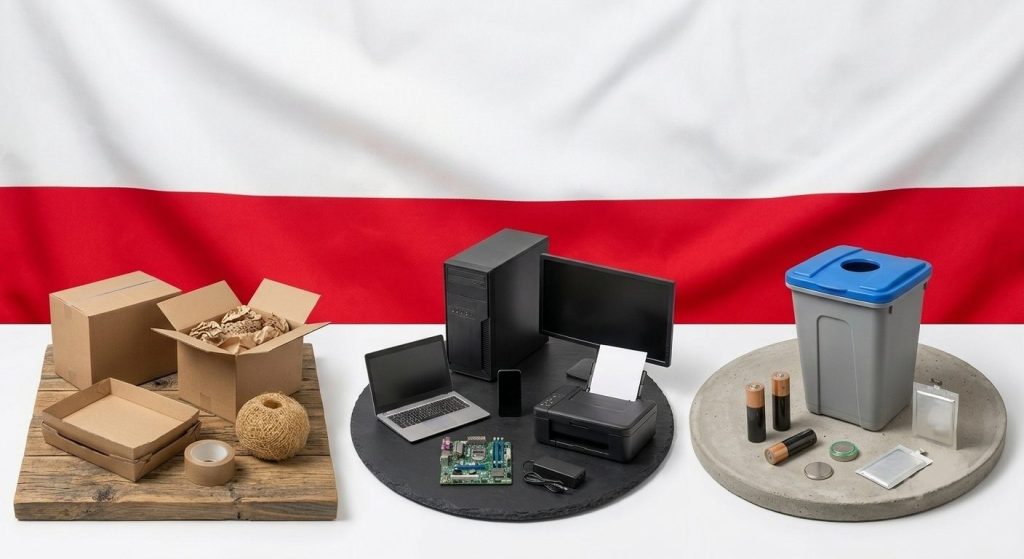
Every physical product comes with packaging. In Poland, strict registration, licensing, and reporting requirements under the BDO system apply to household (B2C), commercial, and industrial packaging, as well as to shipping and online retail. Since there are no minimum quantities, you must enter into contracts with a Polish recycling organization starting with your very first shipment.

Batteries and Rechargeable Batteries

Whether they are loose batteries or rechargeable batteries permanently installed in electronic devices, make sure you comply with the legal registration requirements in the Polish waste database. Poland strictly distinguishes between appliance, industrial, and automotive batteries. Specific take-back rates, labeling requirements (crossed-out trash can symbol), and financial security deposits apply to each category.

Electrical and Electronic Equipment (WEEE)

From household appliances to industrial machinery: Learn everything you need to know about proper labeling with the WEEE symbol, classification into the official Polish equipment categories, and obligations for the take-back of end-of-life equipment. Anyone importing electrical equipment into Poland must often provide financial guarantees for subsequent recycling in addition to BDO registration.

Every physical product comes with packaging. In Poland, strict registration, licensing, and reporting requirements under the BDO system apply to household (B2C), commercial, and industrial packaging, as well as to shipping and online retail. Since there are no minimum quantities, you must enter into contracts with a Polish recycling organization starting with your very first shipment.

Batteries and Rechargeable Batteries

Whether they are loose batteries or rechargeable batteries permanently installed in electronic devices, make sure you comply with the legal registration requirements in the Polish waste database. Poland strictly distinguishes between appliance, industrial, and automotive batteries. Specific take-back rates, labeling requirements (crossed-out trash can symbol), and financial security deposits apply to each category.

Electrical and Electronic Equipment (WEEE)

From household appliances to industrial machinery: Learn everything you need to know about proper labeling with the WEEE symbol, classification into the official Polish equipment categories, and obligations for the take-back of end-of-life equipment. Anyone importing electrical equipment into Poland must often provide financial guarantees for subsequent recycling in addition to BDO registration.

Contact

We look forward to your message!

info@ecopv-eu.com

+49 6196 5835357

Frankfurter Str. 70-72
65760 Eschborn

Contact

We look forward to your message!

info@ecopv-eu.com

+49 6196 5835357

Frankfurter Str. 70-72
65760 Eschborn