
🇮🇪 EPR Compliance for Batteries in Ireland |
Guide and Checklist 2026

Extended Producer Responsibility (EPR) for Batteries and Accumulators – 7 Steps to Compliance + Step-by-Step Checklist

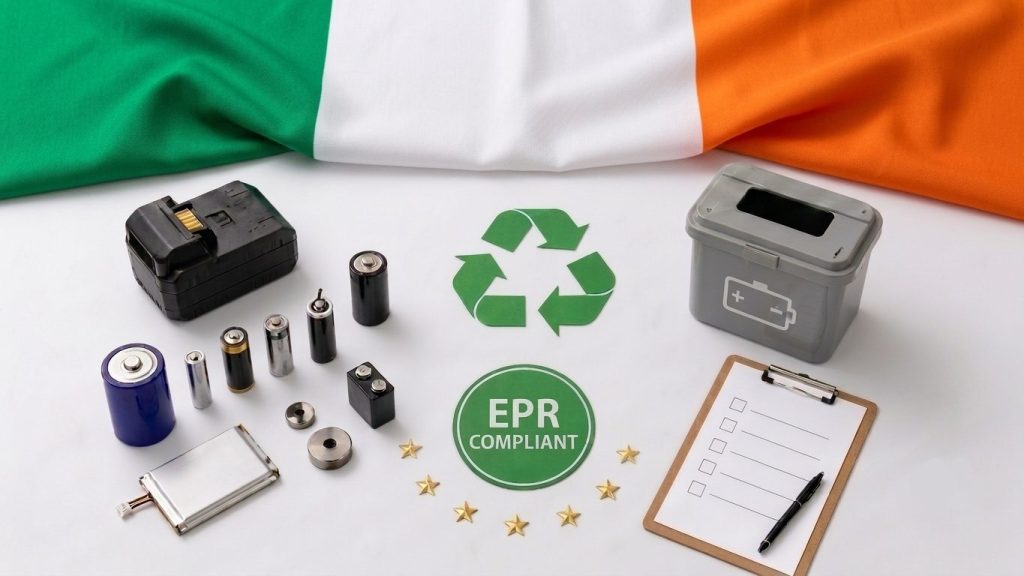
Anyone who sells batteries or battery-powered devices in Ireland has a legal obligation: Extended Producer Responsibility (EPR) makes companies jointly responsible for the end-of-life management of their batteries. The legal basis is Irish S.I. 283/2014 (European Union Batteries and Accumulators Regulations), supplemented by the EU Battery Regulation (EU 2023/1542), which has been directly applicable since August 18, 2025. Administration is handled by the Environmental Protection Agency (EPA) and the national registration body, Producer Register Limited (PRL).

What does this mean specifically for your company? Here are the 7 most important steps – including a checklist to get you started.
Who is considered a “producer” under Ireland’s Battery EPR?

A producer is any natural or legal person who, for the first time, commercially places batteries – whether individually or installed in devices – on the Irish market. Specifically, this applies to:

  • Manufacturers – those who produce and distribute batteries in Ireland under their own name or brand
  • Importers – those who import batteries into Ireland for commercial purposes from abroad (the EU, the United Kingdom/Northern Ireland, or third countries)
  • Distance selling / online retailers – those not based in Ireland who sell batteries directly to Irish households or businesses
  • EEG manufacturers with integrated batteries – anyone who places electrical or electronic equipment with built-in batteries on the market in Ireland is automatically required to register as both an EEG producer and a battery producer

Practical example: A German company operates an online store and ships Bluetooth speakers with built-in rechargeable batteries directly to Irish end customers → is considered both a battery producer and an EEE producer → must appoint an Authorized Representative (AR) in Ireland → must register with PRL and obtain an IE number → must join a compliance scheme (WEEE Ireland or ERP Ireland) → submit monthly volume reports by the 19th of the following month via the PRL Blackbox → renew registration annually by January 31.

The 7 Most Important Steps for Battery Compliance in Ireland

Step 1: Appoint an Authorized Representative (for foreign companies)

Manufacturers not based in Ireland who sell batteries directly to Irish customers must appoint an Authorized Representative (AR) based in Ireland.

The AR assumes all of the manufacturer’s legal obligations in Ireland – registration with the PRL, reporting requirements, membership in the compliance scheme, and financing of disposal.

Requirements for the AR:

  • A natural or legal person established in the Republic of Ireland
  • A written mandate in English is required
  • The AR must be officially registered with the PRL as the AR for the foreign manufacturer
  • A Hague Apostille is not required; the EPA validates the appointment through the PRL registration

Step 2: Mandatory registration with Producer Register Limited (PRL)

Competent authority: Environmental Protection Agency (EPA) Ireland – administers registration through Producer Register Limited (PRL)

Registration platform: producerregister.ie

Procedure:

  • Submit an application via the PRL online portal (producerregister.ie)
  • Provide company details, battery categories and chemical composition, distribution channels (B2C/B2B), and proof of compliance scheme membership or the 3-year waste management plan
  • PRL issues a unique IE registration number
  • At the same time, login credentials for the PRL Blackbox reporting portal are issued

Annual renewal: PRL registration must be renewed annually by January 31.

Step 3: Membership in a Compliance Scheme or Self-Compliance

For B2C Producers – Mandatory: Compliance Scheme

Manufacturers who sell batteries to private households must join one of the two government-approved compliance schemes:

SchemeFocus
WEEE IrelandIreland’s largest scheme (~75% market share); covers all battery categories as well as EEG; operates blue collection boxes in retail stores and schools; organizes logistics and recycling
ERP Ireland DAC (European Recycling Platform)Alternative for all battery types; internationally oriented; also specializes in industrial and LMT batteries; offers customized take-back solutions

The schemes organize collection (blue collection boxes in retail stores, schools, and public collection points), logistics, and recycling. Members of a compliance scheme are exempt from the direct reporting requirement to the EPA and from individual recycling quota targets – the scheme assumes this responsibility.

For B2B producers (commercial) – Choice between two options:

Unlike B2C manufacturers, B2B battery producers can choose how to fulfill their legal obligations:

Option A: Join a compliance scheme (recommended for foreign distributors)

  • Process: The producer joins WEEE Ireland or ERP Ireland as a B2B member.
  • Advantage: In exchange for an annual fee, the system assumes regulatory responsibility. The manufacturer is exempt from the obligation to submit its own disposal plans or annual reports to the EPA.

Option B: Self-compliance via the EPA EDEN portal

  • 3-Year Plan: The producer submits a 3-year Waste Battery Management Plan to the Environmental Protection Agency (EPA) via the official government portal, EDEN Ireland. This detailed plan must describe how the take-back from commercial customers is organized, which logistics and recycling partners are used, and how compliance is documented.
  • Annual Waste Report: B2B producers who opt for self-compliance are required to submit an Annual Waste Battery Management Report via EDEN by January 31 of each year. This report must demonstrate exact compliance with the statutory recycling and collection quotas.

Step 4: Monthly Volume Reporting in the PRL Blackbox

All battery producers – regardless of whether they operate in the B2C (via the Scheme) or B2B (self-compliance) sectors – must report volumes monthly via the PRL Blackbox portal.

Report Contents:

  • Chemistry and weight of batteries placed on the Irish market
  • Breakdown by battery type and category

Deadline: The PRL Blackbox opens on the 1st of the month and must be populated with the previous month’s data by the 19th of the following month. After the 19th, the portal closes until the 1st of the next month.

Important: Monthly volume reporting in the PRL Blackbox system is mandatory only for members of a collective scheme (scheme members). Self-compliant entities, on the other hand, report their data directly to the EPA via the EDEN portal. While the scheme handles the operational take-back, the obligation to submit monthly data reports in the Blackbox system remains with the respective scheme member.

Step 5: Financial Contributions and Disposal Costs

Environmental Management Costs (EMC) for Batteries: Similar to WEEE, the fees are based on battery type (lithium, lead-acid, alkaline) and weight. Lithium batteries are subject to higher rates due to the greater effort required for recycling and safety requirements.

Fee Exemption for Collection Boxes: Members of WEEE Ireland do not pay separate installation fees for blue collection boxes; these costs are included in the system fees.

Recycling Management Costs (RMC): In addition to the EMC, WEEE Ireland charges so-called RMC for B2C products reported in the PRL Blackbox – even if a vEMC (Visible Environmental Management Cost) has already been charged for the device.

Step 6: Expanded Reporting Requirements

CO₂ Footprint Declaration:

  • Manufacturers of EV batteries and certain stationary industrial batteries must provide a verified CO₂ footprint declaration for the Irish market
  • Authorized representatives (ARs) of foreign manufacturers are required to keep this documentation available and submit it to the EPA upon request

Due Diligence – effective 2027:

  • Manufacturers of batteries with a capacity exceeding 2 kWh must document their due diligence regarding the sourcing of raw materials (cobalt, lithium, nickel, natural graphite) for the Irish market and make this documentation available to the AR

Step 7: Labeling Requirements

The following labels are required by law for all batteries placed on the Irish market:

  • Crossed-out trash can: Required on every battery or, if space is limited, on the packaging
  • Capacity: Must be specified in mAh, Ah, or Wh
  • IE registration number: Must appear on all invoices to retailers and distributors

Step-by-Step Checklist

(a) Companies based in Ireland

1. Classify batteries into the 5 EU categories

2. Enter into a compliance scheme agreement or self-comply via the EDEN portal

3. Complete registration with PRL (producerregister.ie) and obtain an IE number (annual renewal due by January 31)

4. Activate login credentials for PRL Blackbox; set up monthly volume reporting due by the 19th of the following month

5. Provide CO₂ footprint documentation (EV and stationary industrial batteries)

6. Document due diligence records for batteries exceeding 2 kWh starting in 2027 (cobalt, lithium, nickel)

7. Check labeling: trash can symbol, capacity rating, and chemical symbols on all batteries

8. Check for duplicate registration: EEG with built-in batteries → Requirement for separate EEG and battery registration

(b) Companies from other EU countries

1. Appoint an Authorized Representative (AR) in Ireland; execute a written power of attorney

2. The AR registers with PRL as the AR for the foreign manufacturer and receives an IE number

3. The AR enters into a contract with a compliance scheme on behalf of the manufacturer (or, for purely B2B batteries, alternatively manages self-compliance).

4. Submit monthly export data (weight, chemistry, category) to the AR

5. Ensure that the AR renews the PRL registration annually by January 31

6. Provide CO₂ footprint data for EV batteries to the AR

7. Provide due diligence documentation for batteries exceeding 2 kWh to the AR starting in 2027

(c) Companies from third countries (outside the EU)

1. Review the supply chain: Supply to an Irish importer → the importer assumes the manufacturer’s obligations; submit all quantity and chemical data in a timely manner

2. Direct shipment to Irish end customers without an Irish intermediary → all steps listed in (b) must be handled through an Authorized Representative (AR) based in Ireland

Are you planning to sell your products in Ireland?

We’ll help you ensure compliance with Ireland’s EPR regulations for batteries so you can get started with legal certainty.

Contact

We look forward to your message!

info@ecopv-eu.com

+49 6196 5835357

Frankfurter Str. 70-72
65760 Eschborn