EPR Compliance in Italy:
WEEE, Batteries, and Packaging

Italy has a strictly regulated Extended Producer Responsibility (EPR) system that is closely monitored by the Ministry of the Environment and Energy Security (MASE) and the relevant national consortia. Anyone placing goods on the Italian market must comply with comprehensive legal obligations. Failure to comply with these requirements results in sales bans, bans on online marketplaces, and severe penalties imposed by the relevant authorities.

With our detailed guide, including a checklist, you’ll learn what EPR obligations you face in Italy.
EPR Compliance in Italy:
WEEE, Batteries, and Packaging

Italy has a strictly regulated Extended Producer Responsibility (EPR) system that is closely monitored by the Ministry of the Environment and Energy Security (MASE) and the relevant national consortia. Anyone placing goods on the Italian market must comply with comprehensive legal obligations. Failure to comply with these requirements results in sales bans, bans on online marketplaces, and severe penalties imposed by the relevant authorities.

With our detailed guide, including a checklist, you’ll learn what EPR obligations you face in Italy.

Who is legally considered a producer in Italy?

Who is legally considered a producer in Italy?

Under Italian environmental law, the concept of producer responsibility extends far beyond the mere manufacturer. The decisive factor is the first commercial supply of goods on Italian territory. In packaging law, the legislation also makes a precise distinction between Produttori (manufacturers of raw materials/empty packaging) and Utilizzatori (users and importers).

You are subject to EPR obligations in Italy if you:

  • Manufacture in Italy and place the goods or packaging on the market there for the first time.
  • Import goods or empty packaging into Italy and distribute them commercially there.
  • As an online retailer (B2C), send packaged goods directly to Italian end consumers from abroad.
  • As a marketplace operator, are liable for the compliance and conformity of third-party sellers on your platform (e.g., under the EU Packaging and Packaging Waste Regulation (PPWR)).

Your 4 Key Obligations for EPR Compliance in 2026

Regardless of the specific product category, you must always follow the same core steps in Italy:
  1. Join the relevant take-back systems: You must register with the respective state-approved consortia. For packaging, the central umbrella organization is CONAI. For waste electrical and electronic equipment (WEEE) and batteries, registration is handled through the relevant collective systems.
  2. Registration in the national registries: You must officially register as a distributor in the respective government registries (e.g., the national WEEE registry, Registro AEE, or the battery registry) to legalize your market participation.
  3. Regular volume reporting & environmental contribution: You are required to periodically declare the weight and quantity of products and packaging placed on the Italian market and to pay the corresponding recycling fees.
  4. Strict information and labeling requirements: You must ensure that your packaging complies with the strict Italian regulations on environmental labeling as well as the upcoming EU requirements under the PPWR.

Under Italian environmental law, the concept of producer responsibility extends far beyond the mere manufacturer. The decisive factor is the first commercial supply of goods on Italian territory. In packaging law, the legislation also makes a precise distinction between Produttori (manufacturers of raw materials/empty packaging) and Utilizzatori (users and importers).

You are subject to EPR obligations in Italy if you:

  • Manufacture in Italy and place the goods or packaging on the market there for the first time.
  • Import goods or empty packaging into Italy and distribute them commercially there.
  • As an online retailer (B2C), send packaged goods directly to Italian end consumers from abroad.
  • As a marketplace operator, are liable for the compliance and conformity of third-party sellers on your platform (e.g., under the EU Packaging and Packaging Waste Regulation (PPWR)).

Your 4 Key Obligations for EPR Compliance in 2026

Regardless of the specific product category, you must always follow the same core steps in Italy:
  1. Join the relevant take-back systems: You must register with the respective state-approved consortia. For packaging, the central umbrella organization is CONAI. For waste electrical and electronic equipment (WEEE) and batteries, registration is handled through the relevant collective systems.
  2. Registration in the national registries: You must officially register as a distributor in the respective government registries (e.g., the national WEEE registry, Registro AEE, or the battery registry) to legalize your market participation.
  3. Regular volume reporting & environmental contribution: You are required to periodically declare the weight and quantity of products and packaging placed on the Italian market and to pay the corresponding recycling fees.
  4. Strict information and labeling requirements: You must ensure that your packaging complies with the strict Italian regulations on environmental labeling as well as the upcoming EU requirements under the PPWR.

Packaging

Packaging

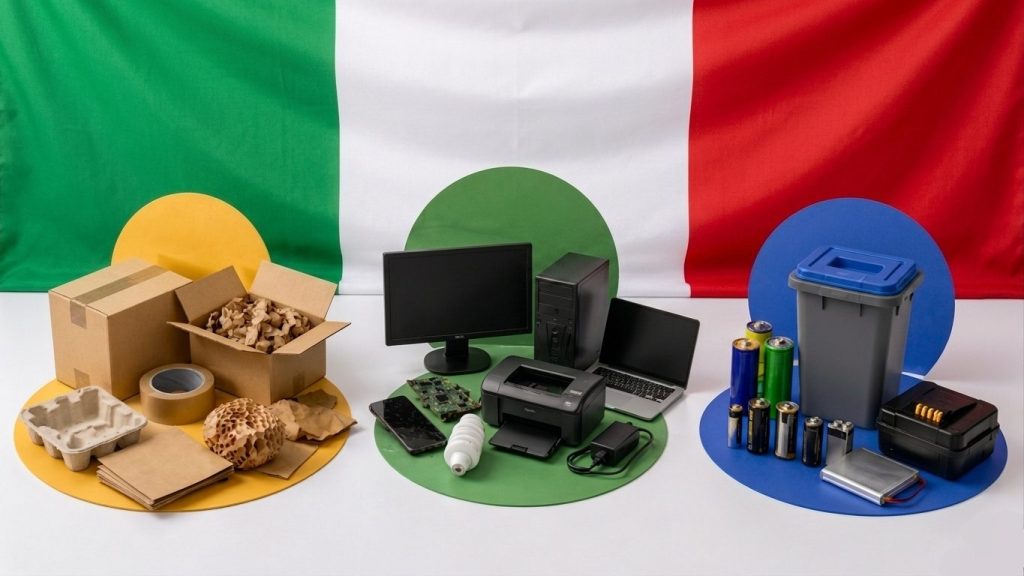
Every physical product comes with packaging. Learn all about the obligations for household and commercial packaging and how to work with CONAI, the Italian national packaging consortium.

Batteries and Accumulators

Whether loose batteries or built-in rechargeable batteries in electronic devices: Fulfill your registration obligations in a legally compliant manner and learn how registration in the national registry (Registro Pile) and collaboration with accredited collective systems work.

Electrical and Electronic Equipment (WEEE)

Learn everything you need to know about proper registration in the national register (Registro AEE), labeling with the crossed-out wheelie bin symbol, and how to correctly classify your products into the official WEEE categories.

Every physical product comes with packaging. Learn all about the obligations for household and commercial packaging and how to work with CONAI, the Italian national packaging consortium.

Batteries and Accumulators

Whether loose batteries or built-in rechargeable batteries in electronic devices: Fulfill your registration obligations in a legally compliant manner and learn how registration in the national registry (Registro Pile) and collaboration with accredited collective systems work.

Electrical and Electronic Equipment (WEEE)

Learn everything you need to know about proper registration in the national register (Registro AEE), labeling with the crossed-out wheelie bin symbol, and how to correctly classify your products into the official WEEE categories.

Contact

We look forward to your message!

info@ecopv-eu.com

+49 6196 5835357

Frankfurter Str. 70-72
65760 Eschborn

Contact

We look forward to your message!

info@ecopv-eu.com

+49 6196 5835357

Frankfurter Str. 70-72
65760 Eschborn