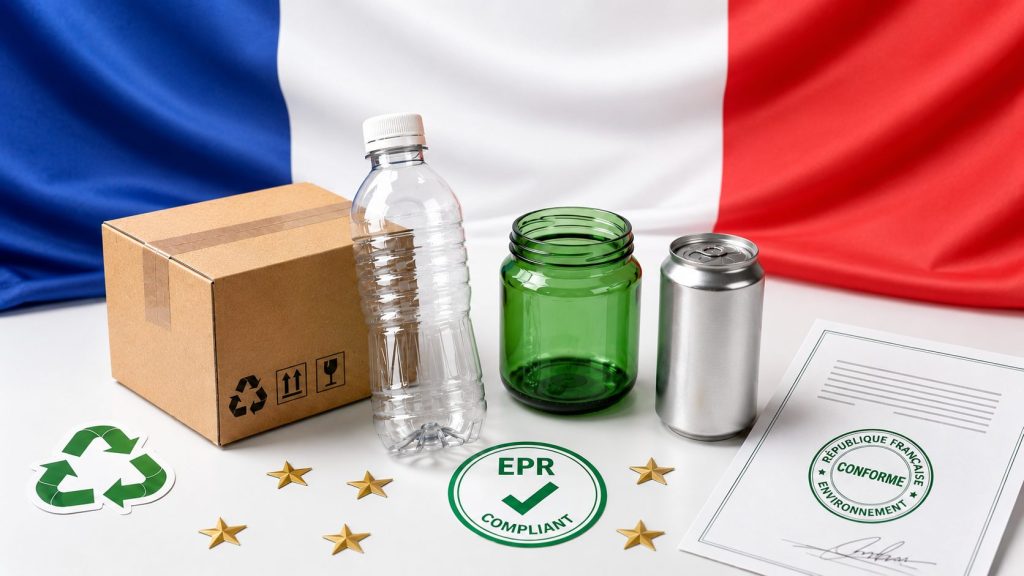
🇫🇷 EPR Compliance for Packaging in France |
Guide and Checklist 2026

Extended Producer Responsibility (EPR) for Packaging – 7 Steps to Compliance + Step-by-Step Checklist

Anyone who sells products in France is familiar with the topic: Extended Producer Responsibility (EPR) makes companies jointly responsible for the end-of-life of their packaging. The system has been in place for household packaging since 2022 – and commercial and industrial packaging will also be included starting in 2025.

What does this mean for your business, specifically?

Here are the 7 most important steps – including a checklist to get you started.
🇫🇷 EPR Compliance for Packaging in France |
Guide and Checklist 2026

Extended Producer Responsibility (EPR) for Packaging – 7 Steps to Compliance + Step-by-Step Checklist

Anyone who sells products in France is familiar with the topic: Extended Producer Responsibility (EPR) makes companies jointly responsible for the end-of-life of their packaging. The system has been in place for household packaging since 2022 – and commercial and industrial packaging will also be included starting in 2025.

What does this mean for your business, specifically?

Here are the 7 most important steps – including a checklist to get you started.
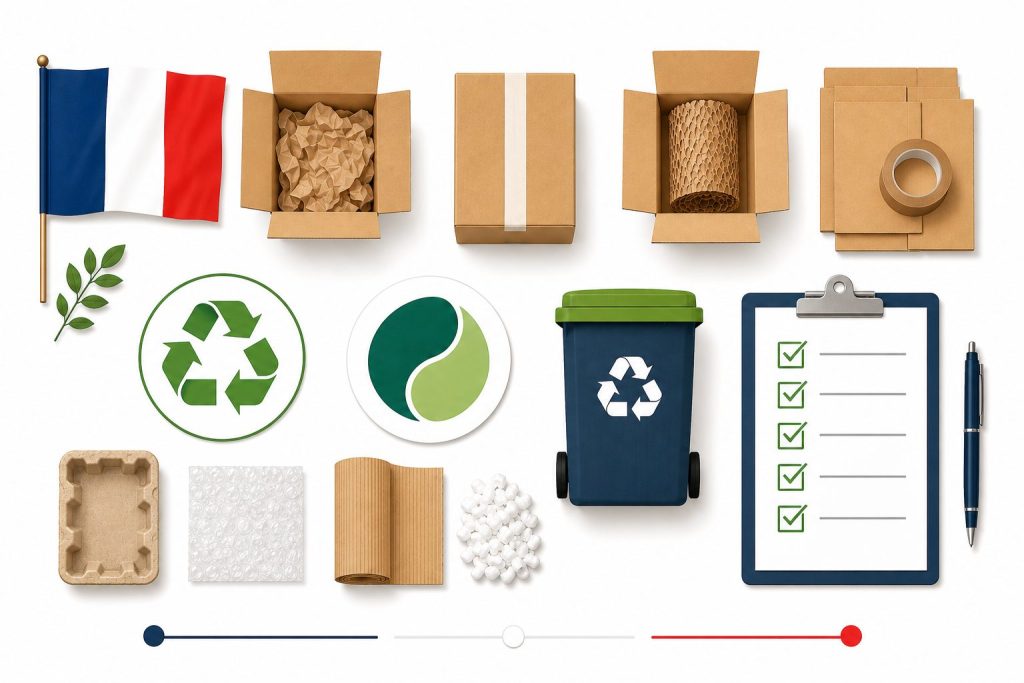
Who is considered a “producteur”?

Under the French Packaging Regulation, a “producteur” is any company that places packaged goods on the market in France for the first time – regardless of where the company is headquartered.

Specifically, this applies to:

  • Brand owners based in France (if the name or logo appears on the product)
  • Importers – those who import packaged goods into France from the EU or third countries
  • Private-label retailers – retailers who sell products under their own brand
  • E-commerce / Direct-to-Consumer – foreign online stores that ship packaged goods directly to French end customers (including shipping boxes and packing materials)
  • New as of July 1, 2026: Anyone using transport packaging (pallets, shrink wrap) in the B2B sector is considered a Producteur in the new category “commercial and industrial packaging” (EIC REP)

Practical example: A German online retailer ships products directly to French end customers → is considered a Producteur → must appoint an authorized representative → requires an IDU and system participation → must also include shipping cartons and packing material in the quantity report.

The 7 Key Steps to EPR Compliance in France

Step 1: Appoint an Authorized Representative (for foreign companies)

Companies not headquartered in France that sell to households via distance selling may appoint an authorized representative to handle all administrative obligations toward ADEME and the eco-organization.

Until August 11, 2026, the following applies: This representative is mandatory for non-EU companies; EU companies may alternatively still register directly themselves.

Note: The new EU Packaging Regulation (PPWR) takes effect on August 12, 2026. From that date on, a local authorized representative will be mandatory without exception for all cross-border online retailers without a French branch.

Step 2: Membership in an approved eco-organization

Membership in a state-approved Éco-Organisme (also known as a PRO – Producer Responsibility Organization) is mandatory. This organization handles collection, sorting, recycling, and data reporting to ADEME.

Step 3: Mandatory registration in the SYDEREP registry & receipt of the IDU number

SYDEREP is the national registry managed by ADEME. Every company needs an IDU number (Identifiant Unique) – a unique identifier for each EPR category.

Process:

  1. Join the eco-organization
  2. The eco-organization automatically submits your data to ADEME
  3. ADEME issues the IDU within approximately 48 hours
    The IDU must then be displayed prominently: in terms and conditions, legal notices, invoices, marketplace profiles (Amazon, eBay, etc.), and on the website.

Step 4: Collect and Report Packaging Data

Annual volume reporting is mandatory – broken down by material and weight (plastic, paper/cardboard, glass, metal, etc.) and, where applicable, by number of units. Reports are submitted digitally via the eco-organization’s portal. For companies with their own management system, direct reporting via SYDEREP is also an option.

What must be reported?

  • Product packaging (retail packaging)
  • Shipping boxes, inner padding, filling material (for e-commerce)
  • Transport packaging (B2B, new category effective July 1, 2026)
  • Household and commercial packaging must be recorded and reported separately

Step 5: Calculate and Pay Eco-Fees

The amount of the fees depends on the type of packaging, quantity, material, and recyclability. The basic calculation formula:

(Weight × Material Price) + (Number of Units × Fixed Price) – Rebates + Penalty Surcharges

The system operates according to the eco-design principle: Those who use recyclable or environmentally friendly packaging pay less (bonuses). Those who use materials that are difficult to recycle pay penalty surcharges. Starting in 2025, new incentives for the use of recycled plastic will apply.

Step 6: Comply with labeling requirements (Triman + Info-Tri)

The following labels are mandatory for all packaging sold to households:

  • Triman logo: The standardized symbol for recyclable packaging – must appear physically on the packaging (legal basis: Art. L.541-9-3 Code de l’environnement, Decree 2021-835)
  • Info-Tri: Detailed sorting instructions – which bin, which material separation, in which color. The eco-organization (e.g., Citeo) provides brand- and material-specific Info-Tri graphics and guidelines.

Note: Different labeling rules apply to purely commercial (B2B) packaging. The requirements depend on the intended use.

Step 7: Develop a 3R Prevention Plan (above certain thresholds)

Companies that place more than 10,000 units per year on the French market are required to develop a 5-year prevention plan (3R: Réduire, Réemployer, Recycler – Reduce, Reuse, Recycle) and submit it through their eco-organization. This plan outlines specific measures to reduce packaging waste and increase recyclability.

Who is considered a “producteur”?

Under the French Packaging Regulation, a “producteur” is any company that places packaged goods on the market in France for the first time – regardless of where the company is headquartered.

Specifically, this applies to:

  • Brand owners based in France (if the name or logo appears on the product)
  • Importers – those who import packaged goods into France from the EU or third countries
  • Private-label retailers – retailers who sell products under their own brand
  • E-commerce / Direct-to-Consumer – foreign online stores that ship packaged goods directly to French end customers (including shipping boxes and packing materials)
  • New as of July 1, 2026: Anyone using transport packaging (pallets, shrink wrap) in the B2B sector is considered a Producteur in the new category “commercial and industrial packaging” (EIC REP)

Practical example: A German online retailer ships products directly to French end customers → is considered a Producteur → must appoint an authorized representative → requires an IDU and system participation → must also include shipping cartons and packing material in the quantity report.

The 7 Key Steps to EPR Compliance in France

Step 1: Appoint an Authorized Representative (for foreign companies)

Companies not headquartered in France that sell to households via distance selling may appoint an authorized representative to handle all administrative obligations toward ADEME and the eco-organization.

Until August 11, 2026, the following applies: This representative is mandatory for non-EU companies; EU companies may alternatively still register directly themselves.

Note: The new EU Packaging Regulation (PPWR) takes effect on August 12, 2026. From that date on, a local authorized representative will be mandatory without exception for all cross-border online retailers without a French branch.

Step 2: Membership in an approved eco-organization

Membership in a state-approved Éco-Organisme (also known as a PRO – Producer Responsibility Organization) is mandatory. This organization handles collection, sorting, recycling, and data reporting to ADEME.

Step 3: Mandatory registration in the SYDEREP registry & receipt of the IDU number

SYDEREP is the national registry managed by ADEME. Every company needs an IDU number (Identifiant Unique) – a unique identifier for each EPR category.

Process:

  1. Join the eco-organization
  2. The eco-organization automatically submits your data to ADEME
  3. ADEME issues the IDU within approximately 48 hours
    The IDU must then be displayed prominently: in terms and conditions, legal notices, invoices, marketplace profiles (Amazon, eBay, etc.), and on the website.

Step 4: Collect and Report Packaging Data

Annual volume reporting is mandatory – broken down by material and weight (plastic, paper/cardboard, glass, metal, etc.) and, where applicable, by number of units. Reports are submitted digitally via the eco-organization’s portal. For companies with their own management system, direct reporting via SYDEREP is also an option.

What must be reported?

  • Product packaging (retail packaging)
  • Shipping boxes, inner padding, filling material (for e-commerce)
  • Transport packaging (B2B, new category effective July 1, 2026)
  • Household and commercial packaging must be recorded and reported separately

Step 5: Calculate and Pay Eco-Fees

The amount of the fees depends on the type of packaging, quantity, material, and recyclability. The basic calculation formula:

(Weight × Material Price) + (Number of Units × Fixed Price) – Rebates + Penalty Surcharges

The system operates according to the eco-design principle: Those who use recyclable or environmentally friendly packaging pay less (bonuses). Those who use materials that are difficult to recycle pay penalty surcharges. Starting in 2025, new incentives for the use of recycled plastic will apply.

Step 6: Comply with labeling requirements (Triman + Info-Tri)

The following labels are mandatory for all packaging sold to households:

  • Triman logo: The standardized symbol for recyclable packaging – must appear physically on the packaging (legal basis: Art. L.541-9-3 Code de l’environnement, Decree 2021-835)
  • Info-Tri: Detailed sorting instructions – which bin, which material separation, in which color. The eco-organization (e.g., Citeo) provides brand- and material-specific Info-Tri graphics and guidelines.

Note: Different labeling rules apply to purely commercial (B2B) packaging. The requirements depend on the intended use.

Step 7: Develop a 3R Prevention Plan (above certain thresholds)

Companies that place more than 10,000 units per year on the French market are required to develop a 5-year prevention plan (3R: Réduire, Réemployer, Recycler – Reduce, Reuse, Recycle) and submit it through their eco-organization. This plan outlines specific measures to reduce packaging waste and increase recyclability.

Step-by-Step Checklist

(a) Companies based in France

  1. Join an eco-organization (Citeo, Léko, or another approved PRO)
  2. Track household and commercial packaging separately
  3. Include the IDU number in the Terms and Conditions and Legal Notice
  4. Check labeling: Triman logo + Info-Tri on all household packaging
  5. Submit annual volume reports (by weight and material)
  6. Calculate and pay eco-contributions on time
  7. Create a 3R prevention plan (if >10,000 units/year)

(b) Companies from other EU countries

  1. Appoint an authorized representative in France (voluntary until August 2026, mandatory thereafter under the PPWR)
  2. Complete registration through the authorized representative with an eco-organization
  3. Provide the IDU number to all French trading partners and marketplaces (Amazon, eBay, Zalando, etc.)
  4. Include the IDU on the website, in the Terms and Conditions, legal notice, and invoices
  5. Prepare an annual volume report (weight by material, separating household vs. commercial packaging)
  6. Ensure Triman + Info-Tri labels are present on packaging for end customers

(c) Companies from third countries (outside the EU)

  1. Authorized representative based in France is mandatory
  2. Have the registration process handled entirely by the authorized representative
  3. Communicate the IDU to all French marketplaces and trading partners
  4. Prepare an annual volume report (weight by material)
  5. Do not forget compliance for shipping packaging and filling materials

Step-by-Step Checklist

(a) Companies based in France

  1. Join an eco-organization (Citeo, Léko, or another approved PRO)
  2. Track household and commercial packaging separately
  3. Include the IDU number in the Terms and Conditions and Legal Notice
  4. Check labeling: Triman logo + Info-Tri on all household packaging
  5. Submit annual volume reports (by weight and material)
  6. Calculate and pay eco-contributions on time
  7. Create a 3R prevention plan (if >10,000 units/year)

(b) Companies from other EU countries

  1. Appoint an authorized representative in France (voluntary until August 2026, mandatory thereafter under the PPWR)
  2. Complete registration through the authorized representative with an eco-organization
  3. Provide the IDU number to all French trading partners and marketplaces (Amazon, eBay, Zalando, etc.)
  4. Include the IDU on the website, in the Terms and Conditions, legal notice, and invoices
  5. Prepare an annual volume report (weight by material, separating household vs. commercial packaging)
  6. Ensure Triman + Info-Tri labels are present on packaging for end customers

(c) Companies from third countries (outside the EU)

  1. Authorized representative based in France is mandatory
  2. Have the registration process handled entirely by the authorized representative
  3. Communicate the IDU to all French marketplaces and trading partners
  4. Prepare an annual volume report (weight by material)
  5. Do not forget compliance for shipping packaging and filling materials

Are you planning to sell your products in France?

We’ll help you ensure compliance with France’s EPR regulations for packaging so you can get started with legal certainty.

Are you planning to sell your products in France?

We’ll help you ensure compliance with France’s EPR regulations for packaging so you can get started with legal certainty.

Contact

We look forward to your message!

info@ecopv-eu.com

+49 6196 5835357

Frankfurter Str. 70-72
65760 Eschborn

Contact

We look forward to your message!

info@ecopv-eu.com

+49 6196 5835357

Frankfurter Str. 70-72
65760 Eschborn