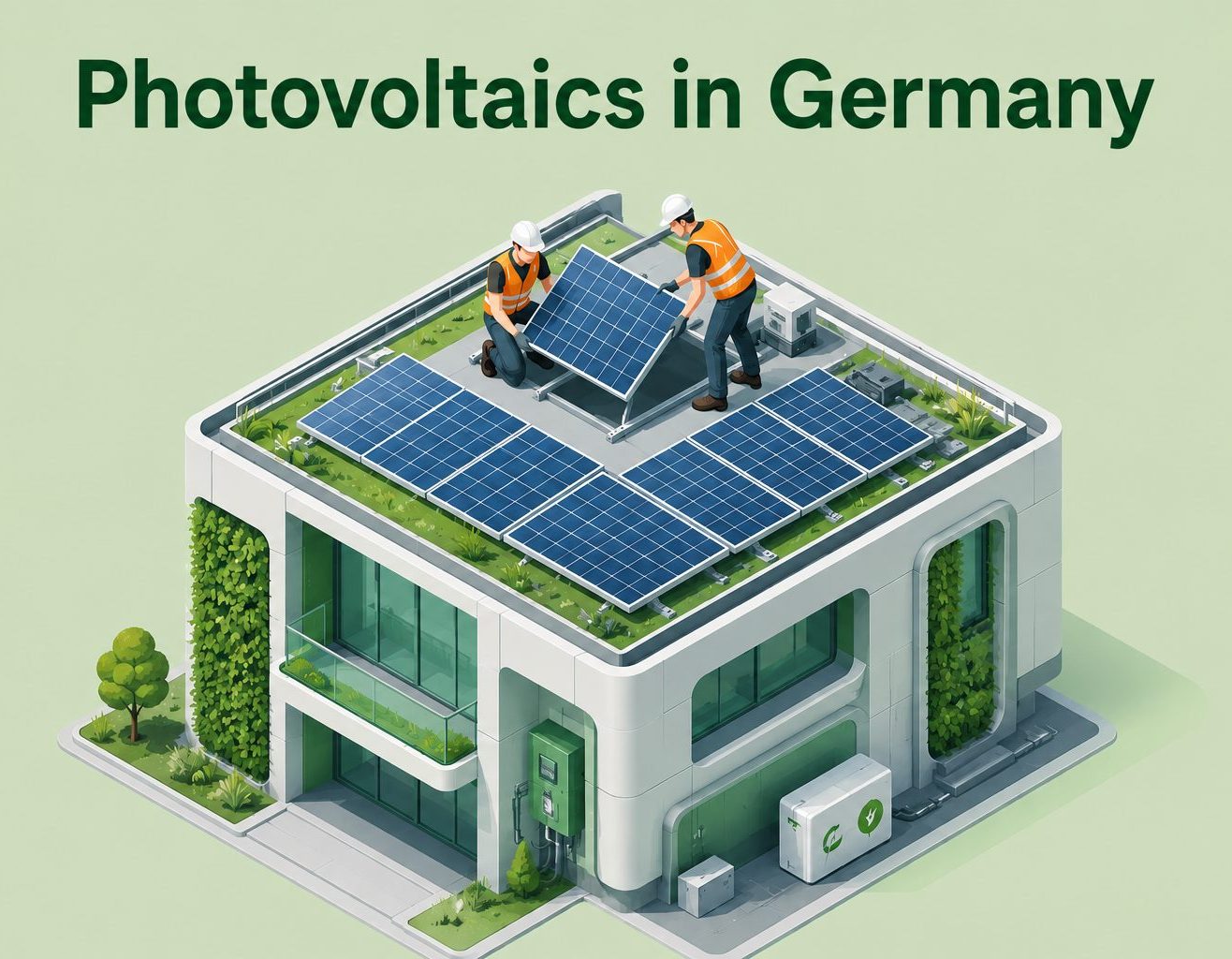
The modern solar cell was invented in 1954. Once an expensive technology used in satellites, it now supplies a large portion of our electricity.
Market Development & Key Figures
- Total Capacity: By the end of 2025, there were over 4.2 million solar installations in Germany, generating a combined output of approximately 117 gigawatts (GWp) and reaching a new all-time high with a total of 87.4 terawatt-hours (TWh) of solar power generated.
- Widespread Adoption: Residential rooftops have seen very high adoption rates. However, the greatest growth in the market is currently being driven by solar systems installed in open spaces.
- Significant Potential: Enormous capacity remains untapped on industrial and logistics buildings. According to the Fraunhofer Institute IIS, over 80% of company rooftops do not yet have a solar system.
Technological Evolution & Design
New technologies, flexible installation sites, and regulations are transforming the solar industry.
- Higher Efficiency: Conventional silicon modules are the standard.
However, new tandem solar cells already achieve over 30% efficiency. They convert sunlight into electricity even more effectively. - New Locations: Solar modules are no longer limited to rooftops. They can be found above fields (agri-PV), floating on lakes (floating PV), or directly integrated into building facades (BIPV).
- EU Product Passport: Between 2028 and 2030, the Digital Product Passport for solar modules will be introduced. A QR code will then display the materials used, recycling options, and CO₂ emissions.
Cost-Effectiveness & Grid Integration
- Low Costs: Because so many solar panels are manufactured worldwide, solar power is now the most affordable form of electricity generation.
- Self-Consumption: The revenue from feeding electricity into the grid is steadily decreasing. That’s why it pays to use the electricity yourself – for example, to power your own heat pump, electric car, or battery storage system.
- Good for the climate: By 2025, solar power in Germany will have saved over 50 million tons of CO₂.
- Grid strain during solar peaks: Massive solar power generation during periods of high solar radiation strains the infrastructure. Without the expansion of power grids and the use of local storage, this requires intensive feed-in management.
- Fluctuations in solar energy: Without sunlight at night or in winter, PV output drops to near zero. To ensure grid security, storage systems must then be activated and controllable backup power plants brought online.
Conclusion
This shows: We’re heading in the right direction, and the foundation is in place. The solar boom of recent years proves that the transition has become a reality. Now we must build on this momentum and take the next logical step. If we continue to expand on what we have achieved and channel clean electricity even more strategically into our heating supply, a fully sustainable energy future is possible.
Questions about EPR compliance? Send us your inquiry!
 www.ecopv-eu.com/en/contact/ |
  E-Mail: info@ecopv-eu.com
 Supported over 20,000 customers with EPR compliance
Rated 5.0 on Google
Contact
We look forward to your message!