In less than three months, the world of sustainability communication will change.
On September 27, 2026, the new EmpCo requirements will take effect for companies that advertise to or communicate with consumers.
What is EmpCo?
The acronym stands for the EU directive “Empowering Consumers for the Green Transition.”
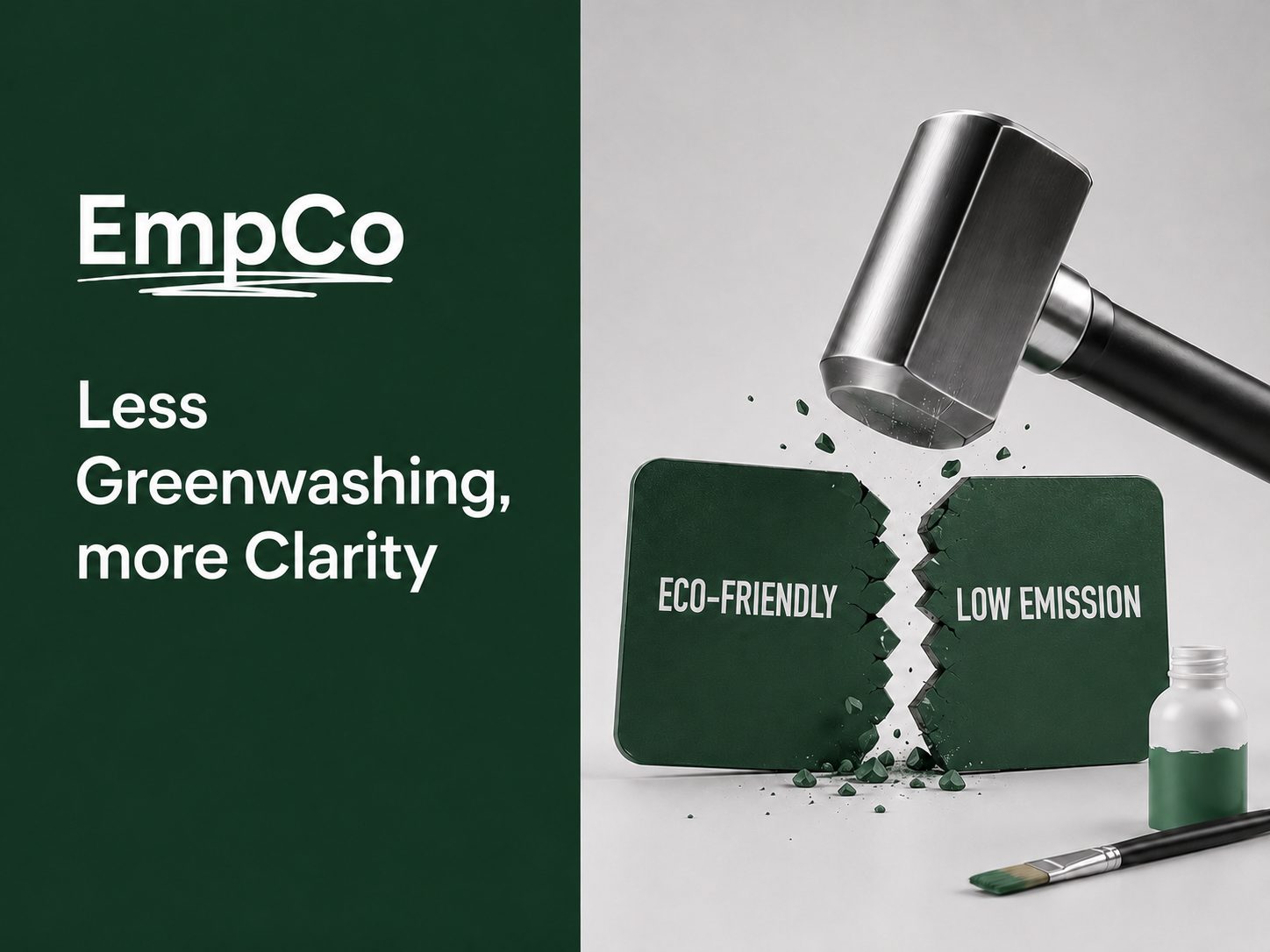
The goal: to strengthen consumer rights and consistently prevent misleading advertising – known as “greenwashing.”
The Pillars of the New Regulation
The EmpCo Directive rests on five central pillars that will be mandatory for all market communications in the future:
- Prohibition of Vague Claims: General environmental claims such as “environmentally friendly,” “green,” or “sustainable” will generally be prohibited in the future unless they can be substantiated by recognized and easily accessible evidence.
- End of Offset Claims: Advertising claiming “climate neutrality” that is based solely on the purchase of CO₂ credits (offsetting) outside the company’s own value chain will be completely prohibited in the future.
- Strict Rules for Labels: Sustainability labels must be based on official systems (e.g., the EU Ecolabel) or independent certification processes. Proprietary, unregulated marketing logos are off-limits.
- Precision in Future Promises: Anyone advertising with goals such as “climate-neutral by 2030” must substantiate them with a concrete, transparent, and verifiable implementation plan.
- Focus on Durability & Repairability: New disclosure requirements regarding durability, repairability, and warranties, as well as bans on certain practices of planned obsolescence (premature wear and tear).
What the Guideline Means for Sustainability Communication
The EmpCo Guideline transforms sustainability communication from advertising into fact-based reporting:
- Scientific Evidence: Environmental claims must be supported by robust, verifiable evidence.
- Vocabulary: General environmental terms are permitted only if they comply with legal requirements and are substantiated.
- No Offsetting: Claims such as “climate-neutral” are not permitted if they are based solely on offsetting through CO₂ credits.
- Actual Reduction: Companies may communicate emission reductions provided that these actually occur and are verifiable.
- Roadmap Requirement: Long-term commitments must be based on a concrete, verifiable implementation plan.
Conclusion
Starting September 27, 2026, significantly stricter requirements will apply to environmental and sustainability claims. Companies must provide verifiable evidence to support such claims; in the future, compensation-only models will no longer be sufficient for carbon neutrality claims.
Questions about your EPR compliance? Contact us!
 www.ecopv-eu.com/en/contact/ |
  E-Mail: info@ecopv-eu.com
 Supported over 20,000 customers with EPR compliance
Rated 5.0 on Google
Contact
We look forward to your message!