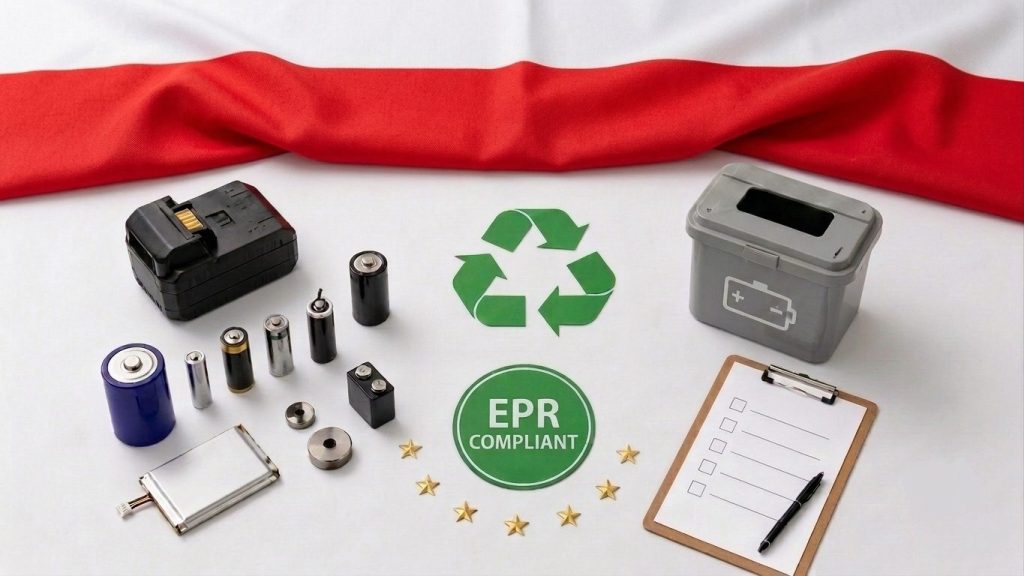
🇵🇱 EPR Compliance for Batteries in Poland |
Guide and Checklist 2026

Extended Producer Responsibility (EPR) for Batteries and Rechargeable Batteries – 7 Steps to Compliance + Step-by-Step Checklist

Poland combines two levels of battery EPR: EU battery legislation (Regulation 2023/1542, fully in effect as of August 18, 2025) with the Polish BDO system – the central national environmental and EPR registry.

In practice, this means that every battery manufacturer or importer selling in Poland must comply with both EU requirements (carbon footprint, labeling, due diligence) and national requirements (BDO registration, Polish NIP, annual report due by March 15, membership in a take-back system).

A particular characteristic: The BDO registration process is conducted entirely in Polish – a common stumbling block for foreign companies. The portal bdo.mos.gov.pl is available only in Polish, and the registration process takes 6–8 weeks for foreign companies. Anyone wishing to sell in Poland must start early.

What does this mean specifically for your company? Here are the 7 most important steps – including a checklist to get you started.

🇵🇱 EPR Compliance for Batteries in Poland |
Guide and Checklist 2026

Extended Producer Responsibility (EPR) for Batteries and Rechargeable Batteries – 7 Steps to Compliance + Step-by-Step Checklist

Poland combines two levels of battery EPR: EU battery legislation (Regulation 2023/1542, fully in effect as of August 18, 2025) with the Polish BDO system – the central national environmental and EPR registry.

In practice, this means that every battery manufacturer or importer selling in Poland must comply with both EU requirements (carbon footprint, labeling, due diligence) and national requirements (BDO registration, Polish NIP, annual report due by March 15, membership in a take-back system).

A particular characteristic: The BDO registration process is conducted entirely in Polish – a common stumbling block for foreign companies. The portal bdo.mos.gov.pl is available only in Polish, and the registration process takes 6–8 weeks for foreign companies. Anyone wishing to sell in Poland must start early.

What does this mean specifically for your company? Here are the 7 most important steps – including a checklist to get you started.
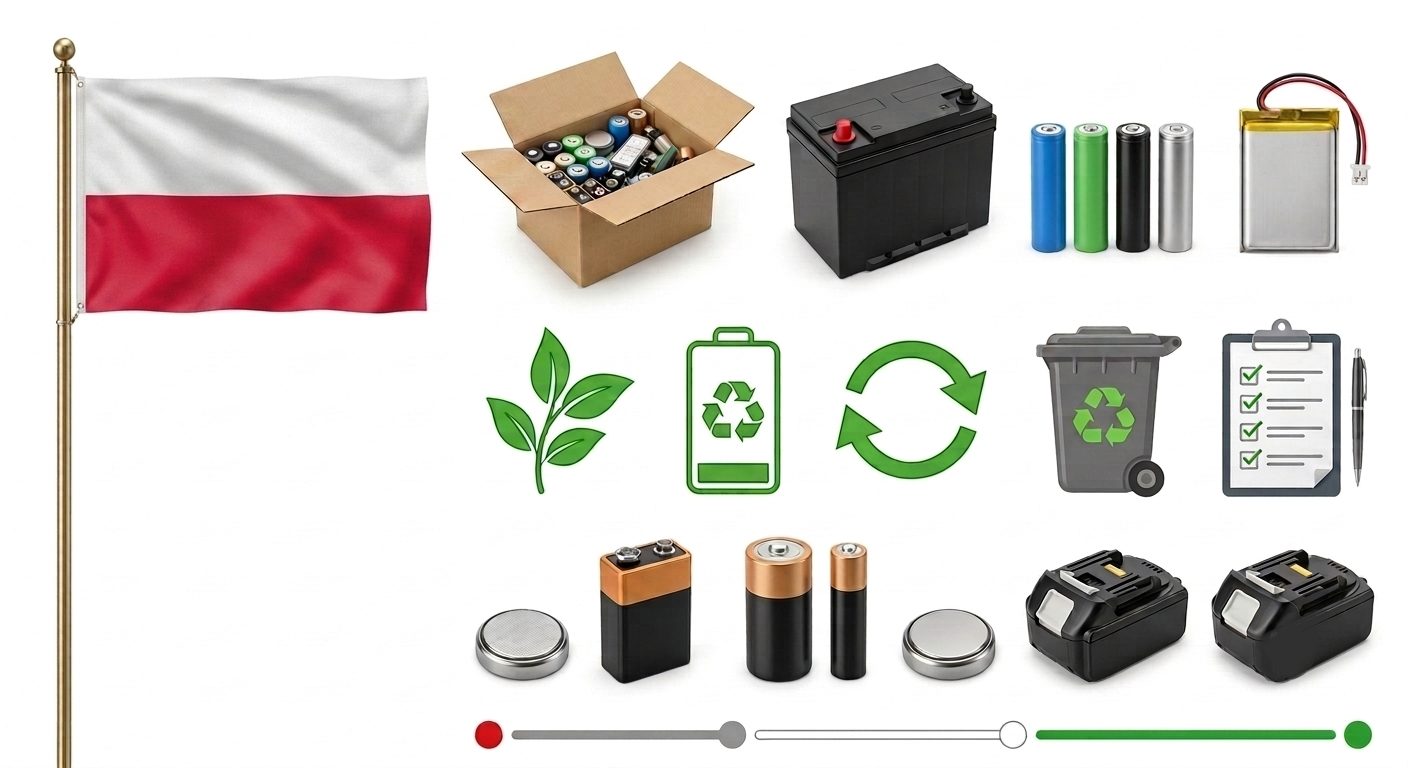
Who is considered a “manufacturer” (Producent) under the Polish Battery EPR?

The obligation is determined by the first commercial placing on the Polish market. The following are considered Producent:

  • Companies based in Poland:
    • Producent: Anyone who manufactures batteries in Poland and markets them under their own name or brand.
    • Importer: Anyone who commercially imports batteries or battery-powered products into Poland from abroad (EU or third country).
  • Companies from other EU countries: Anyone who supplies batteries or battery-powered goods via distance selling (online store, marketplaces) directly to Polish end consumers (B2C) or business customers (B2B).
  • Companies outside the EU: Any entity that delivers directly to Polish end consumers via e-commerce. In traditional B2B supply chains, the manufacturer’s liability transfers to the first importer based in Poland.
  • White-label / private-label manufacturers: Any entity that markets devices with built-in or included batteries under its own label in Poland is considered the first distributor of the batteries contained therein.
  • Marketplace operators: Platforms such as Allegro and Amazon.pl are subject to subsidiary liability under Polish e-commerce regulations. They validate BDO numbers in the merchant backend and suspend accounts without valid proof of compliance – especially since the tightening of marketplace obligations in 2025/2026.

Important clarification: The Polish BDO number also serves as the national EPR registration number for all EPR categories (batteries, WEEE, packaging, SUP). It must appear on all commercial documents (invoices, delivery notes).

Practical example: A Dutch company sells e-bike batteries (LMT batteries) directly to Polish end customers via its website → is considered a producer → must appoint an authorized representative in Poland → apply for a Polish NIP number → complete BDO registration → enter into a take-back system agreement → submit quarterly volume reports → file an annual report by March 15.

The 5 EU Battery Categories

The EU Battery Regulation 2023/1542 defines 5 categories that must be reported separately for BDO registration and volume reporting in Poland:

CategoryDescriptionExamples
Portable Batteries Sealed batteries up to 5 kgAA/AAA, button cells, smartphone batteries, laptop batteries
LMT Batteries Light-duty vehiclesE-bike batteries, e-scooter batteries
Starter Batteries / SLI Starting, Lighting, Ignition Automotive starter batteries
Industrial Batteries Large-format, industrial applications, >5 kg (not LMT/EV)Energy storage systems, forklifts, UPS
EV Batteries Propulsion batteries for electric vehiclesPassenger car and truck traction batteries

Important BDO requirement for registration: Unlike WEEE, the BDO registration for batteries must include additional declarations: type of market placement (sold separately vs. built into a device) and classification according to the new LMT/EV categories. These details must be specified exactly.

Dual Registration for Batteries + WEEE: Devices with built-in batteries (laptops, smartphones, power tools) require two separate BDO registrations in Poland: one for WEEE (Subsection VI) and one for batteries – through the same or different take-back systems.

The 7 Most Important Steps for Battery EPR Compliance in Poland

Step 1: Appoint an Authorized Representative (for Foreign Companies)

All foreign companies without a branch in Poland that sell directly to Polish end users via distance selling are required to appoint an authorized representative.

The authorized representative assumes financial and administrative liability for BDO reports, contracts with take-back systems, and fee payments.

Requirements for the authorized representative:

  • A natural person or legal entity domiciled in Poland
  • Written power of attorney in Polish (or bilingual); a Hague Apostille is not required as a standard procedure
  • Proof of the foreign signatory’s authority to represent the company (e.g., a current extract from the commercial register) must be attached
  • Prior to BDO registration: Application for a Polish tax identification number (NIP) for the foreign company

Step 2: Membership in an Approved Take-Back System

Before BDO registration can be completed, the manufacturer must join an approved take-back system and submit proof of this.

Self-Compliance: Virtually impossible for portable batteries and LMT batteries, as a nationwide, municipality-based take-back network would have to be demonstrated. For industrial and EV batteries in the purely B2B sector, self-compliance through direct, contractually agreed take-back arrangements with commercial end customers is common practice.

Step 3: Mandatory registration in the BDO Register

BDO registration is a key requirement for all battery manufacturers in Poland. The BDO portal (bdo.mos.gov.pl) is the official platform – available exclusively in Polish.

Competent authority: Marshal (Marszałek) of the relevant voivodeship, based on the manufacturer’s or authorized representative’s registered office

Procedure:

  1. Register with the take-back system (Step 2) and prepare proof of membership
  2. Apply for a Polish NIP number for the foreign company (allow one week for processing)
  3. Submit the online application at bdo.mos.gov.pl: company details, NIP, precise specification of battery categories (chemical composition), proof of take-back system membership, declarations regarding the type of market placement
  4. Receive the 9-digit BDO number

Required use of the BDO number:

  • On all commercial documents (invoices, delivery notes, receipts) – a legal requirement
  • Enter it in the merchant backend on Allegro, Amazon.pl, and other platforms
  • Failure to display the BDO number on documents may result in penalties

Step 4: Financial Obligations & Fee Structure

Disposal fees are calculated per kilogram of batteries placed on the market, differentiated by chemical composition and category.

Calculation basis:

Net weight (kg) × fee rate per category and chemical composition

Step 5: Reporting Requirements & EU Requirements Under the Battery Regulation

Annual Report (BDO Portal)

  • Deadline: March 15 of the following year for the preceding calendar year
  • Channel: Digitally only via the BDO Portal (bdo.mos.gov.pl)
  • Content: Batteries placed on the market by number of units, weight, and the 5 new categories; chemical composition; B2C/B2B separation
  • Take-back systems accept monthly or quarterly reports throughout the year for contribution billing

Annual BDO administrative fee

  • Deadline: End of February of each year
  • Payment to the relevant provincial marshal’s office
  • Flat rate regardless of the number of EPR categories

Expanded obligations under the EU Battery Regulation:

  • CO₂ footprint: Manufacturers of EV batteries must provide the CO₂ footprint declaration digitally using the PEF methodology or include it with the product. The declared value must not include carbon offsets.
  • Due Diligence starting in August 2027: Larger manufacturers (net revenue >€40 million) must provide evidence of compliance with due diligence requirements for raw material supply chains (cobalt, lithium, nickel, natural graphite).
  • Digital Battery Passport starting in February 2027: Starting in February 2027, EV, LMT, and industrial batteries (>2 kWh) must provide access to the digital battery passport via a QR code.

Step 6: Labeling Requirements

  • Crossed-out trash can symbol: Must be displayed on every battery; permitted on the packaging if space is limited
  • Capacity specification: Required for all portable batteries and automotive batteries – to be stated in mAh, Ah, or Wh
  • BDO number on all commercial documents: The 9-digit BDO number must appear on all invoices, delivery notes, and other commercial documents issued by the manufacturer – a strict Polish requirement that goes beyond the EU minimum standards.

Step 7: Product Levy for Failure to Meet Collection Quotas

Poland’s battery EPR includes a specific product levy as a penalty mechanism. The product levy becomes due if the manufacturer (or its system) fails to meet the legally mandated minimum collection and recycling quotas for a calendar year.

Calculation:

(Legally required take-back quantity in kg – actually verified recycling quantity in kg) × Ministry penalty rate per kg

Payment: Declaration via the BDO system and payment directly to the Marshal’s Office by March 15.

Benefit of system membership: As a member of an approved take-back system, quota compliance is collectively managed by the system. The system is liable for the total quota of all members – the product levy does not apply to the individual manufacturer, provided they have correctly reported their quantities and paid the required contributions.

Who is considered a “manufacturer” (Producent) under the Polish Battery EPR?

The obligation is determined by the first commercial placing on the Polish market. The following are considered Producent:

  • Companies based in Poland:
    • Producent: Anyone who manufactures batteries in Poland and markets them under their own name or brand.
    • Importer: Anyone who commercially imports batteries or battery-powered products into Poland from abroad (EU or third country).
  • Companies from other EU countries: Anyone who supplies batteries or battery-powered goods via distance selling (online store, marketplaces) directly to Polish end consumers (B2C) or business customers (B2B).
  • Companies outside the EU: Any entity that delivers directly to Polish end consumers via e-commerce. In traditional B2B supply chains, the manufacturer’s liability transfers to the first importer based in Poland.
  • White-label / private-label manufacturers: Any entity that markets devices with built-in or included batteries under its own label in Poland is considered the first distributor of the batteries contained therein.
  • Marketplace operators: Platforms such as Allegro and Amazon.pl are subject to subsidiary liability under Polish e-commerce regulations. They validate BDO numbers in the merchant backend and suspend accounts without valid proof of compliance – especially since the tightening of marketplace obligations in 2025/2026.

Important clarification: The Polish BDO number also serves as the national EPR registration number for all EPR categories (batteries, WEEE, packaging, SUP). It must appear on all commercial documents (invoices, delivery notes).

Practical example: A Dutch company sells e-bike batteries (LMT batteries) directly to Polish end customers via its website → is considered a producer → must appoint an authorized representative in Poland → apply for a Polish NIP number → complete BDO registration → enter into a take-back system agreement → submit quarterly volume reports → file an annual report by March 15.

The 5 EU Battery Categories

The EU Battery Regulation 2023/1542 defines 5 categories that must be reported separately for BDO registration and volume reporting in Poland:

  1. Portable Batteries – Sealed batteries up to 5 kg: AA/AAA, button cells, smartphone batteries, laptop batteries
  2. LMT Batteries – Light-duty vehicles: E-bike batteries, e-scooter batteries
  3. Starter Batteries / SLI – Starting, Lighting, Ignition: Automotive starter batteries
  4. Industrial Batteries – Large-format, industrial applications, >5 kg (not LMT/EV): Energy storage systems, forklifts, UPS
  5. EV Batteries – Propulsion batteries for electric vehicles: Passenger car and truck traction batteries

Important BDO requirement for registration: Unlike WEEE, the BDO registration for batteries must include additional declarations: type of market placement (sold separately vs. built into a device) and classification according to the new LMT/EV categories. These details must be specified exactly.

Dual Registration for Batteries + WEEE: Devices with built-in batteries (laptops, smartphones, power tools) require two separate BDO registrations in Poland: one for WEEE (Subsection VI) and one for batteries – through the same or different take-back systems.

The 7 Most Important Steps for Battery EPR Compliance in Poland

Step 1: Appoint an Authorized Representative (for Foreign Companies)

All foreign companies without a branch in Poland that sell directly to Polish end users via distance selling are required to appoint an authorized representative.

The authorized representative assumes financial and administrative liability for BDO reports, contracts with take-back systems, and fee payments.

Requirements for the authorized representative:

  • A natural person or legal entity domiciled in Poland
  • Written power of attorney in Polish (or bilingual); a Hague Apostille is not required as a standard procedure
  • Proof of the foreign signatory’s authority to represent the company (e.g., a current extract from the commercial register) must be attached
  • Prior to BDO registration: Application for a Polish tax identification number (NIP) for the foreign company

Step 2: Membership in an Approved Take-Back System

Before BDO registration can be completed, the manufacturer must join an approved take-back system and submit proof of this.

Self-Compliance: Virtually impossible for portable batteries and LMT batteries, as a nationwide, municipality-based take-back network would have to be demonstrated. For industrial and EV batteries in the purely B2B sector, self-compliance through direct, contractually agreed take-back arrangements with commercial end customers is common practice.

Step 3: Mandatory registration in the BDO Register

BDO registration is a key requirement for all battery manufacturers in Poland. The BDO portal (bdo.mos.gov.pl) is the official platform – available exclusively in Polish.

Competent authority: Marshal (Marszałek) of the relevant voivodeship, based on the manufacturer’s or authorized representative’s registered office

Procedure:

  1. Register with the take-back system (Step 2) and prepare proof of membership
  2. Apply for a Polish NIP number for the foreign company (allow one week for processing)
  3. Submit the online application at bdo.mos.gov.pl: company details, NIP, precise specification of battery categories (chemical composition), proof of take-back system membership, declarations regarding the type of market placement
  4. Receive the 9-digit BDO number

Required use of the BDO number:

  • On all commercial documents (invoices, delivery notes, receipts) – a legal requirement
  • Enter it in the merchant backend on Allegro, Amazon.pl, and other platforms
  • Failure to display the BDO number on documents may result in penalties

Step 4: Financial Obligations & Fee Structure

Disposal fees are calculated per kilogram of batteries placed on the market, differentiated by chemical composition and category.

Calculation basis:

Net weight (kg) × fee rate per category and chemical composition

Step 5: Reporting Requirements & EU Requirements Under the Battery Regulation

Annual Report (BDO Portal)

  • Deadline: March 15 of the following year for the preceding calendar year
  • Channel: Digitally only via the BDO Portal (bdo.mos.gov.pl)
  • Content: Batteries placed on the market by number of units, weight, and the 5 new categories; chemical composition; B2C/B2B separation
  • Take-back systems accept monthly or quarterly reports throughout the year for contribution billing

Annual BDO administrative fee

  • Deadline: End of February of each year
  • Payment to the relevant provincial marshal’s office
  • Flat rate regardless of the number of EPR categories

Expanded obligations under the EU Battery Regulation:

  • CO₂ footprint: Manufacturers of EV batteries must provide the CO₂ footprint declaration digitally using the PEF methodology or include it with the product. The declared value must not include carbon offsets.
  • Due Diligence starting in August 2027: Larger manufacturers (net revenue >€40 million) must provide evidence of compliance with due diligence requirements for raw material supply chains (cobalt, lithium, nickel, natural graphite).
  • Digital Battery Passport starting in February 2027: Starting in February 2027, EV, LMT, and industrial batteries (>2 kWh) must provide access to the digital battery passport via a QR code.

Step 6: Labeling Requirements

  • Crossed-out trash can symbol: Must be displayed on every battery; permitted on the packaging if space is limited
  • Capacity specification: Required for all portable batteries and automotive batteries – to be stated in mAh, Ah, or Wh
  • BDO number on all commercial documents: The 9-digit BDO number must appear on all invoices, delivery notes, and other commercial documents issued by the manufacturer – a strict Polish requirement that goes beyond the EU minimum standards.

Step 7: Product Levy for Failure to Meet Collection Quotas

Poland’s battery EPR includes a specific product levy as a penalty mechanism. The product levy becomes due if the manufacturer (or its system) fails to meet the legally mandated minimum collection and recycling quotas for a calendar year.

Calculation:

(Legally required take-back quantity in kg – actually verified recycling quantity in kg) × Ministry penalty rate per kg

Payment: Declaration via the BDO system and payment directly to the Marshal’s Office by March 15.

Benefit of system membership: As a member of an approved take-back system, quota compliance is collectively managed by the system. The system is liable for the total quota of all members – the product levy does not apply to the individual manufacturer, provided they have correctly reported their quantities and paid the required contributions.

Step-by-Step Checklist

(a) Companies based in Poland

1. Correctly classify batteries into the 5 EU categories; clarify the B2C/B2B distinction; declare the type of placement (separate / built-in)

2. Select a take-back system and sign a contract

3. Complete BDO registration online (bdo.mos.gov.pl)

4. Obtain a BDO number and include it on all commercial documents, invoices, and marketplace profiles

5. Record batteries built into devices separately from the WEEE report

6. Pay the BDO annual fee by the end of February

7. Submit the annual report via the BDO portal by March 15

8. Document and provide the CO₂ footprint for EV batteries

9. Prepare the CO₂ declaration for industrial batteries >2 kWh

10. Check labeling: trash can symbol + capacity + chemical symbols on all batteries/packaging

11. Develop a due diligence strategy for raw materials (mandatory starting in August 2027 for companies with revenue >€40 million)

(b) Companies from other EU countries

    1. Appoint an authorized representative in Poland: Prepare a written power of attorney in Polish or in both languages; attach a current extract from the commercial register (with a certified Polish translation).
    2. Apply for a Polish NIP number: The application is submitted by the newly appointed authorized representative.
    3. Enter into a take-back system agreement: The authorized representative enters into the agreement with a Polish collective system (PRO) on behalf of the manufacturer.
    4. Complete BDO registration: The authorized representative submits the digital application at bdo.mos.gov.pl (using the issued NIP and the system agreement).
    5. Marketplace compliance: Enter the assigned 9-digit BDO number in the merchant backend of Allegro, Amazon.pl, and other platforms
    6. Invoice adjustment: Ensure that the BDO number is automatically displayed on every single customer invoice for the Polish market
    7. Data transmission: Continuously transmit structured quantity data (weight, quantity, chemical composition, new EU category, B2C/B2B) to the authorized representative
    8. EU requirements: Comply with CO₂ declaration requirements (e.g., for LMT or industrial batteries) according to the battery category and the deadlines set by the EU Battery Regulation.

(c) Companies from third countries (outside the EU)

1. Option A – Delivery to a Polish importer (B2B): Submit all weight and material data (category, chemical composition) in a timely manner; the importer assumes the manufacturer’s obligations in the BDO

2. Option B – Direct B2C shipping: Appoint an authorized representative in Poland; complete all steps listed in (b)

3. Customs declaration: Ensure that weight and category data are correctly assigned to the manufacturer’s or importer’s Polish BDO account

Step-by-Step Checklist

(a) Companies based in Poland

1. Correctly classify batteries into the 5 EU categories; clarify the B2C/B2B distinction; declare the type of placement (separate / built-in)

2. Select a take-back system and sign a contract

3. Complete BDO registration online (bdo.mos.gov.pl)

4. Obtain a BDO number and include it on all commercial documents, invoices, and marketplace profiles

5. Record batteries built into devices separately from the WEEE report

6. Pay the BDO annual fee by the end of February

7. Submit the annual report via the BDO portal by March 15

8. Document and provide the CO₂ footprint for EV batteries

9. Prepare the CO₂ declaration for industrial batteries >2 kWh

10. Check labeling: trash can symbol + capacity + chemical symbols on all batteries/packaging

11. Develop a due diligence strategy for raw materials (mandatory starting in August 2027 for companies with revenue >€40 million)

(b) Companies from other EU countries

  1. Appoint an authorized representative in Poland: Prepare a written power of attorney in Polish or in both languages; attach a current extract from the commercial register (with a certified Polish translation).
  2. Apply for a Polish NIP number: The application is submitted by the newly appointed authorized representative.
  3. Enter into a take-back system agreement: The authorized representative enters into the agreement with a Polish collective system (PRO) on behalf of the manufacturer.
  4. Complete BDO registration: The authorized representative submits the digital application at bdo.mos.gov.pl (using the issued NIP and the system agreement).
  5. Marketplace compliance: Enter the assigned 9-digit BDO number in the merchant backend of Allegro, Amazon.pl, and other platforms
  6. Invoice adjustment: Ensure that the BDO number is automatically displayed on every single customer invoice for the Polish market
  7. Data transmission: Continuously transmit structured quantity data (weight, quantity, chemical composition, new EU category, B2C/B2B) to the authorized representative
  8. EU requirements: Comply with CO₂ declaration requirements (e.g., for LMT or industrial batteries) according to the battery category and the deadlines set by the EU Battery Regulation.
  9.  

(c) Companies from third countries (outside the EU)

1. Option A – Delivery to a Polish importer (B2B): Submit all weight and material data (category, chemical composition) in a timely manner; the importer assumes the manufacturer’s obligations in the BDO

2. Option B – Direct B2C shipping: Appoint an authorized representative in Poland; complete all steps listed in (b)

3. Customs declaration: Ensure that weight and category data are correctly assigned to the manufacturer’s or importer’s Polish BDO account

Are you planning to sell your products in Poland?

We’ll help you ensure compliance with Poland’s EPR regulations for batteries so you can get started with legal certainty.

Are you planning to sell your products in Poland?

We’ll help you ensure compliance with Poland’s EPR regulations for batteries so you can get started with legal certainty.

Contact

We look forward to your message!

info@ecopv-eu.com

+49 6196 5835357

Frankfurter Str. 70-72
65760 Eschborn

Contact

We look forward to your message!

info@ecopv-eu.com

+49 6196 5835357

Frankfurter Str. 70-72
65760 Eschborn