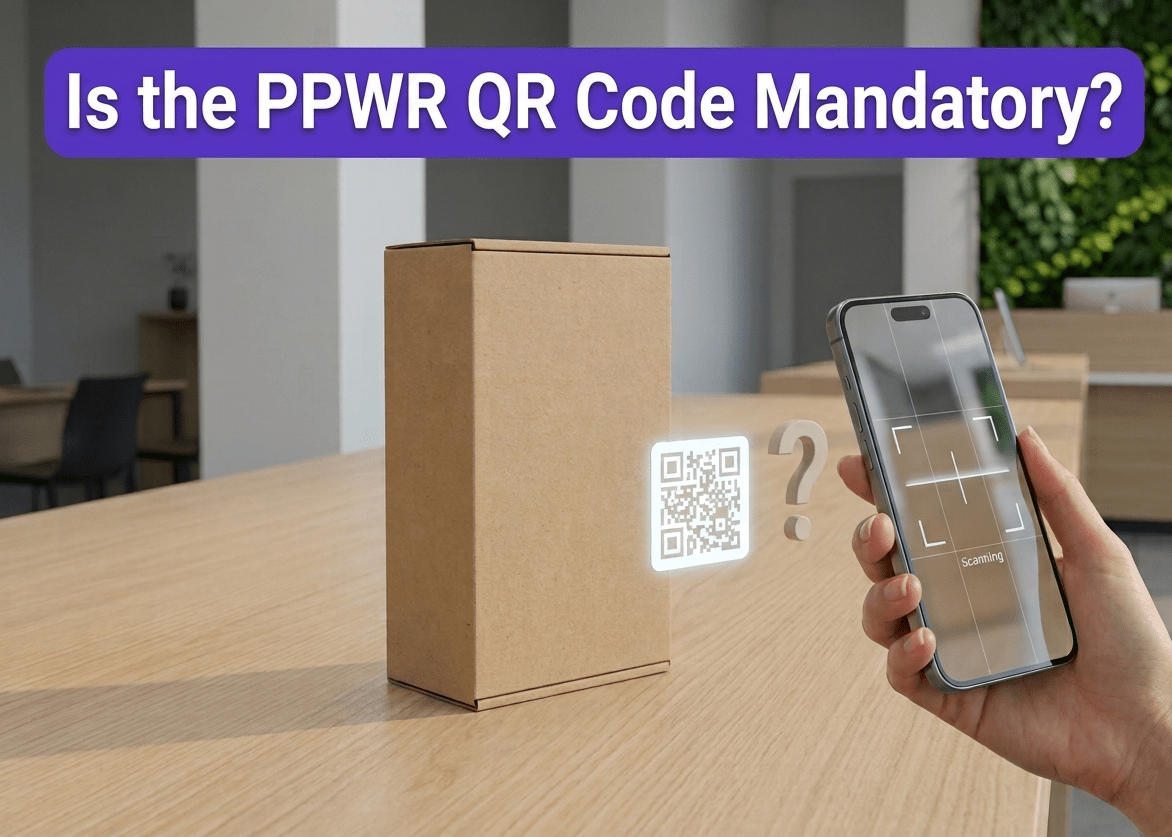
With the implementation of the EU Packaging Regulation (PPWR), many companies are wondering when a QR code is required on packaging. The regulation does not impose a sudden, blanket requirement for all packaging. Instead, the PPWR specifies exactly when, for whom, and for what purposes a QR code or other digital data carrier must be used.
When and for which product packaging is the QR code required?
The PPWR distinguishes between the voluntary or supplementary use of digital data carriers and legally mandated digital information requirements:
- Effective August 12, 2026 – generally voluntary: There is no general requirement for QR codes on standard retail packaging. Companies may already use QR codes to provide supplementary information digitally. Important note: A QR code may not completely replace legally required physical labeling – certain information must still be visibly, legibly, and permanently affixed to the packaging.
- Effective August 12, 2028 – Mandatory material labeling (no QR code, but still important): The previous national and EU labeling regulations based on Decision 97/129/EC will be repealed. They will be replaced by an EU-wide harmonized, pictogram-based labeling system for material composition, designed to help consumers sort packaging correctly.
- Effective February 12, 2029 – Digital data carriers become mandatory for certain reusable packaging: For reusable packaging covered by the PPWR (e.g., reusable transport boxes, reusable bottles, or circular shipping bags in e-commerce), a QR code or another standardized, open digital data carrier will generally be mandatory. Exceptions apply to certain open-loop systems.
- Effective January 1, 2030 – recyclability performance levels: Packaging must then generally achieve at least performance level C for recyclability (classification A, B, or C); starting in 2038, at least level B will be mandatory.
What information must a QR code or digital data carrier provide - when it is used?
For the reusable packaging in question starting in 2029, the digital data carrier must, in particular, enable or provide information on:
- the reusability of the packaging
- the available reuse system, as well as collection and return locations
- the tracking of the packaging and the calculation of the number of cycles through the loop, or an average estimate if an exact calculation is not possible
Practical guidelines for placement (industry best practices; not specified in detail in the text of the law)
- Affix it clearly visible on the outside of the packaging and do not hide it inside the packaging
- Ensure it remains permanently legible throughout the entire intended service life – particularly important for durable reusable packaging
- Design it to be sufficiently large and high-contrast so that the code can be reliably scanned with standard smartphones
Conclusion
Anyone planning for the future should keep a close eye on the timeline: 2026 → 2028 (harmonized material/sorting labeling) → 2029 (digital information requirements for certain reusable packaging) → 2030 (recyclability levels). At the same time, it is advisable to structure the data behind a QR code or digital data carrier from the outset in a way that allows it to adapt to future requirements.
Contact us for comprehensive compliance consulting on electrical equipment, batteries, packaging, and PV panels – and subscribe to our newsletter to stay up to date on laws and trends.
 www.ecopv-eu.com/en/contact/ |
  E-Mail: info@ecopv-eu.com
 Supported over 20,000 customers with EPR compliance
Rated 5.0 on Google
Contact
We look forward to your message!