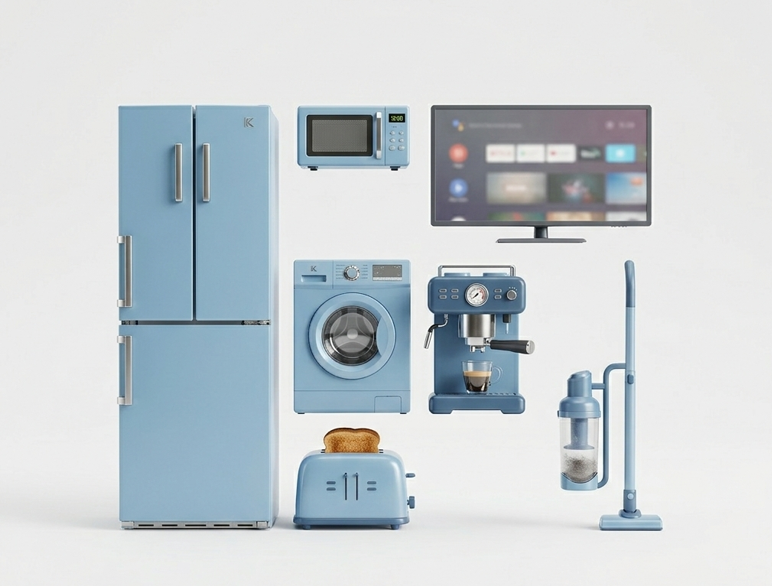
The ElektroG (Electrical and Electronic Equipment Act) has regulated the disposal of technical waste since 2005. The new ElektroG4 amendment, which places a strong focus on fire safety and the circular economy, has been in force since January 1, 2026.
Who must take action?
- Manufacturers and importers: Obligation to register with the ear foundation, report quantities, and finance recycling.
- Retailers (online and local): Obligation to take back old devices. New from July 1, 2026: Mandatory take-back of disposable vapes at all points of sale.
- Consumers: Strict ban on disposal via household waste.
- Local authorities: Implementation of the new counter model (battery-powered devices may only be accepted by specialist personnel).
Which products are affected?
- Household appliances: washing machines, coffee machines, toasters.
- IT & entertainment: smartphones, laptops, televisions.
- Lighting technology: LED lamps, fluorescent tubes.
- Special products: PV modules, disposable vapes, tools.
Penalties for violations
Anyone who violates the ElektroG (e.g., selling without registration or failing to take back products) faces severe consequences:
- Fines: Up to €100,000 per violation.
- Sales bans: Immediate sales ban on unregistered products.
- Warnings: Expensive competition law lawsuits by competitors.
- Profit skimming: Confiscation of revenues generated through unfair sales.
Important for 2026❗️
With the entry into force of ElektroG4, the take-back of small electrical appliances will become mandatory for almost all points of sale, giving retailers an even more central role in the circular economy.
Since the beginning of the year, the counter model has been in effect at recycling centers. What sounds trivial is a response to the massive increase in fire risk from improperly disposed lithium batteries. For manufacturers, this means that their duty to inform end users is growing. They must now provide explicit information about the removal of batteries and light bulbs — and do so in a clearly visible manner in all presentation media.
July 1, 2026: A critical deadline for retailers
In a few months, labeling and take-back requirements will become even stricter:
- Disposable vapes: Gas stations, kiosks, and smoke shops will become collection points. Regardless of size and without requiring a new purchase. The goal is clear: the valuable raw materials in the batteries must be returned to the cycle.
- Visible compliance: The new, two-color take-back logo will be mandatory. In brick-and-mortar stores, it must be at least DIN A4 size; in e-commerce, it must be placed so that the customer cannot overlook it during the ordering process.
Additional tightening of regulations through the ElektroG4 and new EU requirements:
- Take-back of small appliances everywhere: The obligation to take back small electrical appliances (no edge longer than 25 cm) is being extended to almost all final distributors in order to massively increase the collection rate of 30%. This is completely independent of any new purchases.
- Stricter online marketplace liability: Operators of online marketplaces and fulfillment service providers will be held even more accountable. They will only be allowed to sell devices if the manufacturers are correctly registered in the EPR (Extended Producer Responsibility) register of the ear foundation. Violations will result in immediate sales bans on the platform.
- Link to the EU Battery Regulation: Parallel to ElektroG4, strict requirements for the removability of batteries will come into force in 2027. Devices with permanently bonded batteries (e.g., disposable e-cigarettes) are increasingly being pushed out of the market, as repairability and easy recycling are now prioritized by law.
- Information requirements for the circular economy: In the future, manufacturers will not only have to provide information on disposal, but also proactively provide data on the expected service life and availability of spare parts.
Status quo: Alarming collection rate
Germany is falling far short of the legal requirements. While the EU stipulates a collection rate of 65%, the figure in Germany has fallen to around 30% (after peaking at around 40%).
The consequences for companies
- Growing pressure: Since the targets have been significantly missed since 2019, further tightening of laws and controls is to be expected.
- Change of strategy: Companies should no longer view compliance as a chore, but as an essential part of their risk management and brand strategy.
- Proactive action: Instead of merely reacting to new rules, companies must actively promote the return of old equipment in order to remain competitive.
Contact us for comprehensive advice on your compliance issues relating to electrical and electronic equipment, packaging, batteries, and PV panels.
 www.ecopv-eu.com/en/contact/ |
  E-Mail: info@ecopv-eu.com
⭐ Supported over 20,000 customers with EPR compliance
⭐ Rated 5.0 on Google
Contact
We look forward to your message!