
In the future, a data carrier (e.g., a QR code or RFID chip) on products will provide far more than just a serial number. With the Digital Product Passport (DPP), detailed information about a product’s entire life cycle will be available digitally.
The DPP is a key component of the EU Ecodesign Regulation (ESPR) aimed at making products more transparent, durable, and recyclable.
The product passport includes the following data:
- Materials: Raw materials used, recycled content, and substances of concern.
- Supply chain: Origin, production sites, and traceability.
- Repair: Instructions, disassembly guidelines, and availability of replacement parts.
- Circular economy: Recovery, recyclability, and disposal routes.
- Environmental footprint: Carbon footprint (PCF) and relevant environmental indicators.
- Product maintenance: Maintenance logs, history, and mandatory software updates.
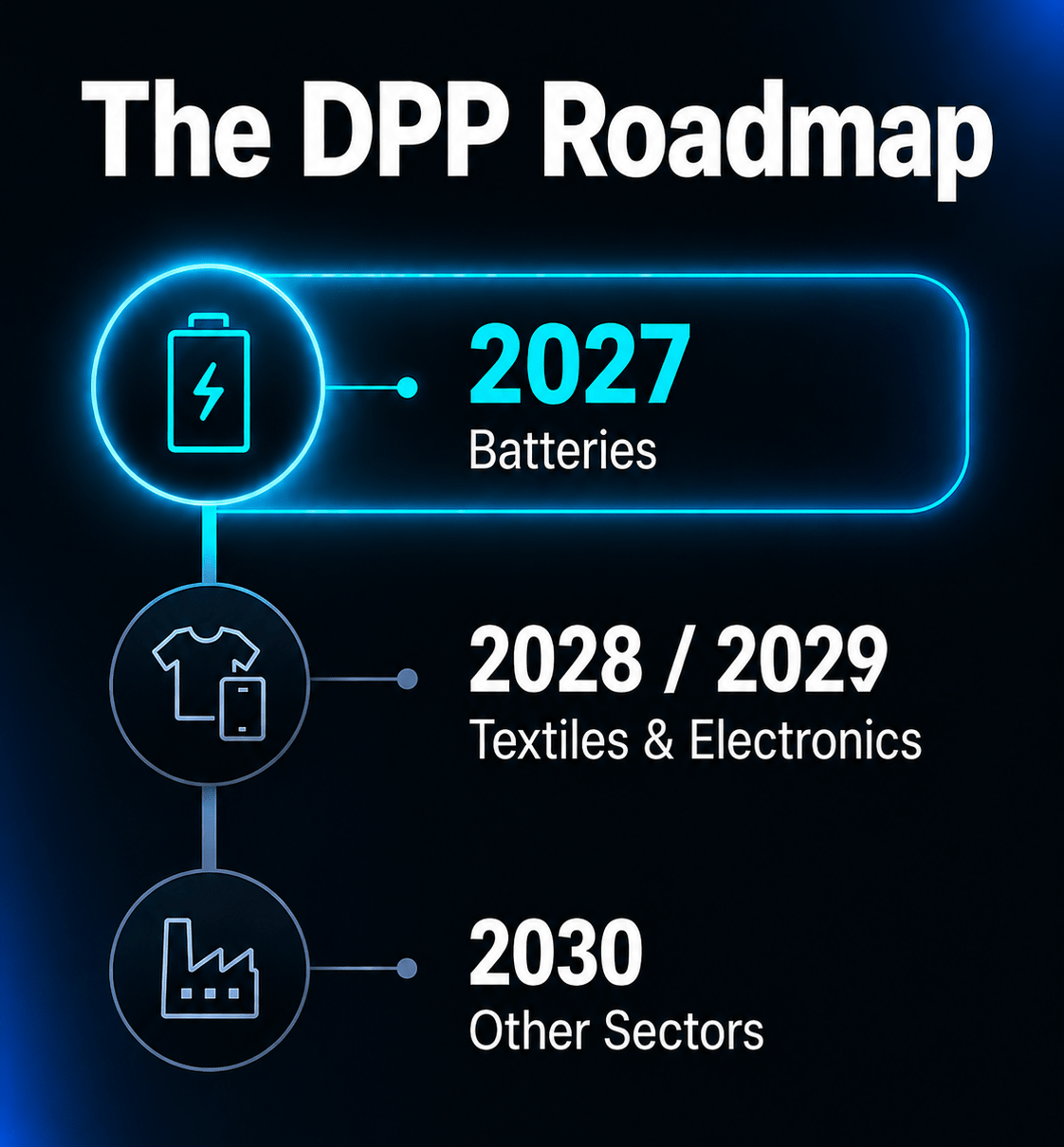
The Roadmap for the Digital Product Passport
Starting February 18, 2027 – Batteries
The first mandatory Digital Product Passport will be the Battery Passport. It applies to:
- Batteries for electric vehicles
- Industrial batteries over 2 kWh
- Batteries for light vehicles such as e-bikes or e-scooters
Expected in 2028/2029 – Textiles & Electronics
The European Commission has designated textiles (clothing, shoes) and electronics (smartphones, tablets, laptops) as priority product groups. The Digital Product Passport will be introduced gradually in these sectors following the adoption of the respective product-specific EU regulations.
2030 – Other Industries
The Digital Product Passport will be gradually expanded to include other product groups. These include, among others:
- Steel and iron
- Aluminum
- Furniture
- Tires
- Detergents
- Chemicals
Why Companies Must Act Now
Companies must take immediate action regarding the Digital Product Passport because its technical implementation poses an enormous challenge for internal IT departments. Collecting, structuring, and securely providing product data from various systems requires months of preparatory work. Those who start too late risk IT bottlenecks and data chaos by the deadline.
Contact us for comprehensive advice on your compliance issues relating to electrical and electronic equipment, packaging, batteries, and PV panels.
www.ecopv-eu.com/en/contact/ |
E-Mail: info@ecopv-eu.com
Supported over 20,000 customers with EPR compliance
Rated 5.0 on Google

Contact
We look forward to your message!