🇸🇪 EPR Compliance for Packaging in Sweden |
Guide and Checklist 2026

Extended Producer Responsibility (EPR) for Packaging – 6 Steps to Compliance + Step-by-Step Checklist

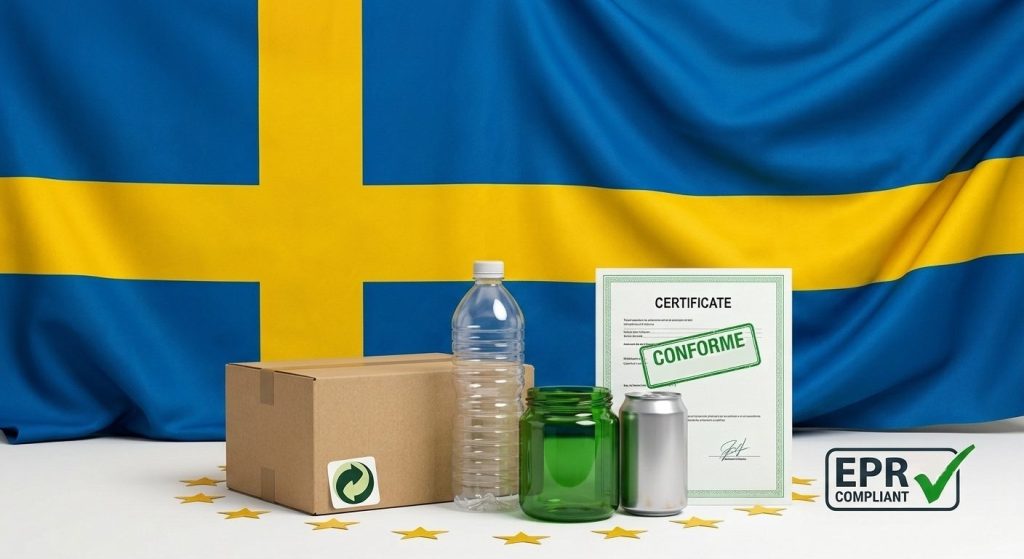
In Sweden, extended producer responsibility for packaging is strictly regulated to accelerate the transition to a circular economy. Companies that commercially place packaged goods on the Swedish market are legally required to assume responsibility for the entire life cycle of that packaging.

The Swedish Environmental Protection Agency (Naturvårdsverket) is the authority responsible for monitoring and registration.

What does this mean specifically for your company?

Here are the 6 most important steps – including a checklist to get you started.
Who is legally considered a “producer” (manufacturer)?

The Swedish Packaging Ordinance defines the term “producer” broadly. The decisive factor is the first commercial placing on the market of packaging or packaged goods in Sweden. This includes:

  • Brand owners: Companies based in Sweden that package, fill, or sell goods under their own name
  • Importers: Entities that commercially import packaged goods (B2B or B2C) into Sweden from abroad
  • Service packaging providers: Companies that import or supply packaging that is filled only at the point of sale (e.g., shopping bags, disposable cups, gift wrap)
  • Online retailers from the EU (distance selling): Companies from other EU countries that ship packaged products directly to Swedish end consumers (B2C). The EPR obligation applies here from the first shipment onward to both product packaging and shipping packaging
  • Companies outside the EU (third countries): In the case of direct B2C shipments, the foreign company bears responsibility; in traditional B2B trade, the obligation automatically transfers to the first importer based in Sweden

Practical example: A German company operates an online store and ships packaged goods (e.g., clothing or electronics) directly to Swedish consumers. Legal consequence: The company is considered the producer of both the product packaging and the shipping packaging → and is required to appoint an authorized representative based in Sweden (effective as of the PPWR in August 2026) → Join an organization for producer responsibility → Register with Naturvårdsverket → Report the weights of the packaging materials used on a quarterly basis → Upload proof of compliance to the backend of marketplaces

The 7 Most Important Steps for EPR Compliance in Sweden

Step 1: Appoint an authorized representative (for foreign companies)

Foreign companies without a physical establishment in Sweden that sell directly to Swedish end users via distance selling are legally required to appoint an authorized representative based in Sweden (effective August 2026 under the PPWR).

Liability: This representative assumes financial and administrative liability for all of the foreign company’s legal packaging obligations in Sweden.

Requirements: The mandate must be granted via a written, legally valid power of attorney in Swedish or English.

Notarization or an apostille is not required by Naturvårdsverket, but the company’s existence is validated digitally.

Step 2: Mandatory Registration with Naturvårdsverket

Every manufacturer must register in the relevant registry before packaged goods are made available on the Swedish market for the first time.

Platform: Registration is completed via Naturvårdsverket’s e-service.

Process: Domestic entities use the Swedish BankID for authentication. Foreign traders are registered through their authorized representative using a separate login procedure.

Required Information: In addition to company master data and the VAT ID, the material categories used (plastic, paper, glass, metal, wood) must be specified.

Furthermore, binding proof of affiliation with an approved Producer Responsibility Organization (PRO) must be submitted.

Identification: Upon successful validation, an official Swedish producer ID is issued.

Step 3: Membership in a Producer Responsibility Organization (PRO)

Since the comprehensive reforms of the Packaging Ordinance, participation in a state-approved system (PRO – Producer Responsibility Organization) has been mandatory; operating outside these systems is illegal.

In-house solutions (self-compliance): For household packaging, individual solutions are completely ruled out, as the collection of private waste is legally tied to collective systems.

In the B2B sector, self-compliance solutions are only possible under extremely strict regulatory requirements for closed industrial loops.

Step 4: Financial Contributions & Fee Structure

Producers pay a material fee to their respective collective system, calculated per kilogram of packaging placed on the market.

  • Eco-modulation: The system rewards sustainable design. Significantly reduced fees apply to unpigmented monomaterials (e.g., pure PP or PE) or packaging with a verified post-consumer recycled content.
  • Penalty fees: Non-recyclable composites (e.g., multilayer plastics) are subject to substantial fee surcharges.

Step 5: Reporting Requirements and Intervals

The exact weights (in kilograms or metric tons) must be reported in detail by material category (e.g., flexible vs. rigid plastic, corrugated cardboard) and source (household vs. commercial).

  • Monthly or quarterly: By default, Swedish systems use a monthly or quarterly reporting interval, which is determined by the amount of annual fees
  • Annual reporting: Very small distributors with low packaging volumes can submit their volumes collectively once a year; the deadline for this is March 25 of the following year

Step 6: Labeling and Marketplace Compliance

  • Material labeling: Packaging is gradually being labeled with European-harmonized material codes (fully mandatory with EU sorting logos starting in August 2028).
  • Platform oversight & EU outlook: Swedish legislation currently does not provide for automatic vicarious liability for online marketplaces regarding packaging. Nevertheless, platforms such as Amazon.se are increasingly requiring proof of compliance. A legal obligation to block listings without an EPR registration number will take effect EU-wide under the new EU Packaging Regulation (PPWR) as of August 12, 2026.

Step-by-Step Checklist

(a) Companies based in Sweden

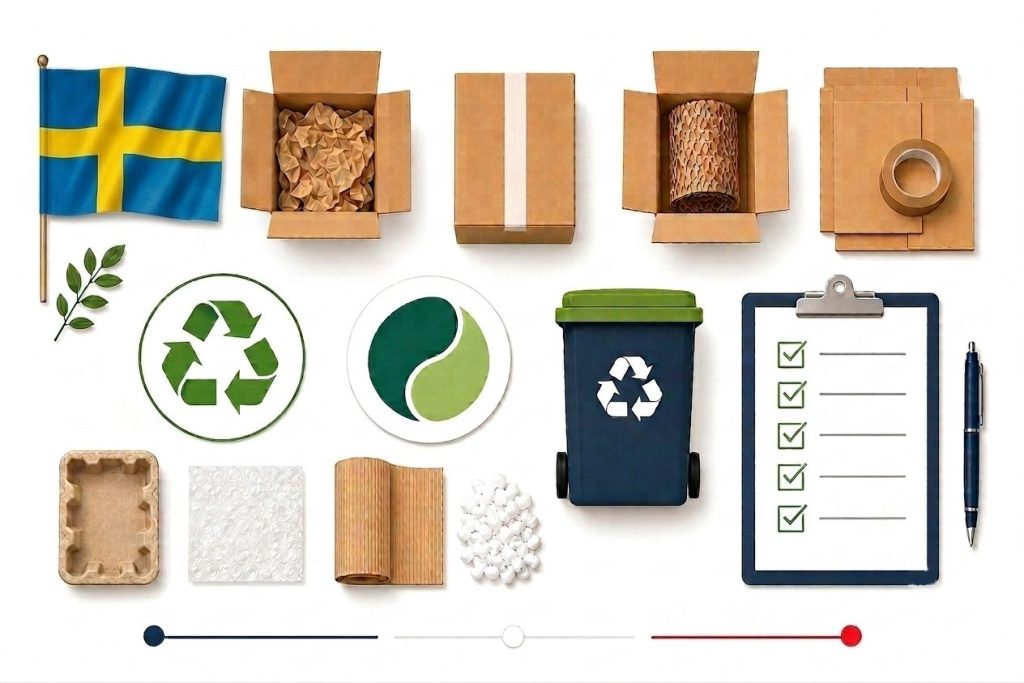
1. Material Audit: Recording of all product and transport packaging by material type and weight

2. System Agreement: Signing up for membership with an approved PRO

3. Notification to Authorities: Registration with Naturvårdsverket, including submission of the system certification

4. Optimization: Comparison of packaging materials with eco-modulation tables to achieve cost savings

5. Data Submission: Setting up regular (quarterly or annual) volume reports on the PRO portal

(b) Companies from other EU countries

1. Authorization: Enter into a contract with a Swedish authorized representative (required upon the PPWR’s entry into force in August 2026)

2. System integration: Instruct the representative to enter into a contract with a PRO

3. Registration: Completion of the digital registration with Naturvårdsverket by the Swedish representative

4. Proof of compliance: Submission of the Swedish EPR number/certificate to the backends of the sales platforms

5. Volume reporting: Ensuring data transmission via the authorized representative to the Swedish system

(c) Companies from third countries (outside the EU)

1. Supply chain verification: When supplying Swedish B2B partners, the Swedish importer is considered the manufacturer; all weight and material data must be provided to the importer

2. Direct sales: For direct e-commerce sales to Swedish consumers, the same obligations apply as in section (b); a Swedish authorized representative is mandatory for this purpose

Are you planning to sell your products in Sweden?

We’ll help you ensure compliance with Sweden’s EPR regulations for packaging so you can get started with legal certainty.

Contact

We look forward to your message!

info@ecopv-eu.com

+49 6196 5835357

Frankfurter Str. 70-72
65760 Eschborn