🇮🇪 EPR Compliance for WEEE in Ireland |
Guide and Checklist 2026

Extended Producer Responsibility (EPR) for Electrical and Electronic Equipment – 7 Steps to Compliance + Step-by-Step Checklist

Ireland is a market with clear structures, two approved compliance systems – and a unique feature in Europe: vEMC (Visible Environmental Management Costs), legally mandated, visible recycling fees that must be shown directly on the end customer’s invoice for certain EEE categories. Anyone selling EEE in Ireland must not only be registered – they must also understand how vEMC and RMC interact, when B2B producers do not need compliance system membership, and how the monthly POM report via the PRLBB (PRLBlackBox) works.

The legal basis is the WEEE Directive 2012/19/EU, implemented by the European Union (Waste Electrical and Electronic Equipment) Regulations 2014 (S.I. 149/2014). The competent national authority is the EPA (Environmental Protection Agency Ireland), while registration is handled by Producer Register Limited (PRL).

Here are the key legal requirements, obligations, and a structured guide to WEEE compliance in Ireland.
Who is considered a “producer” under the Irish WEEE regulations?

A producer is any person or organization that places EEE on the market in Ireland for the first time:

  • Producers based in Ireland: Companies that manufacture EEE under their own brand name and sell it in Ireland.
  • Importers: Companies that import EEE into Ireland on a commercial basis from abroad (EU or third country).
  • Rebranders: Companies that distribute equipment manufactured by third parties under their own name or brand in Ireland.
  • Distance selling / e-commerce: Companies based abroad (EU or third country) that sell EEE directly to Irish households via distance selling – including online marketplaces.
  • Marketplace operators: Since 2025/2026, platforms in Ireland have increasingly been held liable for the compliance of their third-party sellers. They must actively ensure that their third-party sellers are registered with the PRL and are subject to their own reporting and verification obligations.

Important distinction: B2C vs. B2B: This distinction has fundamental legal consequences in Ireland:

  • B2C producers (selling to private households): Mandatory membership in one of the two approved compliance systems (WEEE Ireland or ERP Ireland)
  • B2B: → Self-compliance requirement; 3-year Waste Management Plan (WMP) and annual report (WMR) via the EPA EDEN system

Practical example: A German company sells small household appliances directly to Irish end customers through its online store → is considered a producer (B2C, distance selling) → must appoint an authorized representative in Ireland → AR registers the manufacturer with PRL → AR joins WEEE Ireland or ERP Ireland → monthly POM report via PRLBB by the 19th of the following month → annual registration renewal by January 31.

The 7 Most Important Steps for WEEE Compliance in Ireland

Step 1: Appoint an Authorized Representative (for foreign companies)

All foreign manufacturers without a branch in Ireland that sell EEE directly to Irish households via distance selling are required to appoint an Authorized Representative (AR).

Requirements for the Authorized Representative (AR):

  • A natural or legal person based in Ireland
  • Written power of attorney
  • The AR must be registered with the PRL – the AR is not considered legally valid until it holds the official PRL registration certificate
  • The AR assumes all of the manufacturer’s legal obligations in Ireland (registration, reporting, compliance system membership, financial guarantees)

Step 2: Classify the EEE category and determine B2C/B2B

Ireland uses the categories specified in the WEEE Directive – broken down in the PRL Category Listing, which is available on the PRLBB portal and updated regularly. Of particular practical importance is the correct classification according to:

EEE Categories (EU Standard, 6 groups):

CategoryDescriptionSpecial Note
1Heat Exchangers (refrigeration equipment, air conditioners)Subject to vEMC
2Screens & DisplaysSubject to vEMC (televisions)
3LampsSubject to vEMC (certain light sources)
4Large appliances (>50 cm)Subject to vEMC (washing machines, etc.)
5Small appliances (≤50 cm)No vEMC; RMC-based
6Small IT & telecommunications equipmentNo vEMC; RMC-based

B2C (household) vs. B2B (commercial): Classification as B2C or B2B determines the entire compliance path:

  • B2C: → PCS (Producer Compliance Scheme) requirement (WEEE Ireland or ERP Ireland); monthly POM report via PRLBB
  • B2B: → Self-compliance requirement; 3-year waste management plan (WMP) and annual report (WMR) via the EPA EDEN system

Dual Producers: Many companies are both B2C and B2B producers (dual producers). PCS membership applies to the B2C portion; self-compliance applies to the B2B portion. Both streams are reported separately.

Step 3: Membership in an Approved Compliance System (for B2C)

For B2C producers, membership in one of the two approved compliance systems is mandatory. Self-compliance is effectively impossible for B2C household appliances, as it would require proof of a comprehensive nationwide collection network.

WEEE Ireland:

  • Market leader with approximately 75% market share
  • Non-profit organization supported by industry associations
  • Over 1,600 collection points (civic amenity sites, retail outlets)
  • Covers all EEE categories and batteries
  • Website: weeeireland.ie

ERP Ireland DAC:

  • Europe-wide networked system (European Recycling Platform)
  • Well-suited for companies requiring multi-country EPR compliance
  • Covers all EEE categories and batteries
  • Website: erp-recycling.org/ie/

Both systems handle: collection at municipal collection sites and retail take-back points, recycling, and monthly POM data submission to PRL and EPA.

Step 4: Mandatory Registration with PRL

Registration with Producer Register Limited (PRL) is mandatory for all EEE producers – B2C and B2B – and must be renewed annually.

Procedure:

  1. Join a compliance scheme (WEEE Ireland or ERP Ireland) – for B2C producers
  2. Register online via the PRL portal (producerregister.ie); AR registers on behalf of foreign companies
  3. Receive the Irish producer number (IE number)
  4. Annual renewal by January 31 of each year

Requirement to use the IE number: The Irish producer number (IE number) must be displayed on all invoices issued by the manufacturer to retailers and business partners in Ireland.

B2B self-compliance registration: B2B producers also register with PRL, but must additionally submit a 3-year waste management plan (WMP, due every 3 years) and an annual waste management report (WMR, due annually by January 31) via the EPA EDEN system.

Step 5: Financial Obligations: vEMC, RMC, and Compliance Fees

Ireland has a unique two-tier fee system that does not exist in this form in any other EU country:

1. vEMC – Visible Environmental Management Costs

vEMCs are legally mandated fees for certain B2C EEE categories – they must be clearly displayed and itemized separately on the end-customer invoice when the consumer purchases the product.

Categories subject to vEMC (examples for 2026):

  • Refrigerators and freezers (heat exchangers)
  • Televisions and monitors
  • Washing machines and dishwashers
  • Certain light sources (fluorescent tubes, energy-saving bulbs)

Important restriction: There is no vEMC for batteries. Retailers are expressly prohibited from showing or displaying a visible fee similar to the vEMC for batteries.

For small appliances and IT equipment (no vEMC): The compliance system instead calculates the fee internally based on weight or quantity.

2. RMC – Recycling Management Costs

In addition to vEMCs, WEEE Ireland charges RMCs (Recycling Management Costs) for all reported B2C EEE and batteries. These fees are paid directly to the compliance system to fund collection and treatment. RMCs apply even if a vEMC has already been charged for a product.

Step 6: Reporting Requirements: Monthly POM Report via PRLBB

POM Report (Placed on Market) – Monthly:

  • Content: Types and quantities of EEE placed on the market in Ireland for the first time, broken down by category and B2C/B2B
  • Frequency: Monthly
  • Deadline: Reports for the previous month must be submitted by the 19th of the following month
  • Channel: Exclusively via PRLBB (PRLBlackBox)

PCS Aggregate Report to the EPA: The compliance systems (WEEE Ireland and ERP Ireland) transmit the aggregated POM data for all their members directly to the EPA – individual manufacturers fulfill their statutory reporting obligation by correctly entering data into the PRLBB each month.

Step 7: Labeling Requirements & Take-Back Obligations

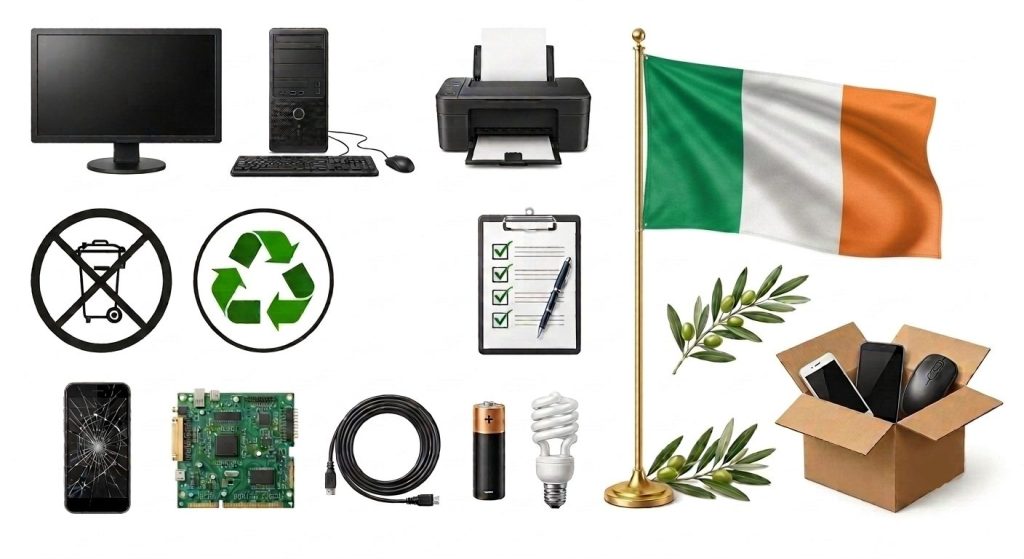
1. Crossed-out trash can (WEEE symbol): Must appear permanently on the product. If the product is too small, the symbol may appear in the product documentation or on the packaging.

2. IE Number on Invoices: The Irish producer number (IE number) must appear on all invoices issued by the manufacturer to retailers in Ireland.

3. vEMC Statement for End Customers (B2C): For product categories subject to vEMC, the retailer must display the legally mandated fee visibly and separately on the consumer invoice or at the point of sale.

Step-by-Step Checklist

(a) Companies based in Ireland

1. Classify products into EEE categories; clearly separate B2C and B2B portions

2. B2C: Join a compliance system

B2B: Submit a 3-year Waste Management Plan (WMP) to EPA EDEN (due every 3 years)

4. Register with PRL; obtain an IE number

5. Renew PRL registration annually by January 31 of each year

6. Submit monthly POM reports via PRLBB by the 19th of the following month

7. B2B: Submit the annual WMR to EPA by January 31

8. Include the IE number on all invoices to Irish retailers

9. vEMC fees: Ensure that for B2C goods subject to vEMC, the recycling fee is clearly and separately itemized at the point of sale (physical store/online store) and on the end customer’s invoice.

10. Affix the crossed-out trash can symbol to devices/packaging

(b) Companies from other EU countries

1. Appoint an authorized representative in Ireland – written power of attorney; the AR must be registered with PRL

2. The AR joins the compliance system on behalf of the manufacturer

3. The AR completes PRL registration; obtain an IE number

4. Communicate the IE number to all Irish trading partners and marketplaces

5. Submit monthly POM data in a structured format to the AR; the AR submits it via PRLBB

6. Ensure annual PRL renewal by January 31

7. Correctly set up the vEMC certificate in the Irish online store for products subject to vEMC

8. Check labeling: WEEE symbol on devices; IE number on invoices

(c) Companies from third countries (outside the EU)

1. Appoint an authorized representative in Ireland (required); handle all steps listed in (b) through this representative

2. Ensure that the authorized representative is officially registered with PRL and holds a PRL certificate

3. Submit proof of compliance to online marketplaces

Are you planning to sell your products in Ireland?

We’ll help you ensure compliance with Ireland’s EPR regulations for WEEE so you can get started with legal certainty.

Contact

We look forward to your message!

info@ecopv-eu.com

+49 6196 5835357

Frankfurter Str. 70-72
65760 Eschborn