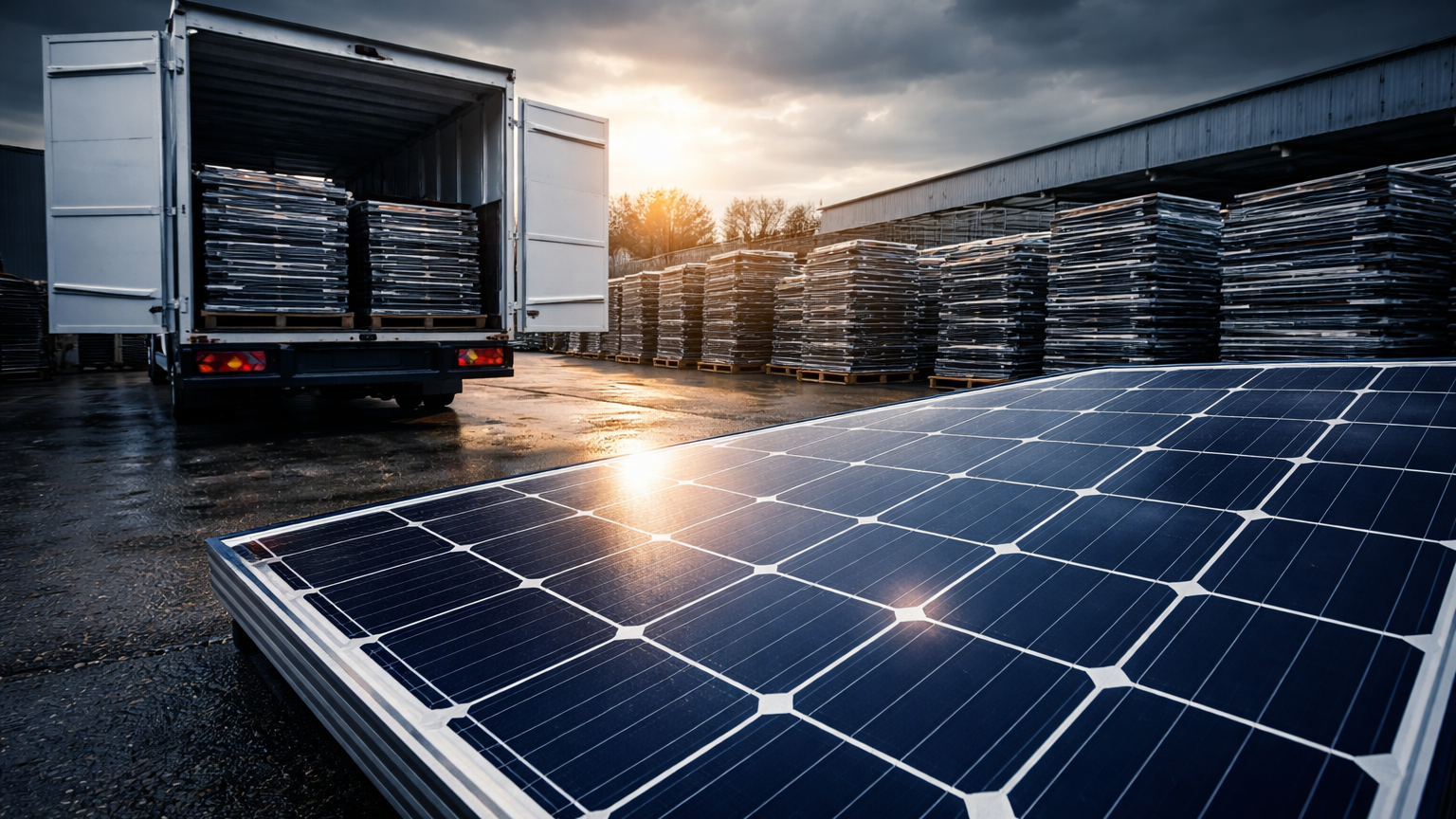
Since October 2015, PV modules have been subject to the WEEE Directive. The biggest challenge here is the tight timeframe at the end of the product’s life cycle: once the collection order from the EAR Foundation arrives, there are only a few business days left to handle all the coordination and logistics.
The Core Obligations
- Registration with the EAR Foundation prior to the first placing on the market
- Regular reporting of quantities of modules placed on the market
- Country-specific EPR compliance for EU-wide distribution
- Financial guarantees for future take-back and recycling costs
When does a return apply?
In both the B2C and B2B sectors.
Example: A private household dismantles its rooftop system after 20 years and drops off the modules at a recycling center.
A solar park operator replaces hundreds of damaged modules at once following a hailstorm.
A commercial roof is being renovated, and the old system is dismantled.
A repowering project replaces an entire ground-mounted system with more powerful technology.
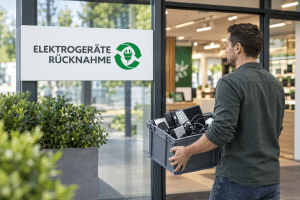
Note: Used B2B equipment may not be dropped off at public collection points. Manufacturers must maintain their own take-back system for commercial customers. Private individuals, on the other hand, can drop off PV modules at collection points free of charge.
The 72-hour window
Due to legally required volume reporting, the EAR Foundation knows exactly which manufacturer is responsible for which share of the take-back. If discarded PV modules accumulate at a public collection point, a pickup order is issued directly to the manufacturer responsible.
The ElektroG requires immediate pickup in this instance. Case law has clarified what “immediately” means: a maximum of one to three business days. The deadline set in the pickup order issued by the ear Foundation specifies this timeframe for each individual case – in practice, 72 hours is often cited.
The solar panels must be picked up from the recycling center within this time frame.
Why the 72-hour deadline?
- Lack of space: Recycling centers have limited storage space. A full container must be replaced immediately so that residents can continue to drop off old modules.
- Smooth operations: Disposal across Germany can only run without interruption if tight deadlines are met.
- Consistent rules: Manufacturers must not delay pickups to save costs or shift the burden onto local governments.
Contact us for comprehensive advice on your compliance issues relating to electrical and electronic equipment, packaging, batteries, and PV panels.
 www.ecopv-eu.com/en/contact/ |
  E-Mail: info@ecopv-eu.com
 Supported over 20,000 customers with EPR compliance
Rated 5.0 on Google
Contact
We look forward to your message!