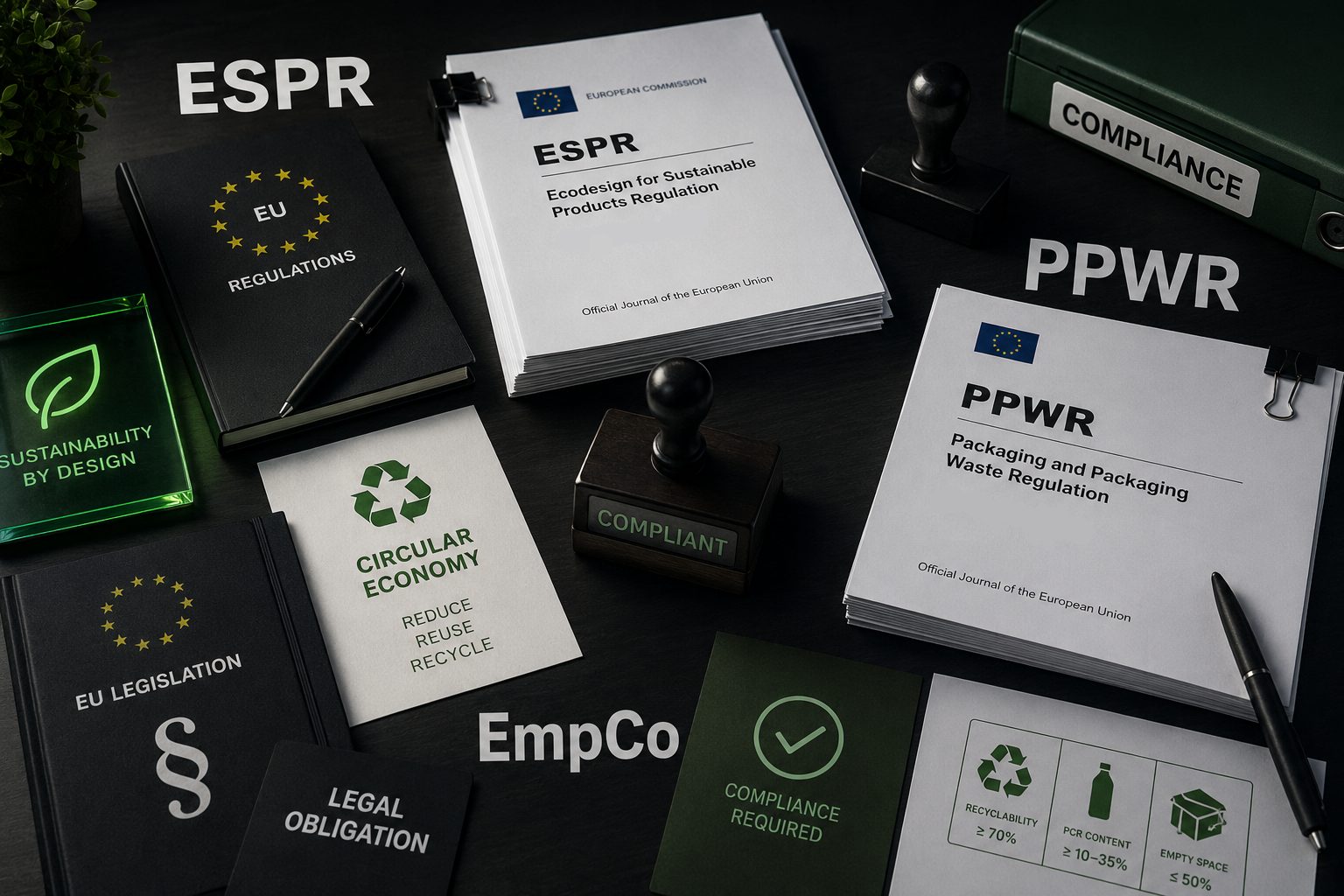
Did you know that we are in the midst of a critical phase of the EU’s sustainability strategy? Whereas “sustainability” used to be little more than a marketing buzzword, it is now becoming a real legal and liability risk.
Throughout 2026, groundbreaking EU regulations will come into effect that will fundamentally change the way companies design, package, and advertise products.
- EmpCo (effective Sept. 2026): Strict ban on greenwashing and unproven eco-claims (such as “climate-neutral”) on products.
- PPWR (effective Aug. 2026): EU-wide requirement for recyclable packaging, minimum recycled content quotas, and a ban on micro-packaging.
- ESPR (effective July 2026): Requirements for durable, repairable products, introduction of the Digital Product Passport, and a ban on textile destruction.
An overview of the 3 regulations:
1. The EmpCo Directive (Consumer Empowerment Directive)
- Start: Mandatory implementation beginning in September 2026. Enacted in Germany through the amended Unfair Competition Act (UWG). Important: There is no phase-out period for existing products on store shelves.
- The trigger: An EU study revealed that 53% of all environmental claims in retail were vague, misleading, or unfounded. The EmpCo aims to regain consumer trust and effectively stop greenwashing.
- The goal: To empower consumers to make genuine, sustainable purchasing decisions through transparent and reliable information.
- The change:
- Broad claims prohibited: General terms such as “environmentally friendly,” “eco,” or “green” will be illegal per se in the future without recognized proof (e.g., the EU Ecolabel).
- No more offsetting for products: Claims such as “climate-neutral,” which are based purely on the purchase of CO₂ certificates (offsetting), will be completely prohibited for products.
2. The EU Packaging Regulation (PPWR)
- Start: Formally in effect since February 11, 2025. Following an 18-month transition period, it will become mandatory for nearly all companies as of August 12, 2026.
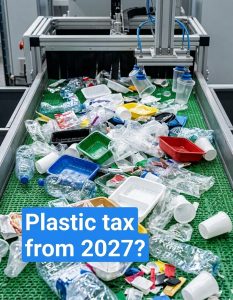
- The trigger: The inexorable rise in packaging waste in Europe. The EU’s goal is to reduce waste by 15% by 2040.
- The goal: Making packaging circular – from product design and material sourcing to true recycling.
- The change:
- Uniform rules: Existing, purely national special rules (such as the German Packaging Act) will be replaced by uniform EU-wide standards.
- Strict recycling and recycled content requirements: Starting in 2030, nearly all packaging must be recyclable. In addition, minimum quotas apply for the use of recycled plastic (recycled content).
- End of single-use formats starting in 2030: Certain types of packaging will be banned. These include mini-packages in hotels (e.g., shampoo) and plastic wrappers for unprocessed fruits and vegetables.
- Ban on deceptive packaging: The regulation introduces a maximum void volume of 50% for shipping and transport packaging.
- New bureaucracy: Starting in August 2026, manufacturers must provide official technical documentation and a declaration of conformity for each type of packaging.
3. The EU Ecodesign Regulation (ESPR)
- Start: Formally in effect since July 2024. The specific product requirements are now being introduced gradually through delegated acts.
- The trigger: The old directive from 2009 was no longer sufficient. The EU is now radically expanding its focus from pure energy efficiency to the entire product life cycle.
- The goal: To make products in the EU more durable, repairable, reusable, and easier to recycle.
- The radical change:
- Applies to almost all products: Nearly all physical goods on the EU market are affected (the only major exceptions are food, feed, and pharmaceuticals).
- The Digital Product Passport (DPP): In the future, products must transparently disclose all relevant data regarding origin, materials, repairability, and disposal via a QR code.
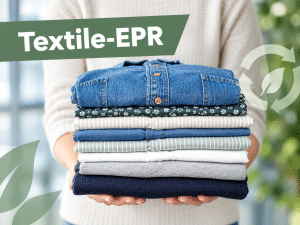
- Ban on the destruction of textiles: Starting in July 2026, large companies will be legally prohibited from destroying unsold clothing, textiles, and shoes. Important: Medium-sized companies have a grace period until 2030, while micro-enterprises are completely exempt.
- Disclosure requirement: Large companies are already required to publicly document online each year how many unsold products they have disposed of and for what reasons.
Key Takeaways for Your Business
The clock is ticking. Any company that fails to get its house in order regarding data documentation, packaging, and product design by the end of 2026 risks hefty fines of up to 4% of annual turnover, costly warnings, and immediate sales bans on the EU market. Transparency is no longer a voluntary choice – it is the law.
Contact us for comprehensive advice on your compliance issues relating to electrical and electronic equipment, packaging, batteries, and PV panels.
 www.ecopv-eu.com/en/contact/ |
  E-Mail: info@ecopv-eu.com
 Supported over 20,000 customers with EPR compliance
Rated 5.0 on Google
Contact
We look forward to your message!