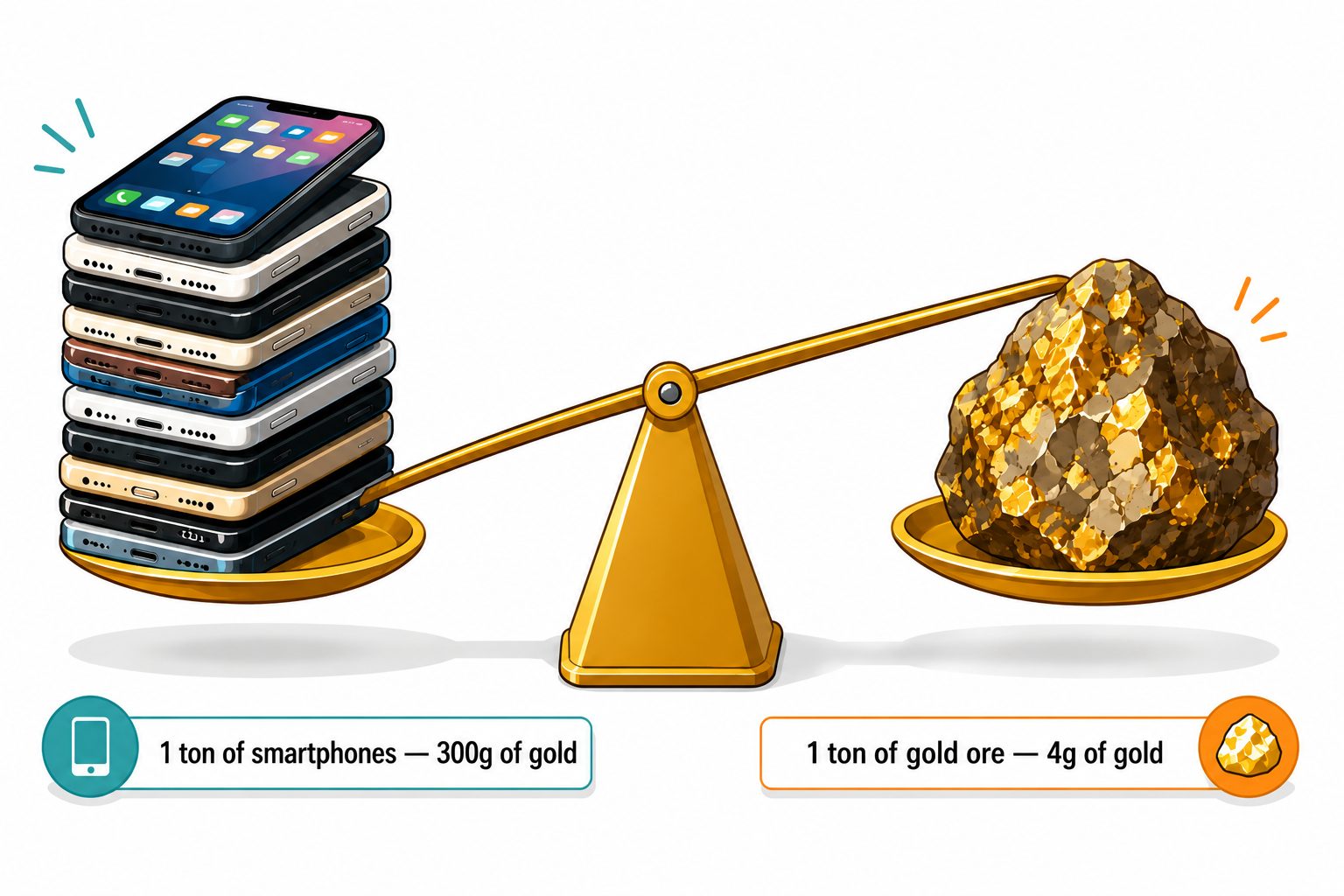
A ton of old iPhones contains significantly more gold than a ton of gold ore. What sounds absurd is a scientific fact and the basis for what is known as urban mining.
While conventional gold ore often yields only 1 to 5 grams of gold per ton, a ton of iPhone circuit boards contains about 200 to 300 grams of gold. The gold concentration in our electronic waste is thus up to 100 times higher than in nature.
This means that to extract the same amount of gold, mining companies would have to extract, blast, and chemically treat over 60 tons of rock, rather than simply recycling one ton of old devices.
Urban mining
This is exactly where urban mining comes in: the built environment becomes a mine. Instead of searching for raw materials deep underground, they are systematically recovered from old appliances, buildings, and infrastructure.
The concept views the entire stock of durable goods as an anthropogenic (man-made) deposit that is systematically tapped at the end of its useful life. Through modern sorting and smelting processes, these valuable resources are kept in the cycle instead of being stored unused in landfills.
✅ Urban mining: Up to 80% fewer CO₂ emissions and 90% less water consumption compared to primary extraction. There is no new impact on the landscape; raw materials remain in the local cycle, and metals such as silver, palladium, and copper are recovered highly efficiently.
❌ Conventional mining: Use of cyanide and mercury for gold extraction, massive tailings piles, destroyed ecosystems, and massive water consumption. Additionally, often under precarious working conditions in geopolitically unstable regions.
Why we still need mines
- Complex mix of materials: In a mine, “only” gold needs to be separated from rock. An iPhone contains over 60 different materials (plastic, glass, rare earth elements, adhesives) that are inseparably integrated. This makes extraction extremely difficult.
- Logistical problem: Rock in a mine is located in one place. With old devices, it is spread across billions of households worldwide. The collection (the logistics) is often more expensive than mining in nature.
- Thermal limitations: To recover the gold in its pure form, the circuit boards must be melted in special blast furnace facilities. There are very few of these worldwide that can cleanly master this high-tech separation process.
Why does electronics contain so much gold in the first place?
Gold is the ultimate contact metal: It does not corrode, can be processed into extremely thin layers, and guarantees perfect signal transmission for decades. While other metals tarnish when exposed to air, gold remains absolutely reliable even on the tiniest contact surfaces.
A single smartphone contains on average about 25 to 30 mg of gold, 300 mg of silver, and over 6 grams of cobalt. What seems tiny in the palm of your hand adds up to a massive treasure of raw materials when you consider the billions of devices in use worldwide.
Can gold be replaced in electronics?
So far, only to a limited extent. While silver conducts electricity even better, it oxidizes more quickly. Copper is the cheaper alternative, but it corrodes too quickly and is less reliable at the microscopic level.
Although researchers are experimenting with nanomaterials and new alloys, gold remains indispensable for high-precision applications in microelectronics for the time being, thanks to its unique durability.
Conclusion
One of the world’s most valuable mines isn’t deep underground – it’s in our drawers.
Certainly, recovery is technically challenging and logistically complex due to the complex mix of materials. But while traditional mining is becoming increasingly expensive and devastating due to declining gold grades and rising environmental regulations, urban mining is the answer to our hunger for raw materials.
Every smartphone that is returned to the cycle reduces the pressure on nature, saves massive amounts of CO₂, and reduces our geopolitical dependence. Urban mining is the decisive step beyond recycling and, as a source of raw materials, ensures technological development.
Contact us for comprehensive advice on your compliance issues relating to electrical and electronic equipment, packaging, batteries, and PV panels.
 www.ecopv-eu.com/en/contact/ |
  E-Mail: info@ecopv-eu.com
 Supported over 20,000 customers with EPR compliance
Rated 5.0 on Google
Kontakt
Wir freuen uns auf Ihre Nachricht!