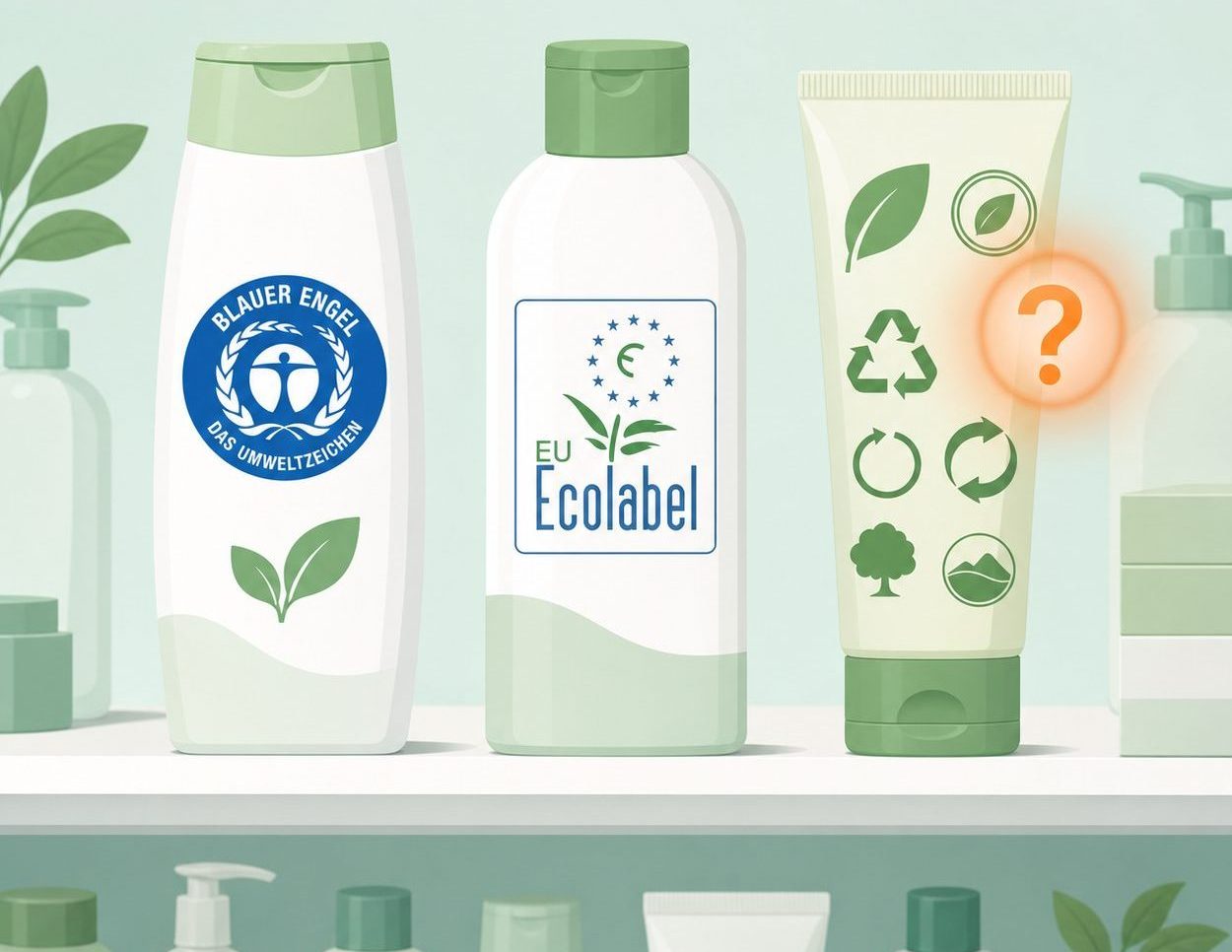
When you pick up a bottle of shower gel at the supermarket today, you’re often faced with a jumble of symbols: a green leaf, the Möbius loop for recycling, or vague claims like “environmentally friendly” or “100% recyclable.” But be careful: many of these symbols are just marketing gimmicks.
Only government-certified labels, such as the Blue Angel or the EU Ecolabel (the “Euroflower”), provide truly reliable guidance.
The Blue Angel
The Blue Angel is the world’s first and oldest environmental label. Since 1978, it has set the standard for environmentally friendly products and services. A strong network stands behind the label: it is owned by the Federal Ministry for the Environment, the criteria are developed by the Federal Environment Agency, and the RAL Institute verifies compliance.
What began in 1978 with pioneering products like CFC-free spray cans is now a success story: Around 30,000 products from approximately 1,600 companies bear the label.
What makes it special: An independent jury sets strict criteria that take into account the entire life cycle – from manufacturing through use to disposal. Companies seeking the label must pass an external audit. This makes it one of the most reliable indicators against greenwashing.
Blue Angel
The EU Ecolabel (the “Euroflower”)
Launched by the European Commission in 1992, the EU Ecolabel is now the most important cross-border environmental label. It provides consumers in all EU member states, as well as in Iceland, Norway, and Liechtenstein, with reliable guidance based on the rigorous ISO 14024 Type I standard.
While it all began in 1993 with washing machines and dishwashers, the Euroflower now appears on over 11,500 products in Germany alone. You’ll find it on cleaning products, textiles, and cosmetics such as shampoos or shower gels. Important to know: Food and medicines are deliberately excluded from the label, as separate regulations (such as the EU Organic Logo) apply to these sectors.
Just like with the Blue Angel, manufacturers must meet strict criteria throughout the entire life cycle – from raw material extraction to disposal. In Germany, RAL gemeinnützige GmbH acts as an independent body to ensure that only true eco-pioneers are allowed to use the logo.
“Euroflower”
Manufacturer-Created Symbols
This is where the real trap lies on the supermarket shelf. Alongside government-certified labels, countless symbols designed by the manufacturers themselves flood the packaging: green leaves, stylish eco-icons, or terms like “Eco,” “Bio-inspired,” and “Gentle on Nature.”
The problem: These symbols are often pure marketing.
- No oversight: There is no independent third-party verification.
- No standards: The manufacturer sets the criteria themselves – or simply does without them altogether.
- No consequences: Until now, almost anyone could project a “green” image without having to provide proof.
Even the well-known Möbius loop on products merely indicates that they are theoretically recyclable and does not allow any conclusions to be drawn about the actual environmental friendliness of their production. This clarification is crucial, as the symbol is not a protected seal and is often interpreted as a misleading marketing claim.
This is where classic greenwashing comes into play: Since many claims have so far been too vaguely worded and government oversight has been lacking, it is often difficult to determine whether there is genuine commitment behind them or whether they are merely exploiting consumers’ good intentions.
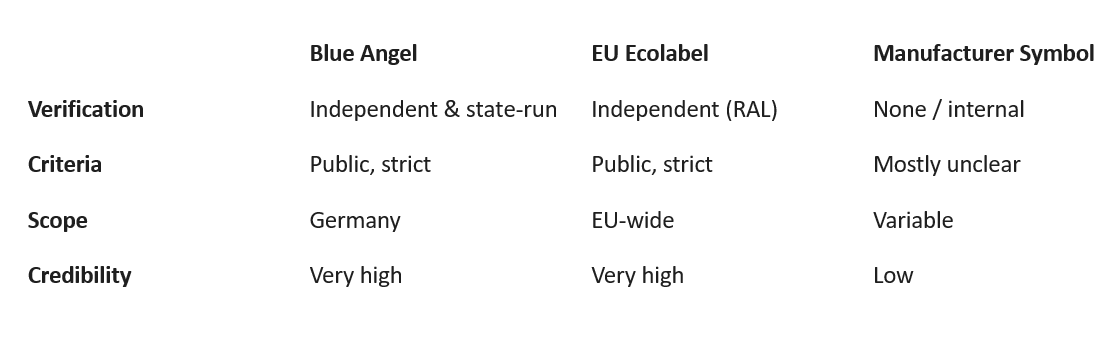
A direct comparison at a glance
What will change from September 2026
The EU Consumer Rights Directive (EmpCo) will take effect on September 27, 2026.
Here’s what will change specifically:
- Ban on vague claims: Terms such as “environmentally friendly,” “climate-neutral,” or “eco” may only be used if outstanding environmental performance is actually proven.
- No more self-created labels: Sustainability labels without official approval or independent certification will be prohibited.
- Transparency in offsetting: Companies may no longer advertise a product as “climate-neutral” if this is achieved solely through offsetting (CO₂ credits).
Conclusion
Ultimately, it becomes clear that not every green symbol on packaging actually contributes to environmental protection.
While the Blue Angel and the EU Ecolabel are the result of decades of work and strict government oversight, manufacturers’ own logos often serve only to market an eco-friendly image.
Anyone who wants to make a conscious decision when shopping should therefore rely on independently verified labels and critically question vague advertising claims that lack substance. True sustainability is not recognized by the color of the packaging, but by the reliability of the certification behind a label.
Contact us for comprehensive advice on your compliance issues relating to electrical and electronic equipment, packaging, batteries, and PV panels.
 www.ecopv-eu.com/en/contact/ |
  E-Mail: info@ecopv-eu.com
 Supported over 20,000 customers with EPR compliance
Rated 5.0 on Google
Kontakt
Wir freuen uns auf Ihre Nachricht!