Starting August 12, 2026, the EU Packaging Regulation (PPWR) will become mandatory in all EU member states, thereby replacing existing national regulations. The implications are far-reaching. The impact will be particularly noticeable in the fresh fruit and vegetable trade.
What will change?
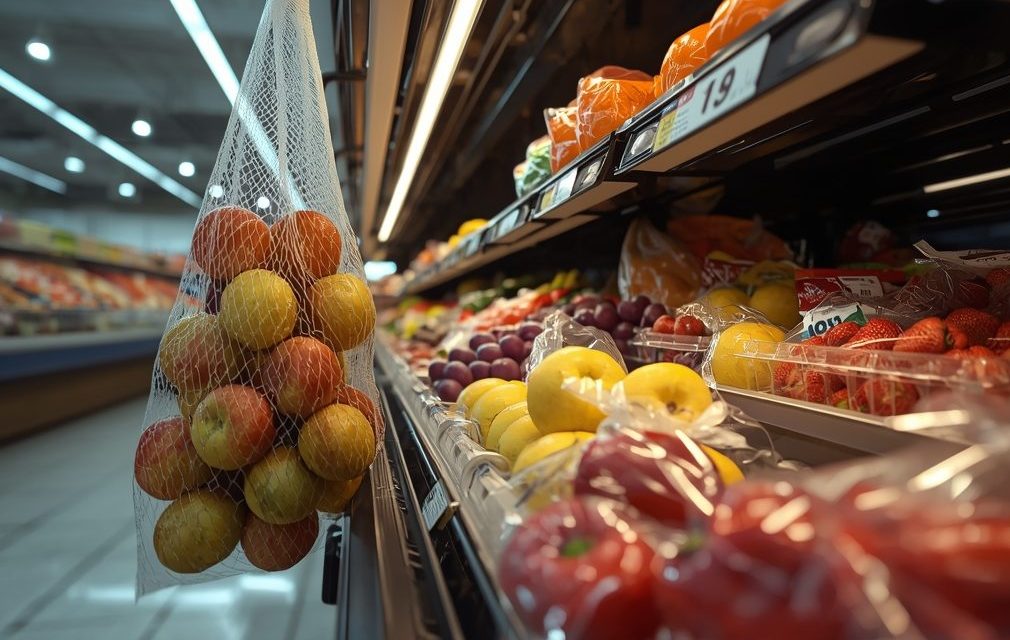
Starting in January 2030, single-use plastic packaging for less than 1.5 kg of unprocessed fresh fruits and vegetables will no longer be permitted throughout the EU. While general recycling standards and labeling requirements will take effect gradually starting in 2026, retailers have until the end of 2029 to fully transition to “loose goods” or paper-based solutions. Exceptions (e.g., for very delicate varieties or berries) will be finalized by the European Commission by 2027.
Affected products:
Bags, nets, trays, and other single-use plastic packaging typically used in supermarkets for small quantities of fruits and vegetables.
The goal is to reduce plastic waste for products that can easily be sold in bulk.
Criticism from the industry
Industry associations welcome the goal of a circular economy but criticize the ban on fruit and vegetable packaging as “discriminatory” compared to other sectors.
A key point of criticism: The ban could lead to massive food waste, as the shelf life of many varieties decreases without a protective atmosphere.
There are also warnings about distortions of competition: While regional producers are subject to strict controls, compliance with PPWR standards for imported goods from non-EU countries is difficult to monitor comprehensively in practice. The high costs of the technical conversion of packaging lines also place a particular burden on small and medium-sized businesses.
What about those small hotel shampoo bottles?
Another well-known example from the PPWR concerns the hotel industry: Starting in January 2030, lodging establishments will no longer be allowed to provide cosmetic, hygiene, and toiletries in single-use packaging.
This applies to cosmetic items with a volume of less than 50 milliliters. Hotels must switch to refillable dispenser systems or solid alternatives. Miniature shampoos, shower gel, soaps, and cream tubes – everything that has been standard in hotels until now – will disappear.
However, another stricter regulation will take effect much earlier, starting in August 2026: An EU declaration of conformity must be available for every piece of packaging placed on the market. This requires companies to guarantee in writing that their packaging complies with the strict requirements for recyclability and the new limits for substances of concern (such as the PFAS ban).
Additional PPWR requirements
- Compostability (effective 2028): Labels on fruits and vegetables, as well as certain bags, must be compostable starting February 12, 2028.
- Minimization (from 2030): Packaging must be designed to reduce its weight and volume to the minimum necessary.
- E-Commerce (from 2030): Particularly in online retail and multipacks, packaging with more than 50% empty space will be prohibited.
- Ban on PFAS: Starting in August 2026, the use of per- and polyfluoroalkyl substances (PFAS) in packaging will be prohibited below certain thresholds.
More information about the new PPWR:
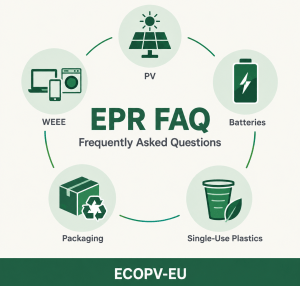
Contact us for comprehensive advice on your compliance issues relating to electrical and electronic equipment, packaging, batteries, and PV panels.
 www.ecopv-eu.com/en/contact/ |
  E-Mail: info@ecopv-eu.com
 Supported over 20,000 customers with EPR compliance
Rated 5.0 on Google
Contact
We look forward to your message!