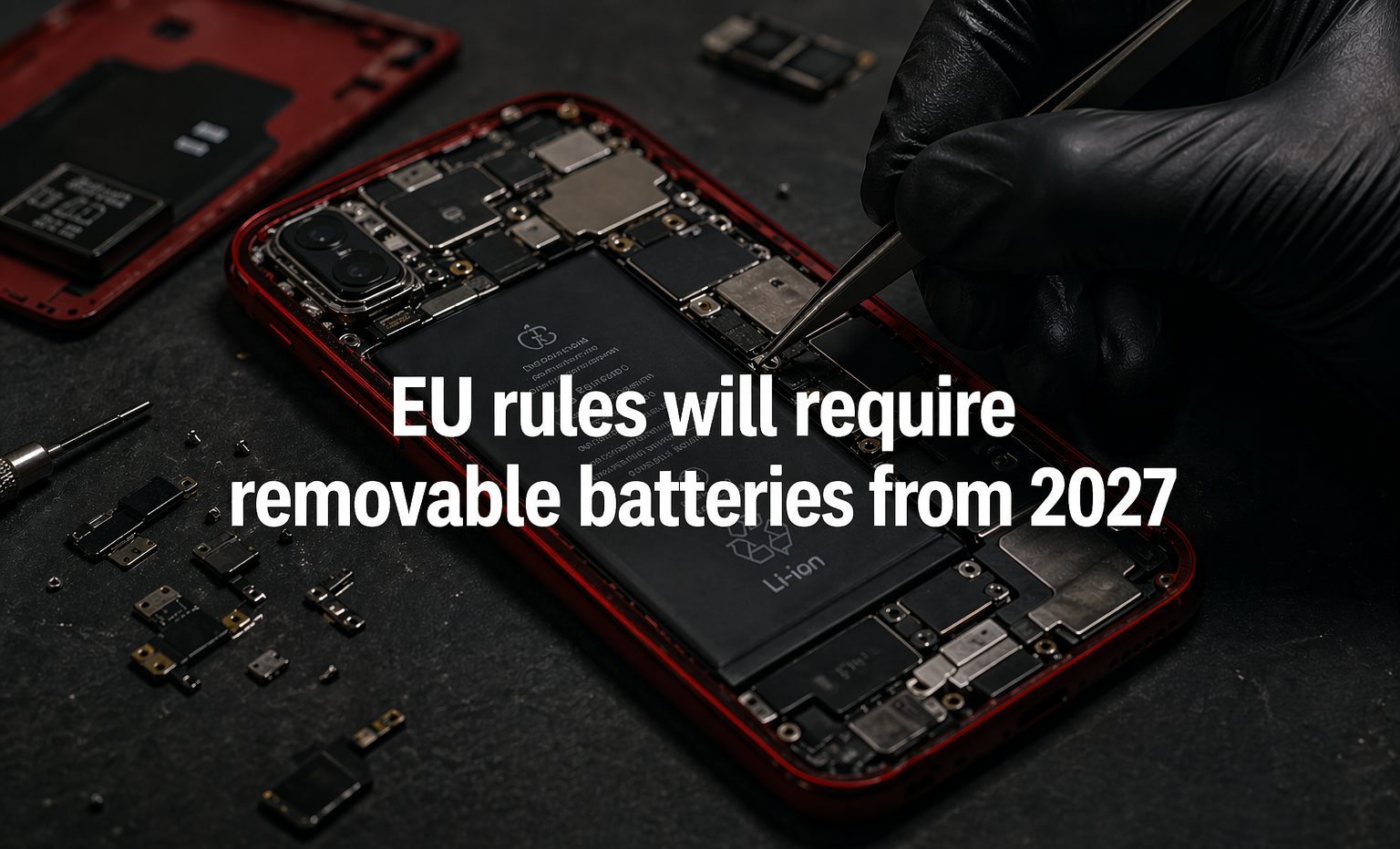
Starting in 2027, there will be a noticeable change for smartphones in the EU: The removable battery is making a comeback. What used to be standard is returning due to legal requirements for new models.
What exactly can we expect?
Starting February 18, 2027, new smartphones and tablets must be designed so that end users can remove and replace the battery themselves using standard tools. Adhesive bonds that require heat to be removed will then be largely prohibited.
Specifically, this means the following for new models starting in February 2027:
- Easy replacement: Batteries must be replaceable using standard tools (e.g., screwdrivers).
- No barriers: The use of adhesives that can only be removed with heat or solvents is prohibited.
- Tools: If a special tool is required for replacement, the manufacturer must provide it free of charge.
- Spare parts guarantee: Replacement batteries must be available to end users at a reasonable price for at least 5 years.
Why is the EU introducing this?
The main driver is the transition to a true circular economy. Currently, smartphones are often replaced as soon as battery performance declines, which wastes enormous amounts of resources.
- Waste prevention: Millions of tons of electronic waste are generated in the EU every year. Easily replaceable batteries significantly extend the lifespan of devices.
- Cost savings: Many users shy away from expensive repairs or buying new devices. The EU estimates that consumers could save tens of billions of euros in total by 2030 thanks to longer usage cycles.
- Resource conservation: Batteries contain valuable raw materials such as lithium and cobalt. If they are easily removable, they can be sorted by type and recycled more efficiently.
- Fire safety: Batteries that are permanently glued in place are often damaged during shredding, which repeatedly leads to dangerous fires in sorting facilities. Clean removal significantly increases safety in the recycling process.
What does this mean for users?
- DIY repairs: Instead of paying a lot of money to visit a repair service, you simply buy the replacement part and swap it out yourself.
- Higher resale value: Used cell phones can be resold much more easily and for a higher price with a brand-new battery.
- Longer software support: Since the hardware lasts longer, there is also increased pressure on manufacturers to offer security updates for a longer period.
Will this make smartphones thicker or less waterproof?
That is the key challenge for designers.
- Modern devices are often bonded together to make them particularly thin and waterproof.
- Removable batteries make this design more difficult, but not impossible.
Manufacturers are already working on solutions, such as:
- new seals instead of adhesive,
- more robust casings with screw mechanisms,
- modular internal structures.
Many users fear that cell phones will break immediately if they get wet in the rain or fall into water. That’s not true: It is entirely feasible to make smartphones waterproof despite having a removable battery. The principle is similar to that of rugged outdoor phones. A rubber gasket running around the battery cover, which is pressed into place by screws or a secure clip, ensures that the interior of the housing is sealed.
It is therefore quite possible that smartphones will become slightly thicker, but significant increases are unlikely, as design remains a key selling point.
Are there any exceptions to the replacement requirement?
Yes, but only in specific cases:
- Specialized hardware: Devices used in highly specialized fields (e.g., medical diagnostics or explosion-proof industrial cell phones) are also exempt if a replaceable battery would compromise safety.
- Extremely long lifespan: To avoid the replacement requirement, a battery would have to be extremely durable. The battery must retain at least 80% of its original capacity after 1,000 charge cycles. That is significantly more than many batteries on the market today can achieve (often around 500–800 cycles).
- Simultaneous water protection: In addition to durability, the device must be water- and dust-tight according to IP67.
Another innovation: the “battery passport”
In addition, the EU is introducing a digital battery passport.
Users and recycling facilities can access important data via a printed QR code. It stores information about the battery’s carbon footprint, the proportion of recycled materials, its chemical composition, and its “state of health.” This represents a huge step forward, particularly for the second-hand market and professional recyclers.
Conclusion
The new EU regulation marks the end of the “disposable” era for smartphones. Starting in 2027, users will benefit from longer device lifespans, easier repairs, and lower costs.
Even though manufacturers will have to adapt their designs to improve water resistance and aesthetics, the benefits for the environment and consumers -including less electronic waste and greater transparency – outweigh these changes.
Contact us for comprehensive advice on your compliance issues relating to electrical and electronic equipment, packaging, batteries, and PV panels.
 www.ecopv-eu.com/en/contact/ |
  E-Mail: info@ecopv-eu.com
 Supported over 20,000 customers with EPR compliance
Rated 5.0 on Google
Contact
We look forward to your message!