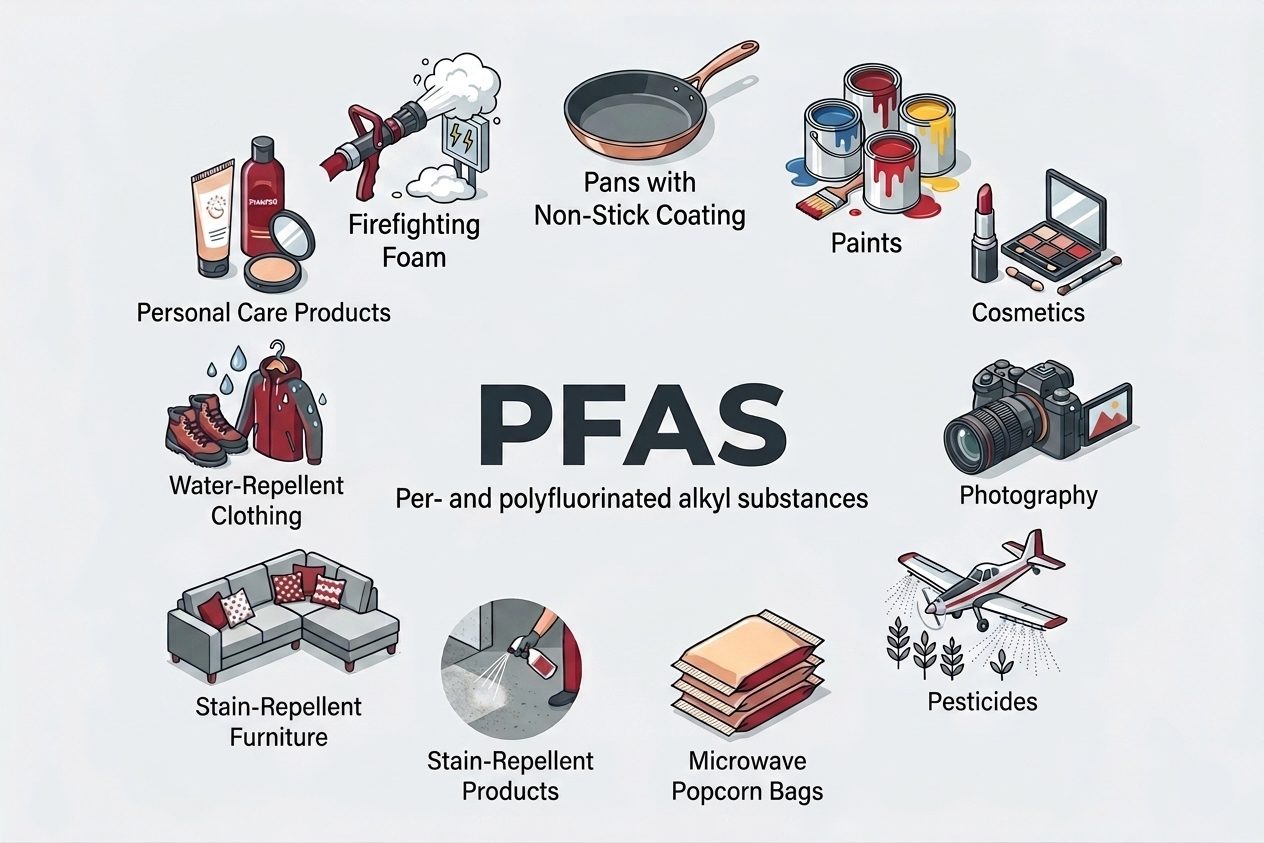
PFAS are a large group of artificially produced chemicals. Experts often refer to them as “forever chemicals.” The reason for this is their extreme durability: once released into the environment, they do not break down for very long periods of time.
Where are PFAS used?
- Kitchen & Food: Non-stick coatings (pans, baking pans), fast-food packaging, popcorn bags, and muffin cups.
- Home & Electronics: Stain protection for upholstered furniture and carpets, refrigerants, and electronic devices.
- Sports & Outdoor: Membranes in functional clothing, ski waxes, climbing ropes, and bicycle chain oils.
- Drugstore & Textiles: Waterproofing treatments for leather, dental floss, and special period underwear.
- Other applications: Fire extinguishers, paints, varnishes, pesticides, and photographic paper.
Why are they used?
Because they repel grease, water, and dirt and make materials more durable. As a result, they often extend the lifespan of products.
- Example: An outdoor jacket with a PFAS membrane remains waterproof and breathable for years, while alternative coatings often wear out faster or need to be re-waterproofed.
Why is this a problem?
PFAS persist in the environment for a very long time. They can accumulate in water, soil, animals, and ultimately in humans as well. This is referred to as bioaccumulation.
Since PFAS are water-soluble and mobile, they spread via rivers and oceans to even the most remote regions (the Arctic). That is why authorities in Europe are working on stricter regulations. The ECHA is pushing for broad restrictions on many PFAS at the EU level. The goal is to significantly reduce releases and mitigate risks.
A particularly important step is the PPWR: the new EU Packaging Regulation. It sets clear limits for PFAS in food contact packaging.
August 12, 2026, serves as the target date for the industry. However, since the transition and the new rules will take some time to implement, the ban will take effect in the course of 2026. The aim is to prevent PFAS from entering food and recycling cycles via packaging.
- Important: There will be no “zero tolerance,” as technical impurities are unavoidable. However, the PPWR stipulates that PFAS may no longer be intentionally used to achieve functional properties (such as grease resistance).
Additional PFAS Regulations
- Starting in October 2026 (PFHxA ban): A ban on the sale of PFAS in many everyday products (rain jackets, textiles, leather, cosmetics, waterproofing sprays).
- Firefighting foams: The use of PFAS-containing firefighting foams is being phased out under the EU regulation. As of October 23, 2026, new fire extinguishers containing PFAS may no longer be placed on the market or refilled.
- General restriction: The ECHA is reviewing a universal PFAS restriction procedure
Conclusion
For the industry, this means a necessary transition. Those who switch to PFAS-free solutions early on will meet legal requirements and protect consumer health.
We can help you stay on top of all legal requirements: Contact us for comprehensive advice on your compliance issues.
 www.ecopv-eu.com/en/contact/ |
  E-Mail: info@ecopv-eu.com
 Supported over 20,000 customers with EPR compliance
Rated 5.0 on Google
Contact
We look forward to your message!