Have you ever gotten frustrated by a cap that’s stuck to the bottle when you’re trying to drink? Since July 2024, so-called “tethered caps” are mandatory in the EU for single-use beverage containers.
The problem: Microplastics in the environment
According to the German Environmental Aid Association (DUH), approximately 16.4 billion single-use plastic bottles are consumed in Germany every year. That’s about 45 million bottles every single day.
Plastic caps are particularly problematic, as they are among the most common types of litter found on European beaches. Because they often become separated from the bottle, hundreds of millions of these small parts are lost every year and pollute the environment.
How do tethered caps work?
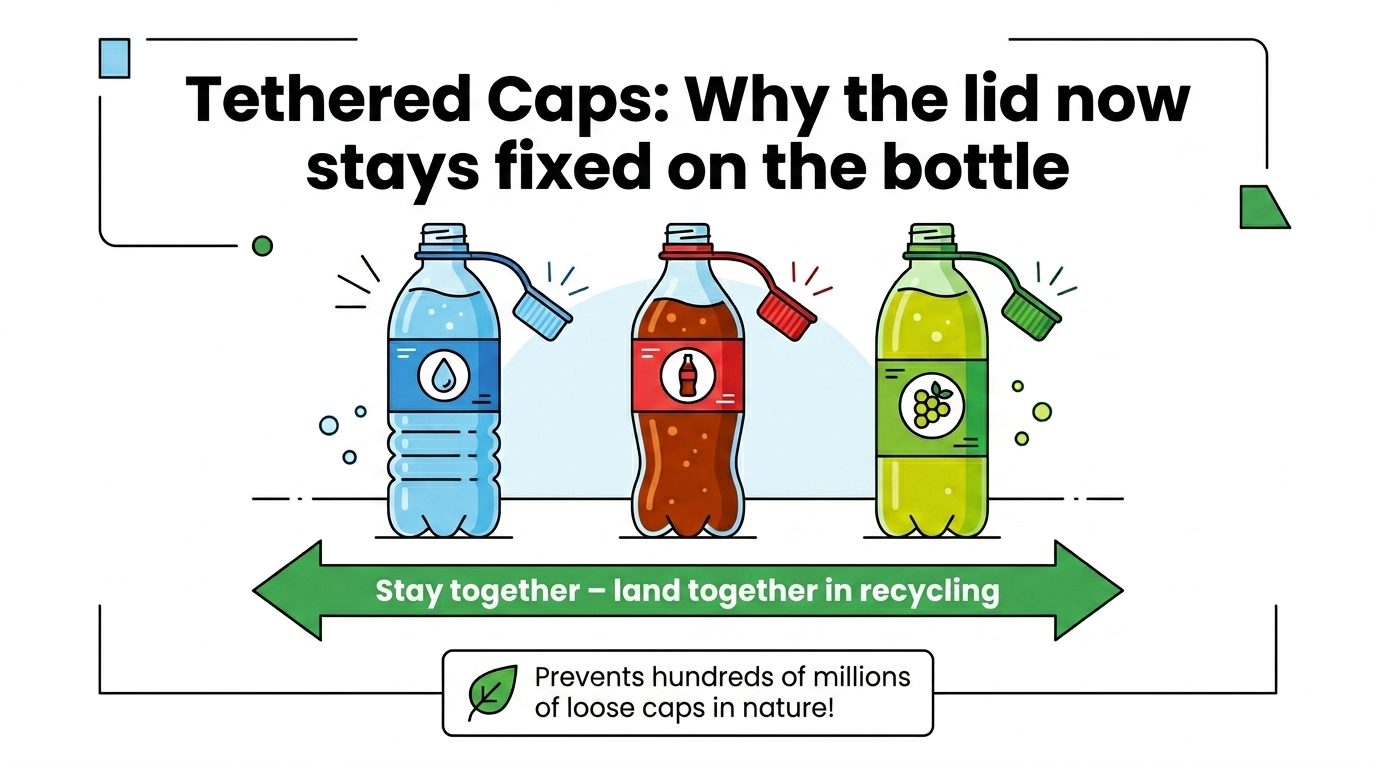
The caps are securely attached to the bottle via a small plastic connector (tab or ring).
The principle is simple:
- The bottle and cap stay together
- Both end up together in the deposit return system or the recycling bin
- At sorting facilities, the caps are reliably captured instead of falling through screens as small parts.
Where does the new requirement apply?
The regulation applies EU-wide to all:
- Single-use plastic beverage bottles (up to 3 liters).
- Beverage cartons with plastic closures.
- Reusable bottles, glass containers, and special closures remain exempt.
Environmental impact and benefits
The biggest advantage lies in environmental protection:
✅ Less plastic waste in forests and oceans
✅ Reduction in microplastics caused by decomposing caps
✅ Higher recycling rates, as more material finds its way back into the cycle.
Criticism
- Partially impractical to use
- Slightly increased material usage
- Described by some as a “false solution” or “fake solution”
According to a Statista infographic based on YouGov data, the EU mandate for permanently attached bottle caps is met with resistance: More than half of those surveyed (around 54%) are bothered by the change, while only about 21% view the permanent closures positively.
At the same time, it is clear that:
Small design changes can have a major environmental impact – especially for products used millions of times every day.
Tethered caps demonstrate how regulation and design can support environmental goals: While they do not solve the entire plastic problem, they do prevent hundreds of millions of caps from ending up in the natural environment. Because they are securely attached, they remain in the cycle and can thus be reliably recycled.
Contact us for comprehensive advice on your compliance issues relating to electrical and electronic equipment, packaging, batteries, and PV panels.
 www.ecopv-eu.com/en/contact/ |
  E-Mail: info@ecopv-eu.com
 Supported over 20,000 customers with EPR compliance
Rated 5.0 on Google
Contact
We look forward to your message!