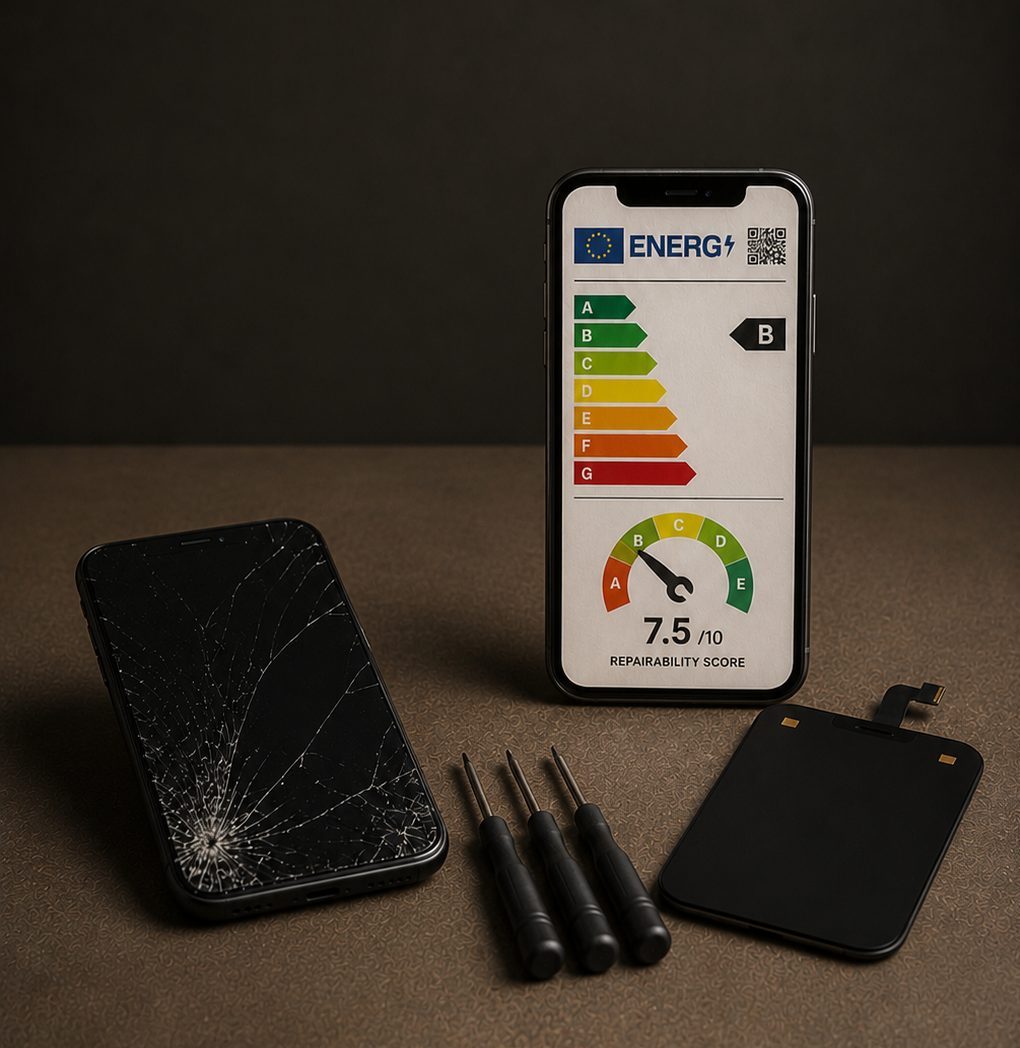
Two new regulations are fundamentally changing the way we deal with electronic devices: the Repairability Score and the Right to Repair. While the score indicates a product’s sustainability at the time of purchase, the new law ensures that repairs become easier and more affordable. But what exactly do these rules mean in everyday life?
1. The Repairability Score: Repairability at a glance
Since June 20, 2025, the index has been mandatory across the EU for the first product categories – smartphones and tablets – and can be found directly on the familiar EU energy label. Other appliance categories, such as clothes dryers, are set to follow in the coming years.
The principle: Similar to the Nutri-Score system, a color scale ranging from A (dark green / very good) to E (red / poor) rates how easy an appliance is to maintain. The rating is based on five main factors:
- Disassembly effort: How many steps are required to access the components?
- Tools: Can the device be opened with standard tools, or does it require special equipment?
- Spare parts: How long does it take to get batteries, displays, and other parts, and how quickly are they available?
- Repair manuals: Is clear information freely available for both professionals and non-technical users?
- Software support: For how many years are updates for the operating system guaranteed?
For manufacturers, this means that repair has become a mandatory requirement. They must design products from the very beginning so that they can be disassembled without being damaged.
For retailers, this means that the energy rating will become a key selling point. Just as is the case today with energy efficiency, retailers will actively promote “A-label appliances” to win over price-conscious and sustainability-minded customers.
For consumers, this means they can tell before making a purchase whether a device is durable and repairable – without having to do any research, right there on the shelf.
2. The Right to Repair
The directive took effect in July 2024; Germany has until July 31, 2026, to transpose it into national law. The new EU law holds manufacturers accountable to ensure that devices do not end up in the trash over minor issues.
Here’s what’s changing:
- Repair obligation after the warranty expires: Even after the statutory warranty period ends, manufacturers must continue to offer repairs (for common appliances such as washing machines, vacuum cleaners, or smartphones).
- Bonus year: If you choose a repair over a replacement device within the warranty period, the coverage is extended by another year.
- Fair spare part prices: Manufacturers are prohibited from offering spare parts at exorbitant prices to artificially make a repair unprofitable.
- Anti-Blocking Ban: Software locks that prevent the installation of third-party or used replacement parts (“part pairing”) are prohibited.
- Transparency: A planned EU-wide online platform will make it easy to find repair shops, refurbished retailers, and community workshops nearby.
💡 Good to know: While we wait for the federal law, states like Thuringia, Saxony, and Berlin are already offering their own repair rebates – often providing up to €200 in reimbursement.
What both regulations are intended to achieve
The Repairability Score provides information – the Right to Repair is a legal obligation.
The Repair Index helps consumers make informed purchasing decisions, while the Right to Repair holds manufacturers accountable. Together, these rules address two key issues: the lack of information when purchasing devices and the premature disposal of broken but repairable electronics.
The intended impact:
- Waste reduction: Less electronic waste through conscious purchasing decisions and an increase in repairs.
- Product design: Increased pressure on manufacturers to develop durable and easy-to-maintain products.
- Fair market competition: A competitive environment in which quality and sustainability become more important criteria than simply the lowest price.
Contact us for comprehensive compliance consulting on electrical appliances, batteries, packaging, and solar panels – and subscribe to our newsletter to stay up to date on the latest laws and trends.
 www.ecopv-eu.com/en/contact/ |
  E-Mail: info@ecopv-eu.com
 Supported over 20,000 customers with EPR compliance
Rated 5.0 on Google
Kontakt
Wir freuen uns auf Ihre Nachricht!