Millions of electrical appliances are sold in Germany every year – in 2024 alone, approximately 2.8 million tons of new products entered the market. Yet the disposal of old appliances remains a massive problem, posing growing legal risks for companies.
The German Environmental Aid Association (DUH) describes the current figures as “catastrophic.” At just under 920,000 tons, only 28.7 percent of electronic waste was officially collected in 2024. This puts Germany miles below the legally mandated quota of 65 percent. The rate for preparing devices for reuse is also stagnating at just 1.9 percent.
The target: 65% of the average weight of devices placed on the market in the three preceding years must be collected annually. This includes all end-of-life devices – from bulky washing machines and broken smartphones to worn-out smartwatches.
Germany has failed to meet this EU collection target for the sixth consecutive year.
Where does all that electronic waste end up?
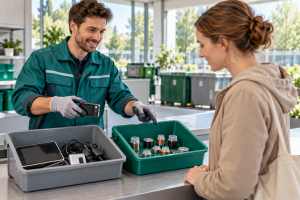
Over 95% of officially recorded volumes are dropped off at municipal recycling centers. Despite legal take-back obligations, retailers continue to play a minor role, accounting for only about 4.6%. Particularly concerning: millions of small, old devices end up in the general waste every year.
But where does the rest go?
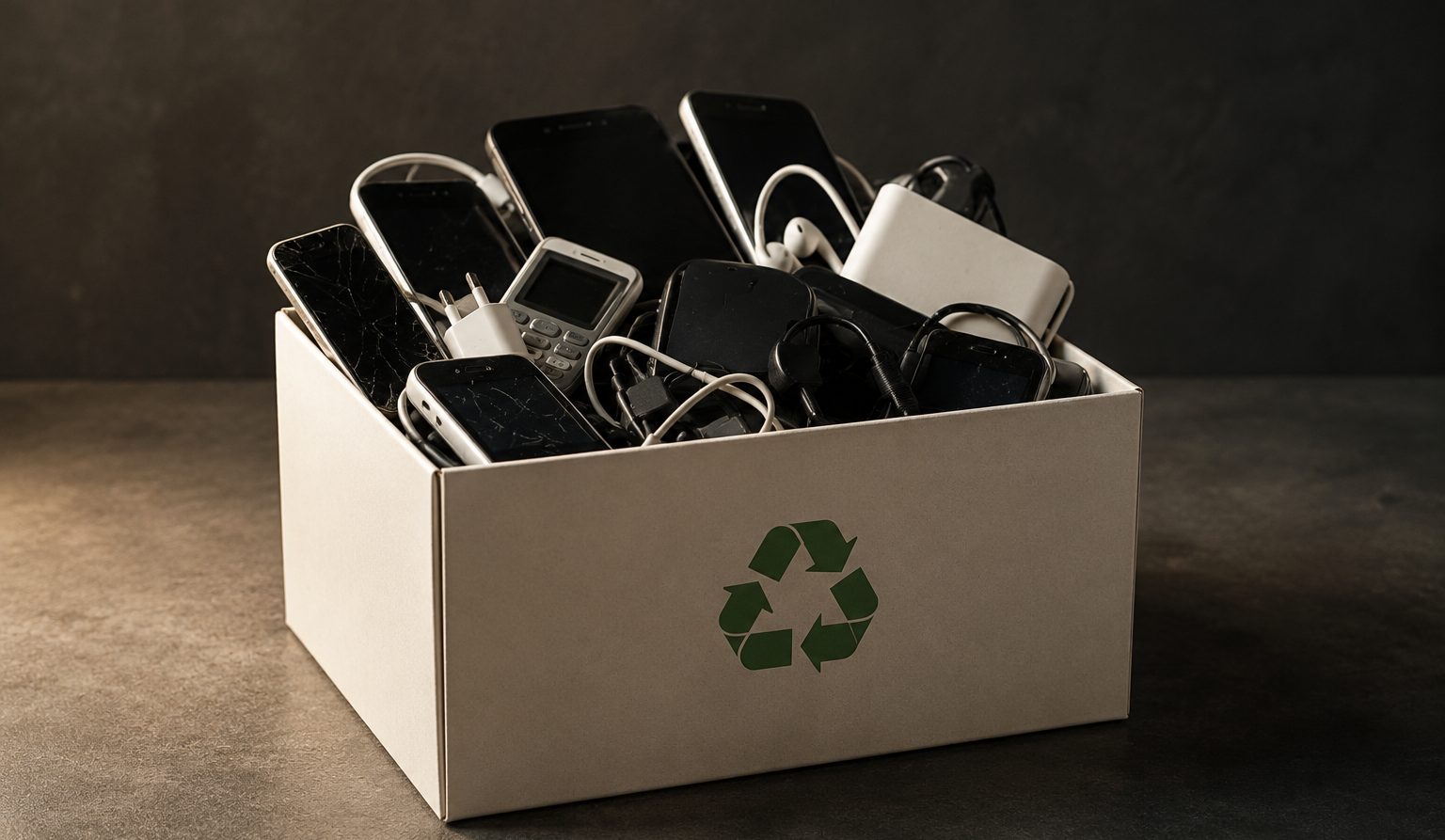
- In German drawers (“hoarding”): According to estimates, over 300 million discarded smartphones and laptops are now stored in German households.
- Illegal exports: A significant portion of electronic waste is illegally shipped to Africa or Asia under the guise of “secondhand goods.” There, the devices are often dismantled under conditions hazardous to health.
- Unofficial collections: Scrap collectors deliberately remove valuable devices (e.g., washing machines or copper cables) from the official system, which further drives down official collection rates.
Why is the proper collection of electronic waste so important?
Proper disposal is much more than a legal obligation – it is essential for a functioning circular economy and the protection of our environment.
- Securing valuable raw materials: Electronic devices are “urban mines.” They contain valuable precious metals such as gold, silver, and copper, as well as rare earth elements (e.g., lithium and cobalt). Through recycling, these materials can be recovered, which reduces energy-intensive and environmentally harmful mining in primary mines.
- Protection against hazardous substances: Many end-of-life devices contain dangerous substances such as mercury, lead, cadmium, or flame-retardant chemicals. If these end up in household waste or in nature, they contaminate soil and groundwater.
- Climate protection & energy savings: Extracting secondary raw materials from scrap consumes up to 90% less energy than extracting them from ore. This significantly reduces the carbon footprint.
- Fire safety: Modern devices almost always contain lithium-ion batteries. If these are improperly disposed of in household waste, damage to them increasingly leads to serious fires in garbage trucks and sorting facilities.
Responsibilities in the recycling cycle: Who is responsible for what?
To achieve the 65% collection rate, the Electrical and Electronic Equipment Act (ElektroG) holds all stakeholders accountable.
1. Manufacturers (and importers)
They bear Extended Producer Responsibility (EPR). This means they are responsible for the entire life cycle:
- Registration: No sales without registration with the EAR Foundation.
- Financing: Covering the costs of collection and recycling of containers provided at collection points.
- Eco-design: Obligation to manufacture devices in a way that makes them easy to repair and allows raw materials to be easily recovered.
- Labeling: Every device must be marked with the “crossed-out wheelie bin” symbol.
2. Retailers (stationary & online)
Retailers are the central collection points for old appliances:
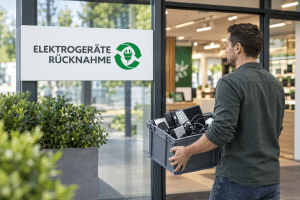
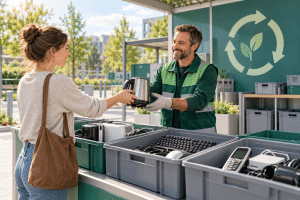
- Take-back obligation: 1:1 take-back: When a new appliance is purchased, an old appliance of the same category must be taken back free of charge. 0:1 take-back: Small appliances (edge length < 25 cm) must always be taken back free of charge – even without a new purchase.
- Information obligation (New in 2026): Retailers must actively and clearly inform customers about return options – both in-store and during the online checkout process.
- Pickup service: When delivering large appliances (e.g., refrigerators), the retailer must take the old appliance with them immediately, provided the customer specifies this at the time of purchase.
3. End users (residential and commercial)
Users also have a legal obligation to return waste:
- Disposal ban: It is illegal to dispose of waste electrical and electronic equipment in regular household trash.
- Return obligation: Waste equipment must be returned to collection points (recycling centers) or retailers.
- Battery removal: Consumers are required to remove used batteries and rechargeable batteries that are not permanently installed in the device without damaging them before handing them in.
Conclusion
A shift to a system of full producer responsibility would secure 810,000 tons of raw materials annually. This corresponds to a value of over two billion euros and could create up to 39,000 new jobs. The 65 percent target is thus not a bureaucratic burden, but a huge economic opportunity.
Contact us for comprehensive advice on your compliance issues relating to electrical and electronic equipment, packaging, batteries, and PV panels.
 www.ecopv-eu.com/en/contact/ |
  E-Mail: info@ecopv-eu.com
 Supported over 20,000 customers with EPR compliance
Rated 5.0 on Google
Kontakt
Wir freuen uns auf Ihre Nachricht!