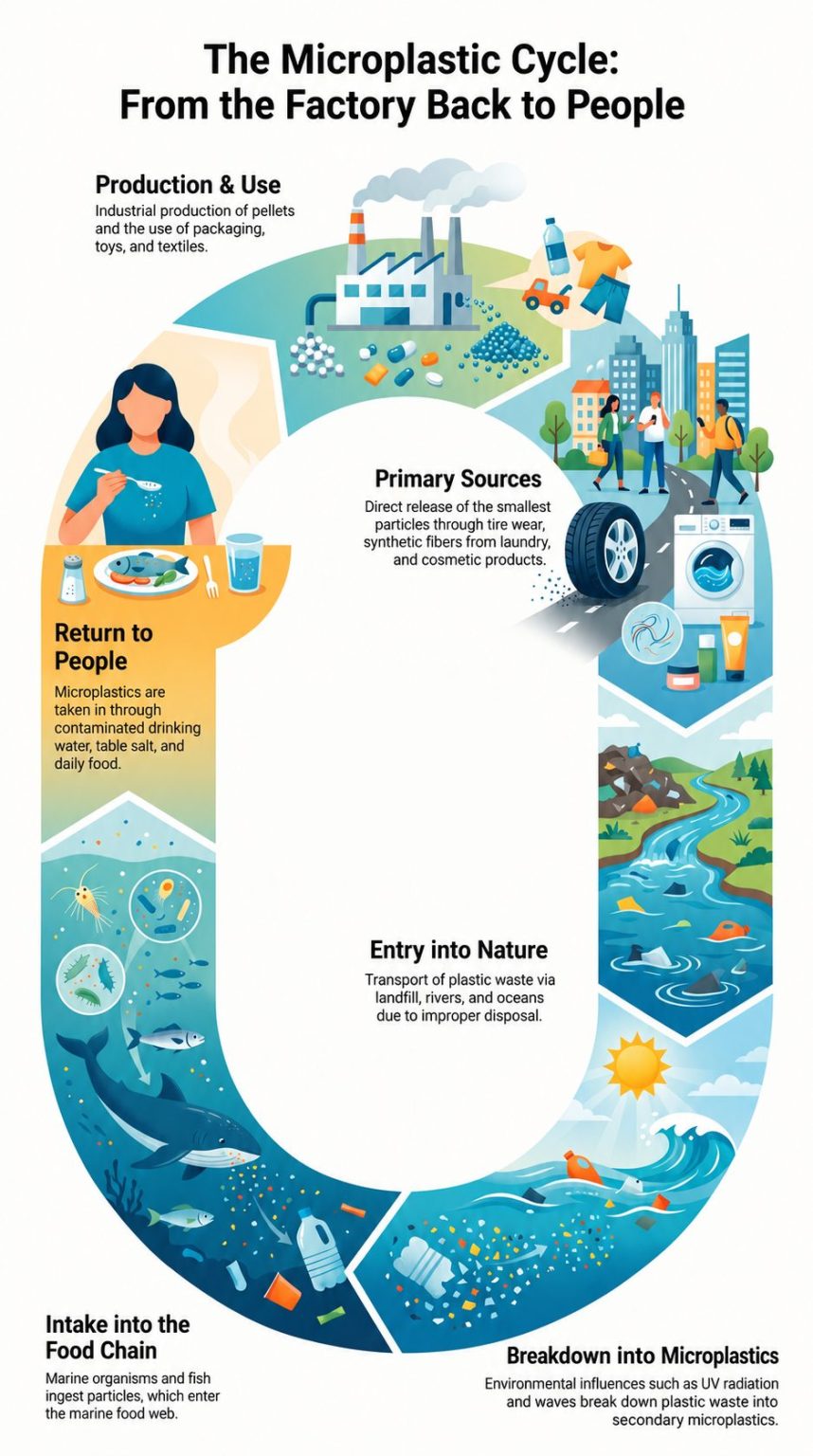
Microplastics are a ubiquitous reality in our environment and our bodies. The life cycle of these tiny particles can be divided into three categories based on their origin:
- Primary microplastics (intentionally manufactured): These include plastic pellets from industry and tiny particles in cleaning products. To prevent loss during transport, companies must now follow strict safety regulations. Those who process large amounts of material must have their processes inspected by independent auditors.
- Unintentional microplastics (from abrasion): These particles are unintentionally generated during the use of products. The main sources in 2026 will continue to be tire wear, the wear of shoe soles, and synthetic fibers washed out of textiles during laundry.
- Secondary microplastics (from degradation): These are created by the breakdown of macroplastics in nature. Plastic bottles, bags, or fishing nets are broken down into smaller and smaller fragments over decades by UV radiation, wind, and waves.
Consumption and Absorption: It’s Already Inside Us
Every day, people unknowingly ingest microplastics through food, drinking water, and the air we breathe. These tiny particles can cross biological barriers: After initial studies detected plastic in the blood of 77% of participants, more recent analyses have already shown detection rates of nearly 90%. In addition to the lungs and intestines, researchers are now documenting the particles in arterial deposits and even in human brain tissue.
It is not only the particles themselves that are dangerous, but also the chemicals they contain, such as plasticizers or bisphenol A (BPA). These substances disrupt our hormonal balance. They are suspected of triggering chronic inflammation, interfering with fertility, and contributing to diseases such as diabetes or cancer.
Disposal: The Path to the Environment
Not all plastic waste is recycled. Large quantities are incinerated. A significant portion ends up directly in the natural environment through littering or tire wear – with serious consequences for our agriculture:
- The problem with agricultural films: Plastic films used in fields (e.g., in asparagus cultivation) tear easily. The remnants break down in the soil into microplastics. This destroys the soil’s ability to retain water. Additionally, crops such as grains or vegetables absorb the plastic through their roots.
- The sewage sludge trap: Sewage treatment plants filter almost all microplastics out of wastewater. The particles then accumulate in the sewage sludge. When this sludge is spread on fields as fertilizer, tons of plastic end up in our soil.
The Perfect Cycle: How We’re Doing Better Today
A perfect cycle means that no more microplastics end up in the environment. The focus is on three key areas:
- Business & Technology: Industry is increasingly turning to advanced, AI-powered recycling technologies. Innovative sorting systems use artificial intelligence to precisely separate hard plastic flakes by polymer type and color. Purely dry mechanical processes prevent microplastics from being washed into the wastewater sub-cycle via the wash water.
In agriculture, certified fully biodegradable mulch films are increasingly replacing the old PE films. Additionally, the European textile strategy is compelling manufacturers to apply the “design for recycling” principle: clothing must be more durable, shed fewer fibers during washing, and companies must cover the subsequent disposal costs through extended producer responsibility.
- Laws & Regulations: To prevent the “sewage sludge trap,” the German Sewage Sludge Ordinance is phasing out the use of sewage sludge as agricultural fertilizer and pushing operators toward single-fuel incineration. At the EU level, REACH restrictions ban the use of microplastics in cosmetics (phased in starting in 2027) and as infill material on artificial turf fields (starting in 2031). At the same time, the CLP hazard classes require manufacturers to strictly label hormone-disrupting or persistent substances.
The EU Packaging Regulation (PPWR), effective August 2026, will also bring about a major shift: It forces companies to drastically reduce packaging waste and completely bans the use of hazardous, long-lasting PFAS chemicals in food packaging.
- Consumers: End users directly influence demand through their consumption habits. In everyday life, individuals can reduce their personal footprint by specifically purchasing clothing made from pure natural fibers and choosing loose food items over elaborate plastic packaging. Consciously avoiding cleaning, laundry, or detergent products that contain liquid plastics or synthetic polymers as additives also helps protect wastewater.
Conclusion
Avoiding microplastics is a task for the century – and once released, particles may never disappear from the environment. Manufacturers and consumers must therefore avoid plastic as much as possible, switch to reusable or biodegradable materials, and sort waste properly. Only through proper disposal can we prevent at least large plastic waste from ending up in nature and ensure that some of the plastics are recycled or incinerated under strict filtration requirements. Nevertheless, this shows that prevention remains the most important measure, as even recycling facilities can release microplastics.
Contact us for comprehensive advice on your compliance issues regarding electrical and electronic equipment, packaging, batteries, and PV panels.
 www.ecopv-eu.com/en/contact/ |
  E-Mail: info@ecopv-eu.com
 Supported over 20,000 customers with EPR compliance
Rated 5.0 on Google
Contact
We look forward to your message!