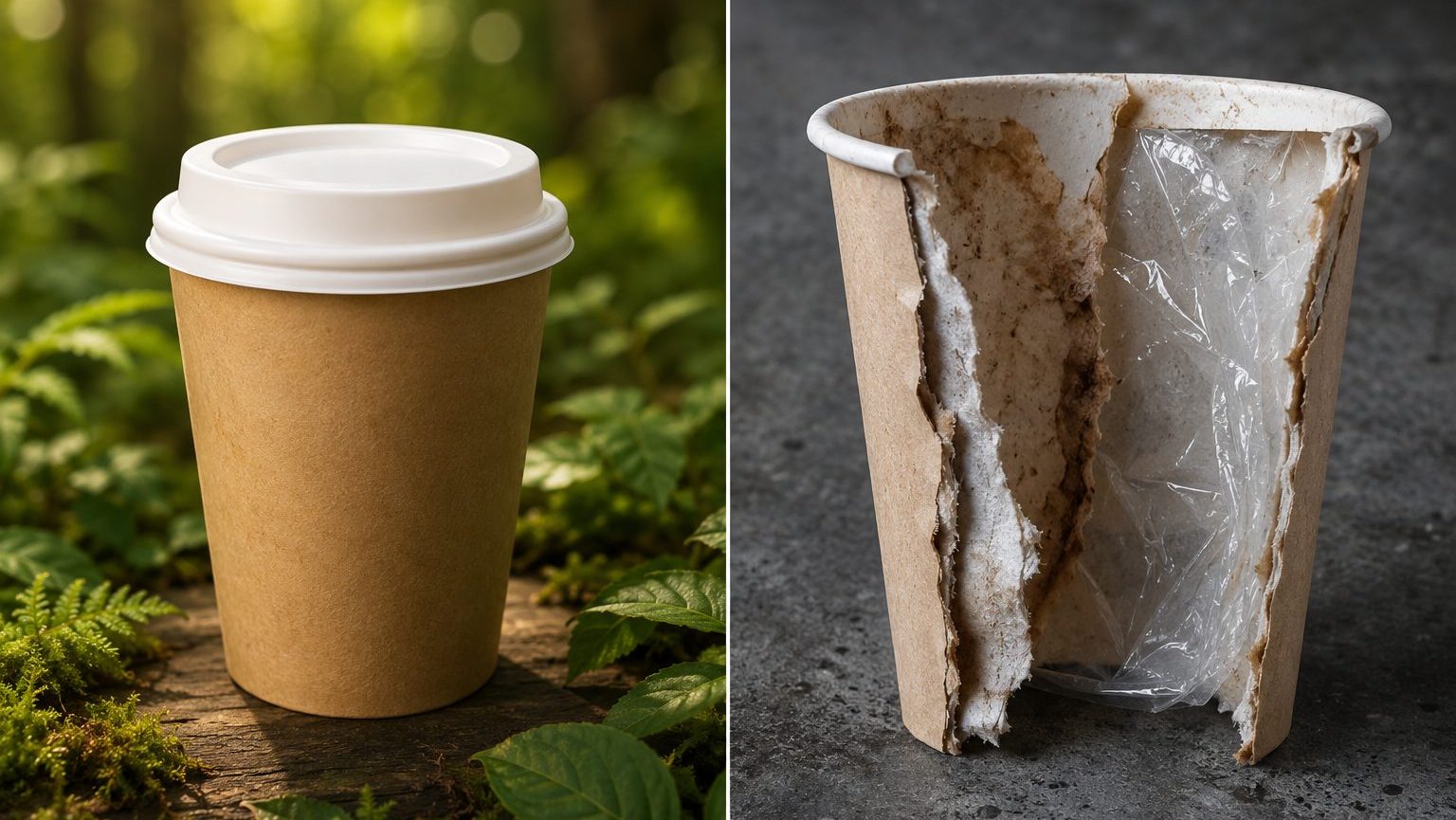
We’re all familiar with takeout cups labeled “eco-friendly” or “sustainable.” But beneath that supposedly green exterior, there’s almost always a wafer-thin plastic coating.
The reason: Without this barrier, the cardboard would immediately soften from the hot liquid, causing the cup to leak.
Even so-called “bioplastic” (PLA) made from cornstarch often doesn’t live up to its promises: In the natural environment, it lasts for decades because the conditions for biodegradation are lacking. On top of that, printing inks and adhesives often contain mineral oil.
The problem: Paper cups almost always end up in incinerators
No matter which bin you throw a conventional paper cup into – it almost always ends up being incinerated:
- In the paper bin: Sorting facilities immediately identify the composite material of paper and plastic as a contaminant. It is sorted out and sent to waste incineration.
- In the yellow bin: Here, too, recycling is theoretically possible but fails in practice. There is a widespread lack of specialized facilities capable of separating these firmly bonded layers.
The result: In the end, waste management companies are usually left with only thermal recovery – that is, incineration.
What’s helping – Mandatory reusable containers:
Restaurants and cafes are required to offer reusable alternatives or their own refill/reusable systems in addition to single-use cups.
What’s expected to help in the future:
Regulations are being tightened drastically in Germany and the EU:
- End to greenwashing starting September 27, 2026: Vague advertising claims such as “environmentally friendly” or “climate neutral” are prohibited under the EmpCo directive, unless they can be substantiated by state-recognized eco-certificates (such as the EU Ecolabel).
- Strict PFAS ban starting August 12, 2026: The EU Packaging Regulation (PPWR) will almost completely ban harmful, grease- and water-repellent PFAS chemicals from food packaging through strict limit values.
- PPWR recycling requirement: Starting in August 2026, all packaging must have a declaration of conformity. By 2030, all packaging must be 70% recyclable – making it so that single-use composite materials that are difficult to separate will gradually be phased out of the market.
Conclusion
Disposable coffee cups are typically made of plastic-coated composite materials and are almost exclusively incinerated rather than recycled in everyday use.
The EU regulations taking effect in late summer 2026 (PPWR and EmpCo Directive) do not immediately ban this practice, but they do increase pressure on the industry: Vague environmental promises and harmful substances like PFAS are being phased out, while stricter recycling requirements are making single-use designs uneconomical. The goal is to steer the market away from single-use plastics toward reusable systems.
Contact us for comprehensive advice on your compliance issues regarding electrical and electronic equipment, packaging, batteries, and PV panels.
 www.ecopv-eu.com/en/contact/ |
  E-Mail: info@ecopv-eu.com
 Supported over 20,000 customers with EPR compliance
Rated 5.0 on Google
Contact
We look forward to your message!