The smartphone is our daily companion. But when the battery capacity declines, the entire device often becomes unusable. The EU Battery Regulation (EU) 2023/1542 addresses this very issue to drastically extend product lifespan and reduce electronic waste.
What takes effect in February 2027?
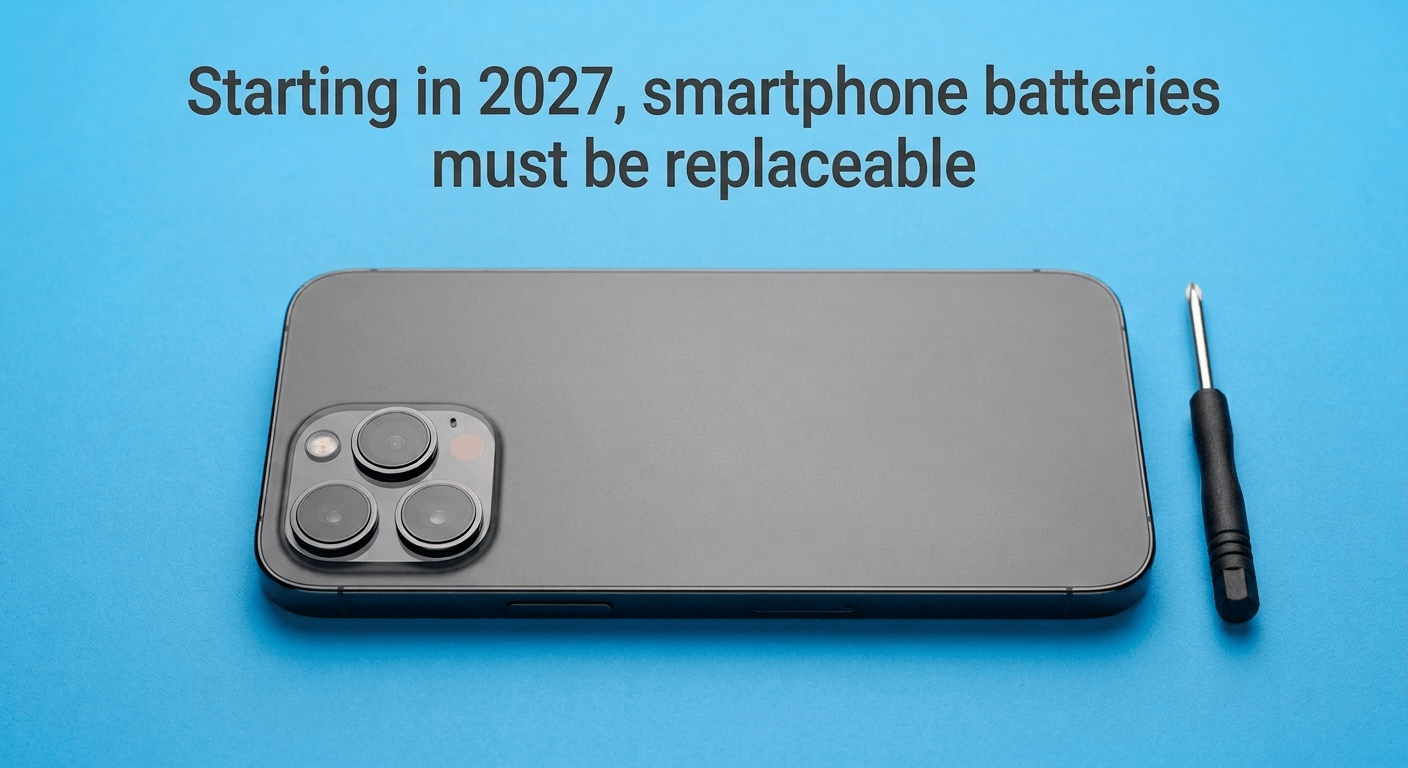
Article 11 stipulates that portable batteries built into devices must, in principle, be removable and replaceable by the end user. This applies to products newly introduced to the EU market starting this month.
The specific design requirements:
- Tools: Replacement must be possible using commercially available tools or tools provided free of charge.
- No barriers: Proprietary special tools or permanent adhesives that block the device cover are prohibited.
- Spare parts guarantee: Replacement batteries must be available for at least 5 years after the model is discontinued.
Do smartphones now have to have a removable battery cover again?
No. Manufacturers are not required to use a retro design. The casing can remain compact as long as the battery can be removed without damaging the device.
Exceptions for certain smartphones: Through the parallel EU Ecodesign Regulation, smartphone manufacturers can circumvent the requirement for end-user battery replacement. If the device achieves full protection against water and dust (at least IP67) and the battery is particularly long-lasting (depending on the option, ≥ 80% or 83% capacity after 500 and 1,000 cycles, respectively), it is sufficient for the battery to be replaceable by independent specialized service providers rather than by the end user.
Why is this so difficult for manufacturers to achieve?
A battery must retain at least 80% of its original capacity after 1,000 charging cycles. At the same time, the smartphone must offer a high level of protection against water and dust.
This presents manufacturers with a challenging task: they must combine long battery life, a compact design, durability, and water resistance. Development therefore extends beyond the battery itself. Cell chemistry, charging electronics, thermal management, and the overall product design are also becoming increasingly important.
The alternative: Manufacturers are increasingly focusing on customer-friendly product designs that make it easier for end users to replace the battery. The new regulation thus directly steers product development toward maximum repairability.
What other exemptions apply?
- General exemptions: Medical imaging devices, devices for wet environments, or systems designed to ensure data integrity.
Through a delegated act, the European Commission has now also established the following exemptions:
- Wearables: Waterproof, washable, dust- or shock-resistant devices (e.g., smartwatches) as well as models that are too compact for users to replace the battery.
- In vitro diagnostic devices: Medical laboratory devices for sample analysis.
- Certain toys: Devices whose design does not allow for safe battery replacement (temporarily valid until July 31, 2030).
- Wireless food thermometers: Wireless probes for kitchen and food service use.
- Explosion-proof products: Devices falling within the scope of Directive 2014/34/EU.
- Wearable medical devices: Automatic dosing systems such as insulin or pain medication pumps.
- Rugged telematics devices: Roof-mounted systems for harsh conditions in the agricultural and construction industries.
Conclusion for the Industry
The regulation forces manufacturers to rethink their product design. Those who intelligently combine long-lasting batteries with repairability will secure a decisive competitive advantage in the European market.
Contact us for comprehensive compliance consulting on electrical equipment, batteries, packaging, and PV panels – and subscribe to our newsletter to stay up to date on laws and trends.
 www.ecopv-eu.com/en/contact/ |
  E-Mail: info@ecopv-eu.com
 Supported over 20,000 customers with EPR compliance
Rated 5.0 on Google
Contact
We look forward to your message!