The WEEE revision is drawing attention across the electrical waste value chain. Fifteen European organisations have set out joint priorities for reforming the framework. APPLiA published the paper on 12 November 2026. Supporters include DIGITALEUROPE, LightingEurope, WEEE Forum, EERA and FEAD. Their proposals address EU policymakers; they are not new obligations that have already been adopted.
WEEE revision: Why the sector wants change
The signatories argue that too much waste equipment leaves authorised channels through informal collection, illegal exports or inadequate treatment. They want more traceable collection and a reliable supply of high-quality secondary raw materials. The European Commission says the findings of its WEEE evaluation will inform a revision proposal as part of the Circular Economy Act.
The ten priorities at a glance
The joint position paper identifies ten areas for action. In condensed form, it calls for:
- Clear roles: Proportionate legal duties for every actor holding or moving WEEE.
- Stronger treatment standards: Authorisation tied to EN 50625 and EN 50614.
- Realistic material recovery: Account for technical feasibility, volumes, quality and demand.
- Secure collection chains: Prevent theft, scavenging and damage, and address battery fires jointly.
- Digital traceability: Record handovers and harmonise registration and reporting formats.
- National coordination: Establish a value-chain body in each member state.
- Action on online free riders: Involve marketplaces more closely in verification and compliance.
- Comparable conditions for schemes: Financial guarantees, transparent fees and open membership, including for SMEs.
- Effective enforcement: Strengthen national programmes, inspections and cooperation between authorities.
- Alignment with ecodesign: Coordinate the revision with the ESPR while keeping product design and waste management distinct.
WEEE revision: The focus on online marketplaces
For sellers, the registration-check proposal is particularly relevant. Marketplaces would verify third-party sellers’ EPR registration before allowing a listing, for example by checking registers. Where registration cannot be confirmed, they should refuse or remove the offer, or undertake the relevant producer obligations. The paper also seeks to retain authorised representatives where applicable and ensure appropriate take-back arrangements in online retail.
The objective of registering once and using one reporting format is likewise a reform proposal. It does not remove the need to assess current obligations separately in each sales country. Digital tracking of waste handovers should also be distinguished from producer registration: the two serve different functions, even where interoperable systems could help reduce duplicated reporting.
What companies should do now
The eventual legal framework, transition periods and application date depend on the legislative process. The position paper does not establish a binding start date. Businesses should therefore use the WEEE revision as a reason to review compliance, rather than act as though the proposed changes already apply.
Check product categories, distribution channels, registrations and evidence for every target market. For Germany, review the relevant stiftung ear entries and any requirement for an authorised representative. Keep registration data, reports and internal responsibilities up to date, and document arrangements with collection and treatment partners.
ECOPV-EU supports WEEE registration, authorised representation and reporting across the EU. This article provides general information and does not constitute legal advice.
Sources: Joint position / Orgalim; APPLiA, 12 November 2026; European Commission; RETEMA, 16 November 2026. Checked on 17 November 2026.
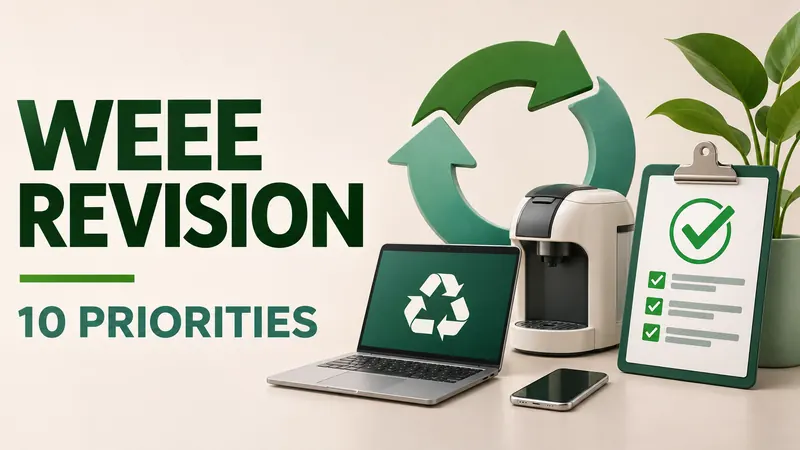
AI-generated concept illustration; it does not depict new rules already adopted.
Contact
Questions about packaging, battery or electrical equipment compliance? We look forward to hearing from you.
Frankfurter Str. 70–72
65760 Eschborn, Germany