

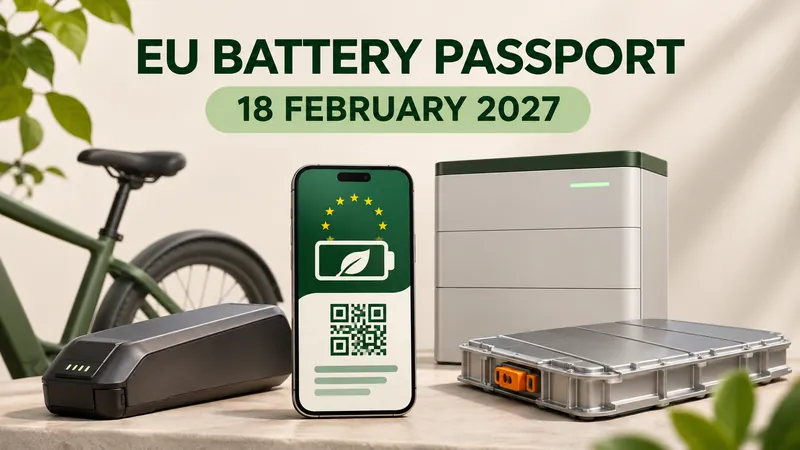
The EU battery passport becomes mandatory for certain battery categories from 18 February 2027. With around three months left, manufacturers and importers should prepare their data and processes. The key questions are which battery is involved and when it is placed on the EU market or put into service. Articles 77 and 78 of the EU Batteries Regulation (EU) 2023/1542 provide the legal framework.
A Minespider announcement of 17 November 2026 offers a practical example: BMZ has selected the provider to integrate digital passports into production in Germany and Poland. Preparation therefore involves more than adding a label.
Which batteries need an EU battery passport?
Article 77 covers the following batteries placed on the market or put into service from the deadline:
- Light means of transport (LMT) batteries, such as e-bike and e-scooter batteries;
- Industrial batteries with a capacity greater than 2 kWh;
- Electric vehicle batteries.
The greater-than-2-kWh threshold applies to industrial batteries, rather than to all three categories. Stationary storage products need to be classified correctly. Ordinary portable batteries in phones, laptops and remote controls do not require a passport under this provision.
There is no general requirement to retrofit every battery already in use. However, repurposing or remanufacturing can trigger separate requirements. The actual operation and the characteristics of the finished battery matter.
EU battery passport and QR code: different requirements
Article 13(6) generally requires all batteries to bear a QR code from 18 February 2027. For the passport categories, it links to the battery passport; for other batteries, it gives access to the applicable required information. A QR code therefore does not automatically mean that a full passport is needed. Placement must follow Article 13, including its provisions where marking the battery itself is technically impossible.
Article 11 on the removability and replaceability of portable and LMT batteries also becomes applicable on that date. Different requirements and exceptions apply. It does not mean that end users must be able to remove every battery themselves.
Data, responsibility and outstanding details
The EU battery passport connects a unique identifier to battery information. Annex XIII covers manufacturer, material, performance and circularity information, with different access levels. Not all data are public. The Commission publishes guidance and battery passport data point lists.
Responsibility rests with the economic operator placing the finished battery on the market or putting it into service. For imported products, this may be the importer. Practical tasks can be delegated in writing without transferring ultimate legal responsibility. An ordinary retailer does not automatically need to create a second passport.
The Commission’s official FAQ describes the detailed arrangements for access to restricted data as still under development. Not every planned field becomes mandatory in February 2027: underlying carbon footprint obligations, for example, have their own application dates. Outstanding details do not justify suspending preparations for the passport.
What businesses should prepare now
- Identify the category, capacity and market-placement date for each battery.
- Establish the responsible economic operator and data suppliers.
- Map required information against the current official data point list.
- Test identifiers, QR access, permissions and technical implementation.
- Review registration, take-back and other EPR duties independently of the passport.
ECOPV-EU supports battery registration, producer responsibility and reporting in European markets. This article provides general information and does not constitute legal advice.
Sources: EU Batteries Regulation, particularly Articles 11, 13, 77, 78 and 96 and Annex XIII; Commission information and FAQ; Minespider announcement, 17 November 2026. Checked on 19 November 2026.
AI-generated concept illustration; the QR code shown is illustrative only.
Contact
Questions about packaging, battery or electrical equipment compliance? We look forward to hearing from you.
Frankfurter Str. 70–72
65760 Eschborn, Germany