Do you know what happens to your old smartphone after you turn it in?
There is much more work and value behind the recycling of electronic devices than meets the eye:
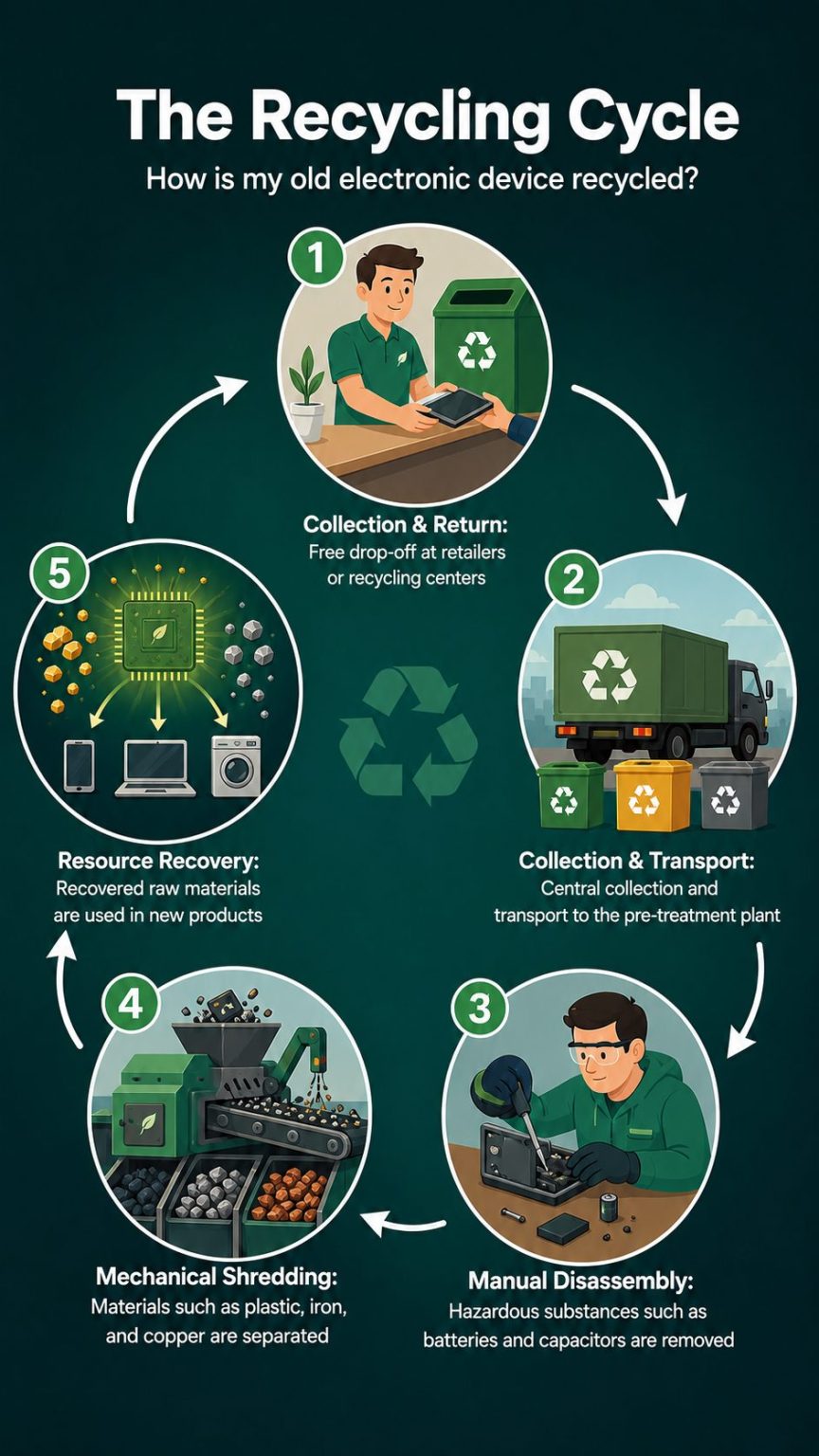
- Step 1 – Collection & Return
Free drop-off at recycling centers or retail stores. Retailers with 400 m² or more of retail space (including online) and discounters with 800 m² or more of retail space are legally required to accept returns.
- Step 2 – Sorting & Transport
Devices are sorted by category and safely transported to certified primary treatment facilities. Special attention is paid to fire safety when handling batteries.
- Step 3 – Manual Disassembly
Specialists manually remove hazardous components such as batteries or display units. Components that are still functional are sorted out for refurbishment.
- Step 4 – Mechanical Shredding
High-performance shredders break down the remaining material. Magnets, screens, and air separation systems precisely sort iron, non-ferrous metals (copper, aluminum), and plastics into material groups.
- Step 5 – Raw Material Recovery
Precious metals such as gold, silver, and platinum are extracted from the circuit boards at high temperatures. Recycling e-waste is up to 95% more energy-efficient than extracting these raw materials through primary mining.
But recycling alone is not enough
According to the Global E-waste Monitor, only about 22% of electronic waste worldwide is officially recorded and recycled. A significant portion of end-of-life electronic equipment is not recycled properly; instead, it disappears from official collection channels and is illegally exported to developing countries or mistakenly ends up in household waste and is incinerated.
The solution: consistent extended producer responsibility (EPR)
In Germany, the ElektroG and the EU-wide WEEE Directive regulate the free take-back and proper disposal of end-of-life devices by manufacturers. In addition, the international standard IEC 63395 sets global standards that clearly prioritize the repair and reuse of e-waste over pure recycling.
The EU’s upcoming “Digital Product Passport” will also create the necessary transparency by comprehensively documenting the material composition and recycling pathways of every device.
And on the consumer side?
According to a YouGov study (2023), sustainability and data protection are gaining importance, while brand names and model freshness matter less. Internationally, this eco-conscious trend is particularly pronounced among Gen Z (33%) and those over 55 (34%) as a key purchasing criterion for electronics.
Conclusion
The use of resources through recycling is currently ineffective, as too many devices are disposed of in an uncontrolled manner. A sustainable system requires a combination of stricter standards, legal requirements, and conscious consumption to secure raw materials for a sustainable circular economy.
Contact us for comprehensive advice on your compliance issues relating to electrical and electronic equipment, packaging, batteries, and PV panels.
 www.ecopv-eu.com/en/contact/ |
  E-Mail: info@ecopv-eu.com
 Supported over 20,000 customers with EPR compliance
Rated 5.0 on Google
Kontakt
Wir freuen uns auf Ihre Nachricht!