Black mass from battery recycling is in the spotlight of European raw materials policy. According to a Financial Times report of 26 November 2026, the EU is considering tighter export controls to curb flows to China. Businesses should distinguish the measures: an updated waste classification has already been adopted, while additional export restrictions remain a policy discussion.
What black mass is and why it matters
Mechanical or thermal treatment of waste batteries produces intermediate fractions containing electrode materials. The dark mixture obtained from lithium-ion batteries is commonly called black mass. Depending on the battery chemistry, it may contain lithium, nickel, cobalt, manganese and graphite. Not every mixture contains all these materials in the same proportions.
Further processing is needed before recovered materials can return to battery production. Restricting exports alone therefore does not create sufficient European refining capacity. Available plants, investment and viable markets also matter.
Black mass classification: 9 December 2026 is the date
Delegated Decision (EU) 2025/934 updates the European List of Waste. It introduces hazardous waste code 19 14 02* for intermediate fractions from the treatment of lithium-based waste batteries and corresponding battery manufacturing waste.
The date needs particular care: an official corrigendum of 19 August 2025 changes the original wording. The amendments apply from 9 December 2026, rather than November. As of this article’s date, 27 November, that application date is still ahead. This does not mean every black mass shipment is non-hazardous or freely exportable before then; its actual classification still needs checking.
Export controls: China and OECD destinations differ
Article 39 of the Waste Shipment Regulation prohibits exports of hazardous waste for recovery to countries to which the OECD Decision does not apply, including China. The explicit new classification of the covered battery fractions is therefore particularly relevant to those routes.
An OECD destination is not an automatic clearance. Hazardous waste shipments generally require prior written notification and consent, alongside other requirements. The waste type, treatment operation and actual route must also comply.
The Commission’s Battery Booster communication commits to preventing circumvention and, where necessary, further restricting black mass exports. This announcement is not itself an additional adopted export rule. Reports about possible onward flows through OECD countries describe a policy concern, not a general permission for such routes.
What battery producers should check now
The EU Batteries Regulation governs producer responsibility and recycling. Its recycled-content minimums from 18 August 2031 cover specified industrial, electric vehicle and SLI batteries, not all batteries. Overseas treatment counts towards recycling targets only with evidence of equivalent conditions.
Businesses should clarify with their compliance schemes and recyclers:
- Which waste codes and treatment stages apply?
- Where do waste batteries and intermediate fractions actually go?
- Are the necessary permits, consents and evidence available?
- Which European recovery routes would remain available if export rules change?
ECOPV-EU supports battery registration, producer responsibility and reporting across the EU. This article provides general information and does not constitute legal advice.
Sources: Financial Times, 26 November 2026; Decision (EU) 2025/934 and its corrigendum; Regulations (EU) 2024/1157 and 2023/1542; European Commission, Battery Booster. Checked on 27 November 2026.
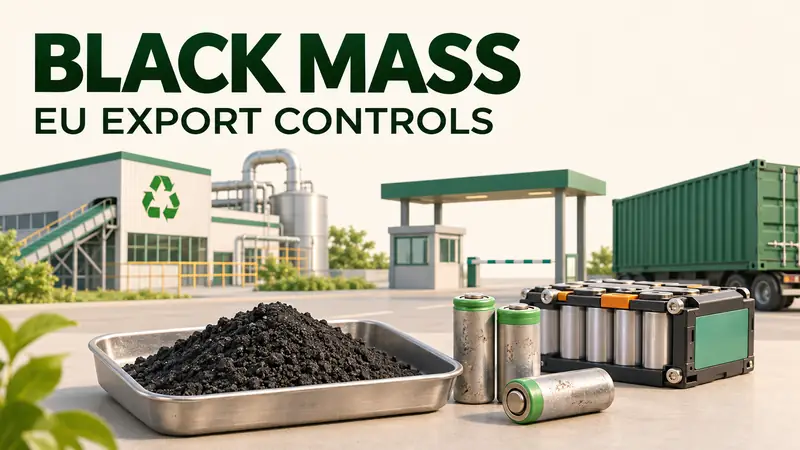
AI-generated concept illustration of black mass and export controls, not a worldwide export ban.
Contact
Questions about packaging, battery or electrical equipment compliance? We look forward to hearing from you.
Frankfurter Str. 70–72
65760 Eschborn, Germany