German textile law is back in the political spotlight. Following the Textilwende alliance, the Greens in the Bundestag are seeking stronger economic incentives against short-lived clothing. Reports published on 23 November 2026, referring to Politico, describe a parliamentary group motion. For businesses, the distinction matters: a political motion does not itself create binding contribution rates or immediate product obligations.
German textile law: What the Greens propose
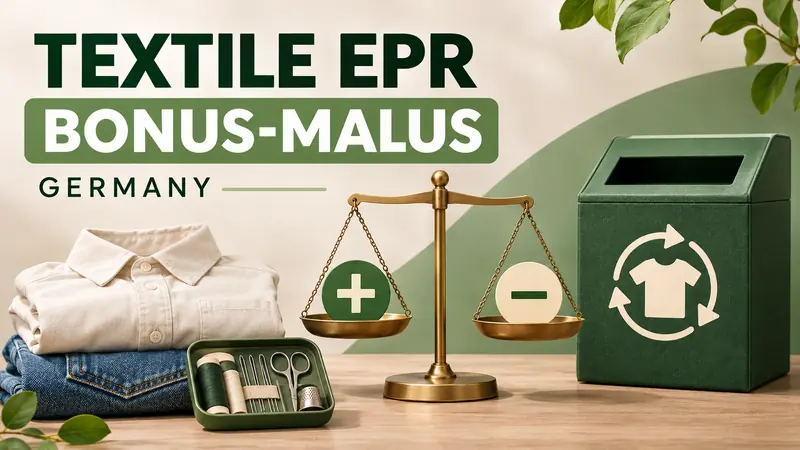
The reported proposal would favour durable, repairable and recyclable textiles through lower producer contributions. Short-lived mass-market goods would attract higher contributions. The requested bonus-malus approach would therefore link the costs of collection and treatment more closely to product characteristics.
The reported political targets for 2040 are:
- 30 percent less textile waste per person compared with 2026;
- reuse or textile-to-textile recycling of at least 70 percent of collected used textiles;
- processing at least a quarter of that within 1,500 kilometres of the collection location.
The reports also describe a transformation fund. These are demands for future policy, rather than obligations already in force. They do not mean that every individual retailer must currently achieve a 70-percent rate or that specific surcharges have been adopted.
Political debate and the legislative process
According to the reports, MP Julia Schneider is pressing for faster progress on the German textile law. The initiative is directed at the federal government. Business planning should distinguish political demands, ministry key points, any subsequent bill and legislation that has actually been adopted.
The Federal Environment Ministry published key points on 27 March 2026 for introducing extended producer responsibility. Such a policy paper helps shape the future system; it does not by itself establish applicable fee schedules. A firm cost forecast based only on the current debate would therefore be premature.
German textile law: Understand the EU deadlines
Directive (EU) 2025/1892 sets the European framework. Its national transposition deadline is 17 June 2027. The separate deadline for establishing textile and footwear EPR schemes is 17 April 2028. These dates should not be merged into one assumed start date for every business obligation.
The German key points envisage registration, participation in a producer responsibility organisation and contributions based on quantities and environmental criteria. Whether a business qualifies as a producer depends on its actual market role. Imports, private labels and cross-border sales should therefore be assessed separately. Authorised representation should also be reviewed against the final rules and the company’s establishment.
What brands and retailers can prepare now
- Record textiles supplied in Germany by product group, quantity and material.
- Collect traceable supplier information on composition, durability and repairability.
- Clarify responsibilities for private labels, imports and marketplace sales.
- Label fee scenarios as planning assumptions and update them once reliable rules are available.
- Follow the German textile law process and the national EPR systems in relevant markets.
This preparation improves the evidence available even while the final fee structure remains open. ECOPV-EU follows preparations for textile EPR in Germany and supports compliance with existing requirements in other European markets. This article provides general information and does not constitute legal advice.
Sources: Reports of 23 November 2026, including Merkur and dts; BMUKN key points of 27 March 2026; Directive (EU) 2025/1892. Checked on 23 November 2026.
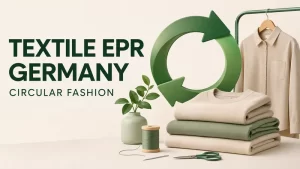
AI-generated concept illustration; differentiated fees are a political proposal, not an adopted tariff.
Contact
Questions about packaging, battery or electrical equipment compliance? We look forward to hearing from you.
Frankfurter Str. 70–72
65760 Eschborn, Germany