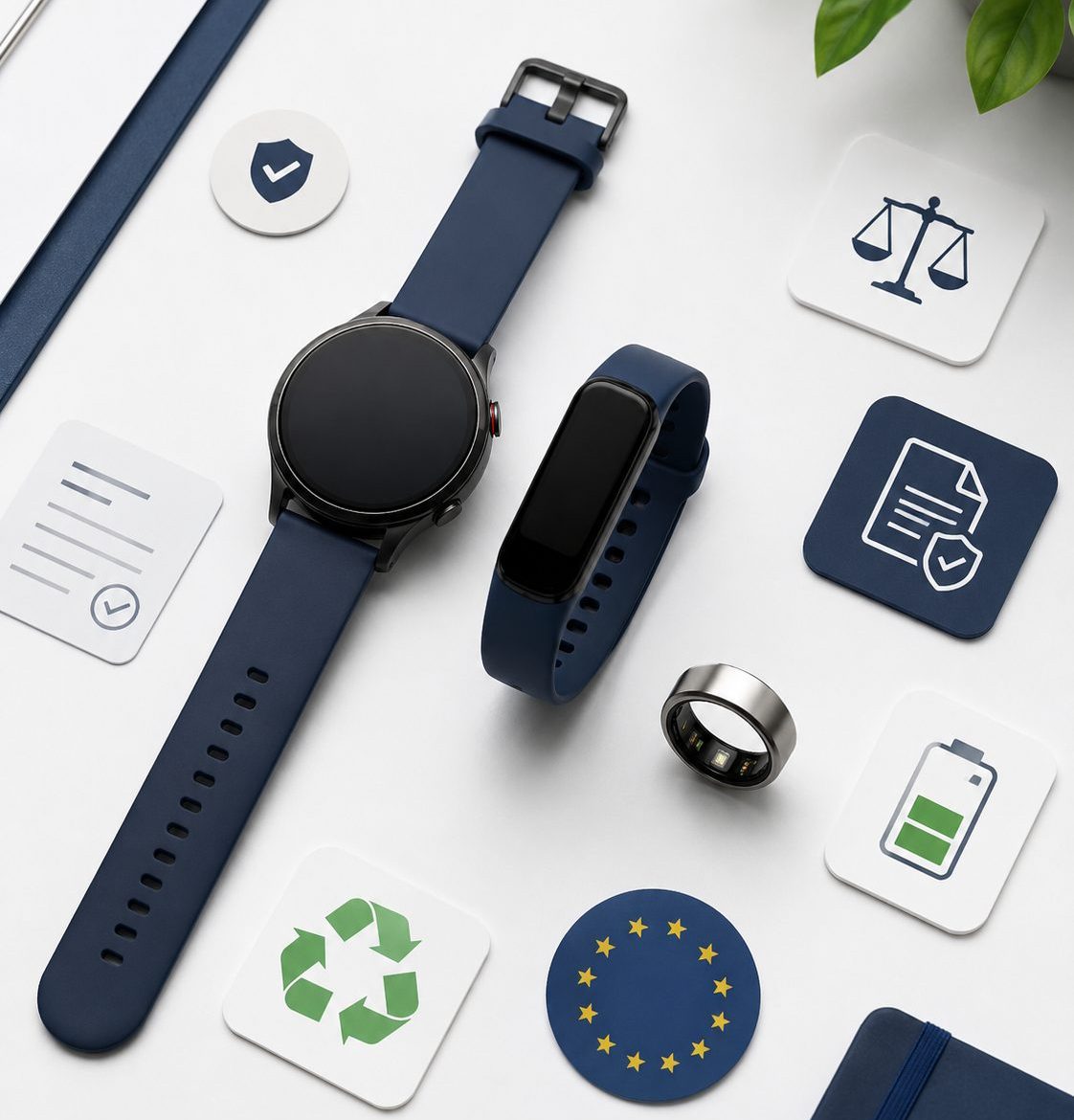
Smartwatches, fitness trackers, and smart clothing are among the fastest-growing product categories. Short innovation cycles, rapid market entry, and international distribution characterize the industry, but they also present complex compliance challenges.
In Germany, wearables are subject to a regulatory “trinity”:
1. ElektroG (WEEE)
Wearables are legally classified as small electrical appliances. Every brand must be registered with the EAR Foundation before the first sale.
- Requirement: Permanent labeling with the “crossed-out wheelie bin” symbol
- Risk: Without a valid WEEE number, automatic blocks on online marketplaces will take effect.
2. BattDG
Started in 2025, the new EU Battery Regulation imposed stricter market controls. Since wearables almost always use lithium-ion batteries, take-back and financing obligations apply.
- Registration requirement: A sales ban applies without proper registration with the EAR Foundation.
- Free take-back: End users must be able to return used batteries nationwide and free of charge.
3. VerpackG
Any company that commercially places packaged goods on the market in Germany must register with the Central Agency for Packaging Registration (ZSVR) via the LUCID portal.
- Licensing (system participation): Shipping packaging (boxes, filling material) and product packaging (the packaging surrounding the product itself) must be licensed through a dual system (license fee).
- Marketplace Check: Amazon and similar platforms are legally required to verify the LUCID number. If this is missing, the product will be blocked from listing.
The requirements mentioned are not a “special regulation” for wearables.
They apply to every manufacturer, importer, and online retailer that places electrical or electronic devices with built-in or included batteries on the market.
Whether it’s an electric toothbrush, a smart kitchen gadget, a cordless tool, or consumer electronics: as soon as a device is powered by a battery or rechargeable battery, the dual registration requirement under the Electrical and Battery Act applies.
Under the law, a manufacturer is anyone who:
- Sells products under their own brand name in Germany.
- Imports products into Germany from abroad for the first time.
- Sells products as a retailer without a registered supplier.
Authorities and marketplaces such as Amazon, eBay, or Otto are significantly tightening their oversight: Without a valid number, sellers face immediate listing bans and fines of up to 100,000 euros.
An integrated compliance approach for ElektroG, BattDG, and VerpackG is no longer an option – it is the foundation for any legally compliant market entry.
Contact us for comprehensive advice on your compliance issues relating to electrical and electronic equipment, packaging, batteries, and PV panels.
 www.ecopv-eu.com/en/contact/ |
  E-Mail: info@ecopv-eu.com
 Supported over 20,000 customers with EPR compliance
Rated 5.0 on Google
Kontakt
Wir freuen uns auf Ihre Nachricht!