The EU plastic waste export ban for non-OECD destinations has applied since 21 November 2026. The European Commission confirmed its start under the Waste Shipment Regulation (EU) 2024/1157. Waste companies and traders face a change to an established outlet. Packaging manufacturers should also distinguish shipping waste from buying recycled plastic as a raw material.
Plastic waste export ban: What is covered?
Importantly, even clean, non-hazardous plastic waste destined for recovery and classified as B3011 may no longer be exported to non-OECD countries. Hazardous and hard-to-recycle plastic waste is subject to other strict rules. The new restriction does not create permission to ship other problematic waste streams.
From 21 May 2029 at the earliest, non-OECD countries may apply to receive certain non-hazardous plastic waste. They must demonstrate environmentally sound management and obtain inclusion on the relevant list. That date therefore does not mean automatic reopening or approval for any particular destination.
OECD exports still require checks
The Commission’s plastic waste guidance explains that exports to OECD countries remain possible in principle but are not exempt from procedures. Since 21 May 2026, prior notification and consent have also been required for clean plastic waste destined for recovery. Classification, destination and treatment operation remain important.
The Commission monitors export flows and environmentally sound treatment. OECD membership alone replaces neither necessary consent nor checks on the receiving facility. Businesses should therefore do more than simply substitute an OECD receiver for an existing non-OECD customer.
Further deadlines: Digital procedures and audits
According to Germany’s Environment Agency, electronic exchange through DIWASS forms part of the rules applying since 21 May 2026. Transitional provisions may matter for older notifications. Check the actual procedural position and the competent authority’s requirements.
From 21 May 2027, additional independent audit requirements apply to permitted waste exports and treatment in facilities outside the EU. Exports of other non-hazardous waste for recovery to non-OECD countries will also be restricted to approved destination countries and waste types. The German Environment Ministry explains these changes. The general destination-list mechanism does not reopen the separately prohibited plastic waste route early.
More waste does not guarantee more recycled plastic
The Commission puts annual EU plastic waste generation at around 40 million tonnes and exports at approximately 1 to 1.5 million tonnes. Important destinations in 2025 included Türkiye, Malaysia, Indonesia, Vietnam and the United Kingdom. These figures describe waste quantities, rather than available supplies of verified recyclate grades.
In its October 2026 market report, recycling federation BIR described subdued demand, limited margins and capacity closures in Europe. Closing an export outlet does not automatically create sorting capacity, suitable material quality or reliable purchase contracts.
Article 7 of the PPWR introduces minimum post-consumer recycled content requirements for plastic packaging, with different categories and exemptions. Timing also requires care: the relevant trigger is 1 January 2030 or three years after the relevant implementing act enters into force, whichever is later. A blanket claim covering every package from 2030 would be inaccurate.
What businesses should do now
- Check waste codes, destination countries, receiving facilities and existing consents for each export route.
- Clarify digital workflows, responsibilities and any applicable transition provisions.
- Prepare audit arrangements for exports that remain permitted.
- Verify origin, quality, evidence and delivery capacity when buying recycled plastic.
- Assess PPWR requirements separately by packaging type and application date.
ECOPV-EU supports PPWR obligations, registration and producer responsibility in European markets. This article provides general information and does not constitute legal advice.
Sources: European Commission, 20 November 2026 and technical guidance; German Environment Agency and Ministry; BIR, 12 October 2026; Regulations (EU) 2024/1157 and 2025/40. Checked on 23 November 2026.
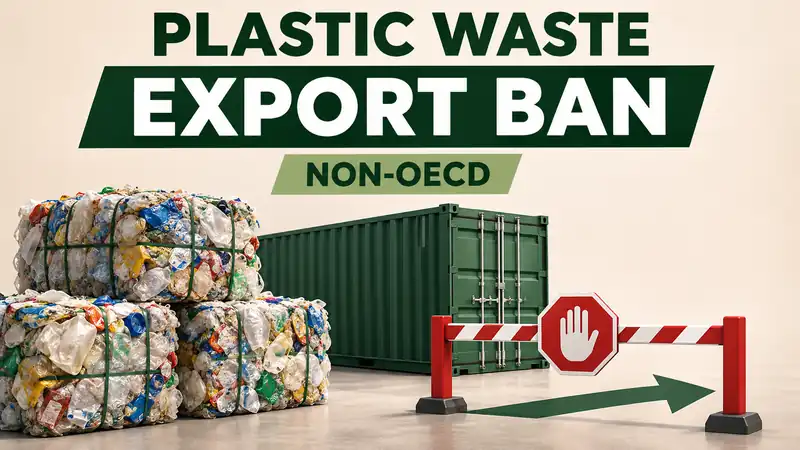
AI-generated concept illustration of restrictions on plastic waste exports, not a general ban on plastic products.
Contact
Questions about packaging, battery or electrical equipment compliance? We look forward to hearing from you.
Frankfurter Str. 70–72
65760 Eschborn, Germany