The “Disposal Wave”: What Happens to Our Solar Panels After 30 Years? ☀️♻️

Millions of photovoltaic modules are gradually reaching the end of their service life after about three decades.
But how does large-scale recycling work in practice?

What does modern PV recycling look like?

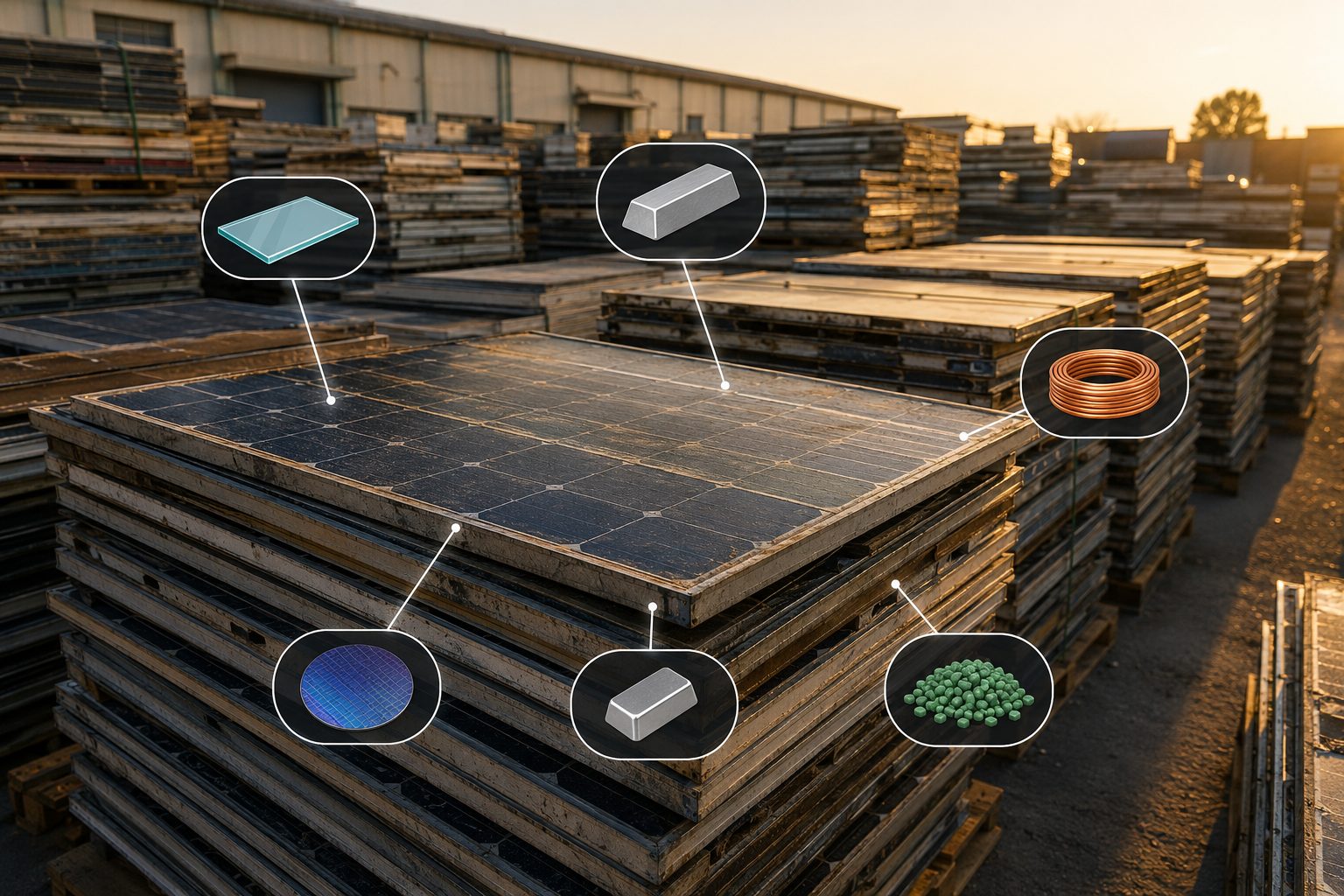
A standard module consists of about 95% recyclable materials. The biggest challenge lies in separating the solar cells from the durable plastic film (EVA):

  • Mechanical & Thermal: Traditionally, the frame and junction box are dismantled. The remaining module is shredded, or the film is burned in an energy-intensive pyrolysis process.
  • Innovative: Future technologies such as flash lamp annealing or laser-based separation (TNO) heat the boundary layers in milliseconds. The film dissolves without chemicals and with up to 95% less energy.

Urban Mining on the Roof: Recovery

  • Metals & Glass: Aluminum and copper are returned to the smelters without any loss of quality. The glass is processed into insulation materials or, in the future, reprocessed into high-quality flat glass.
  • Silicon & Silver: While shredding contaminates the silicon to the point of rendering it unusable, innovative thermomechanical processes cleanly separate the module structure into individual components. This allows valuable silver to be precisely recovered for the economic cycle, while the recovered silicon is available as a high-quality secondary raw material for metallurgy.

Global Perspective & Environmental Benefits

Through the WEEE Directive, the EU mandates a collection rate of 85% and a material recycling rate of 80%. China, which accounts for 85% of global production, is increasingly relying on its own local recycling concepts, as long-distance return transport is economically unfeasible.

  • Energy & Environment: Recycling saves massive amounts of energy compared to primary extraction. Additionally, the recycling process ensures that hazardous substances such as lead or cadmium are reliably isolated.

Outlook: “Safe and Sustainable by Design”

The next generation of PV technology is firmly committed to “Design for Recycling.” The focus is on perovskite semiconductors – an artificial crystal structure that absorbs sunlight extremely efficiently. Applied as an ultra-thin layer on silicon modules, these “tandem solar cells” massively increase performance. However, since these layers contain lead due to the materials used, safe recyclability is essential.

Researchers are therefore already developing suitable recycling methods for isolating hazardous substances, while upcoming EU ecodesign requirements mandate separability as early as the development stage.

EPR Germany: Do you have questions about your PV compliance?


Whether it’s mandatory EAR registration, proof of an insolvency-proof guarantee, or the immediate initiation of pickup when containers are full – we support manufacturers in meeting their legal obligations!

Contact us!


📩www.ecopv-eu.com/en/contact/ | 📧 E-Mail: info@ecopv-eu.com 


⭐ Supported over 20,000 customers with EPR compliance

⭐ Rated 5.0 on Google


Contact

We look forward to your message!

info@ecopv-eu.com

+49 6196 5835357

Frankfurter Str. 70-72
65760 Eschborn

Leave a Reply

Your email address will not be published. Required fields are marked *