The concept of “Zero Waste Cities” emerged from the realization that traditional waste management has reached its limits. Rising waste volumes and limited space call for a shift in thinking. Cities play a central role in this, as they are both the primary generators of waste and drivers of innovation. After all, cities consume about 75% of global resources and produce 50% of the world’s waste.
But what defines a Zero Waste City?
Almost every city sorts waste today, but Zero Waste Cities go a decisive step further: They start at the beginning of the chain (prevention and design) rather than just at the end (disposal). San Francisco and Ljubljana are among the global pioneers. What do they do differently?
- Mandatory laws: In San Francisco, the separate disposal of food waste and recyclables is required by law. Through systematic inspections and strict enforcement against improper disposal, the city achieves one of the highest recycling rates in the world: Over 80% of waste is successfully kept in the cycle instead of ending up in landfills. The collected food waste is processed in industrial facilities into nutrient-rich compost, which is reused regionally.
- Financial incentives: Ljubljana uses the “pay-as-you-throw” (PAYT) principle. You only pay for what you actually use. While the collection of recyclables and organic waste is covered by a flat fee, each individual emptying of the residual waste bin costs extra. Since residual waste is expensive and recycling is “free,” residents sort their waste much more carefully to save money. This financial incentive also ensures that people shop more consciously and avoid packaging waste right in the store. Result: A high sorting rate and a significant reduction in waste volume. Within ten years, the city was able to cut per capita residual waste by half. San Francisco is also relying on this principle to achieve its ambitious zero-waste goals.
- Reuse instead of landfills: These cities are promoting local repair networks and resource centers. In Ljubljana, the “Reuse Center” refurbishes old items and sells them at low prices. The goal is to replace the term “waste” with “resource.” Currently, the city already recycles over 70% of its waste – a record high among European capitals.
Resource Management: Food Waste and E-Waste
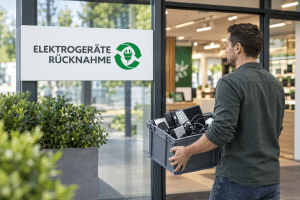
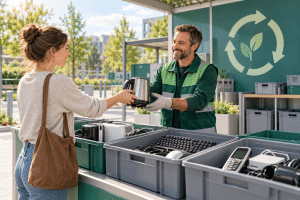
In these cities, food waste is systematically processed into compost or biogas. San Francisco returns this compost directly to regional farmers, thereby closing the nutrient cycle. When it comes to e-waste, the focus is on recovering rare earth metals and extending the lifespan of devices through specialized repair centers.
As of 2026: Challenges and Germany
By 2026, it becomes clear: Zero Waste is an ongoing process. Complex material flows and high infrastructure costs remain challenges. In Germany, too, the movement has gained massive momentum: While Kiel has already become the first German city to be officially certified, major cities like Munich and Berlin are focusing on systematic waste prevention through their own specialized departments and action weeks. Nevertheless, heavy reliance on waste-to-energy plants often delays the transition to a purely circular economy.
Benefits for Business and Lifestyle
Zero Waste reduces costs by preventing waste from being generated in the first place: Companies save twice over, as they need to purchase fewer raw materials and avoid expensive fees for residual waste disposal. While recycling is often costly, consistent waste prevention leads directly to higher profitability. At the same time, the quality of life in cities improves thanks to reduced pollution. For people, this means lower waste disposal fees and financial savings through more conscious consumption.
Conclusion
Zero Waste is not a distant ideal, but an economic strategy for greater efficiency. The success of pioneering cities shows that the shift from costly disposal to smart resource conservation both protects the environment and eases the financial burden on citizens and businesses.
Contact us for comprehensive compliance consulting on electrical appliances, batteries, packaging, and solar panels – and subscribe to our newsletter to stay up to date on the latest laws and trends.
 www.ecopv-eu.com/en/contact/ |
  E-Mail: info@ecopv-eu.com
 Supported over 20,000 customers with EPR compliance
Rated 5.0 on Google
Kontakt
Wir freuen uns auf Ihre Nachricht!