

Section 15b UWG addresses a practical question for retailers: what happens to old stock with problematic environmental claims that was placed on the market before 27 September 2026? The new EmpCo rules for consumer marketing have applied since that date. The special provision does not automatically allow stock to be sold off. It requires proportionate enforcement of specified claims and an assessment of the individual case.
What Section 15b UWG actually regulates
The wording of Section 15b UWG concerns claims for removal and injunctions under Section 8(1) arising from expressly listed infringements. These include certain statements about environmental or social characteristics, durability, repairability and recyclability, and certain sustainability labels. The provision does not cover every possible unfair-competition infringement.
For goods placed on the market before 27 September 2026, enforcement must reflect good faith and proportionality. The statute identifies four factors in particular:
- Seriousness: What is the specific infringement or misleading impression?
- Remedial efforts: What has the business already done to correct it?
- Remediation costs: What would the available corrective measures cost?
- Environmental burdens: What consequences would follow, for example, from disposing of usable goods?
The legislative materials describe possible outcomes: additional information requirements, a specific sell-off period for particular products, or exclusion of an injunction where its effects would be disproportionate. None is automatic. A prohibited claim does not become lawful because the goods are old stock.
When was the stock placed on the market?
Section 15b UWG does not supply its own definition. A warehouse movement or printing date alone should therefore not be treated as conclusive legal proof. Businesses should examine the actual market-supply transaction, including the recipient, date and batch. An internal transfer may differ from supplying a retailer.
Delivery records, invoices and traceable batch data can support that assessment. Whether goods at a wholesaler, on a shop shelf or in transit qualify depends on whether the statutory conditions were actually met before the cut-off date.
What limits remain?
Cease-and-desist warnings and proceedings remain possible. A business seeking a favourable balancing of interests should be able to substantiate its corrective efforts, costs and environmental impacts. The statutory wording also provides no safe blanket exemption for new online product descriptions or advertising campaigns. Those should be reviewed separately.
The special provision introduced through the law of 22 October 2026 is time-limited until 26 September 2028; Section 15b is removed on 27 September 2028. That expiry does not create a general two-year permission to sell off stock.
What manufacturers and retailers should do now
Record stocks and delivery evidence, prioritise problematic statements and assess effective corrections such as over-labelling or relabelling. Keep the measures documented and proportionate.
For new packaging, evidence is not a universal route to permission. Under the UWG Annex, generic environmental claims require the recognised excellent environmental performance specified by the rules. Product claims of neutral, reduced or positive climate impacts based on emissions offsetting are separately prohibited. Evidence alone does not remove that prohibition.
ECOPV-EU supports businesses with packaging compliance in Germany and the EU. This article provides general information and does not constitute legal advice.
Sources: Section 15b UWG; UWG Annex; Federal Law Gazette 2026 I No. 322; Bundestag document 21/8158; Directive (EU) 2024/825. Editorially checked on 4 November 2026.
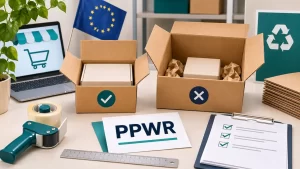
AI-generated concept illustration of a stock review; not an official document or approval of advertising claims.
Contact
Questions about packaging, battery or electrical equipment compliance? We look forward to hearing from you.
Frankfurter Str. 70–72
65760 Eschborn, Germany