Germany’s planned plastic tax is facing growing opposition. In a letter dated 29 October 2026 to Chancellery head Nina Warken, 42 business associations call for the proposal to be stopped. The German Association of System Gastronomy, a signatory, confirms the joint initiative. Participants include BDI, DIHK, VCI, HDE, VDMA and ZVEI, alongside plastics and waste-management associations. For businesses, the key distinction is that the reported timetable and rate remain proposals, rather than an existing payment obligation.
What the plastic tax draft proposes
According to the dpa report of 2 November 2026, a preliminary draft would charge EUR 550 per tonne of plastic in packaging from July 2027. That is EUR 0.55 per kilogram. Reported revenue forecasts are EUR 805 million in 2027 and almost EUR 1.5 billion annually from 2028. The intended legislative route is an amendment to the 2027 Budget Accompanying Act.
The background is Germany’s contribution to the EU plastics own resource. Since 2021, Member States have made budget contributions based on non-recycled plastic packaging waste. This does not itself create an EU tax payable directly by every business. A national plastic packaging tax needs its own legal basis, and its assessment base should not be equated with the EU contribution.
Why businesses oppose the tax
The associations argue that the plastic tax would be unsuitable on fiscal, economic and environmental grounds. Their concerns include:
- Administrative costs: They expect annual business bureaucracy costs in the mid double-digit millions of euros.
- Competitive disadvantages: Additional burdens could weaken businesses operating in Germany.
- Higher consumer prices: In their view, companies would pass costs on to customers.
- Weak investment incentives: They question whether the tax would encourage more sustainable packaging or additional recycling capacity.
These are the signatories’ assessments. If the government pursues the proposal, they want a separate legislative process with an impact assessment, involvement of the relevant ministries and associations, and regular parliamentary scrutiny.
Plastic tax in 2027: No final decision
Handelsblatt reported on 3 November that initial talks between the coalition parliamentary groups had ended without agreement, with the CDU/CSU opposing the draft in particular. The newspaper therefore considers a 2027 launch unlikely. That assessment is not a final cancellation, nor does it establish an agreed postponement date. On the reporting reviewed for this article, the outcome remains open.
What manufacturers and retailers can prepare now
Businesses should follow the legislative process and record packaging materials and weights accurately. For packaging subject to compliance scheme participation, this information is already needed for scheme participation and the applicable LUCID reporting duties. A future tax could require additional data or different classifications. The debate over a new tax also does not remove existing packaging obligations.
ECOPV-EU supports manufacturers and retailers with packaging registration, volume reporting and compliance scheme participation. This article provides general information and does not constitute legal or tax advice.
Sources: BdS, 29 October 2026; dpa, 2 November 2026; Handelsblatt, 3 November 2026; European Commission; Central Agency Packaging Register. Editorially checked on 4 November 2026.
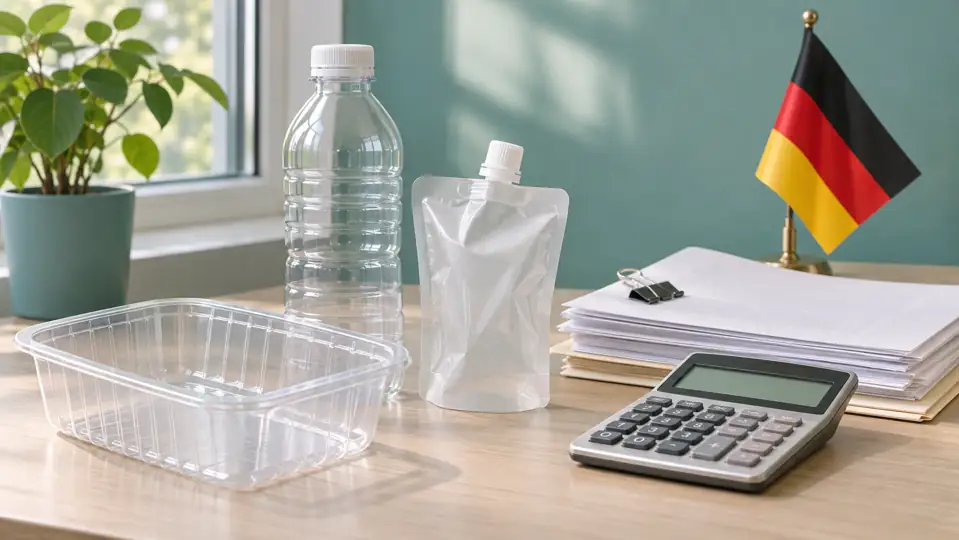
AI-generated concept illustration of the debate over a proposed tax; not an official document.
Contact
Questions about packaging, battery or electrical equipment compliance? We look forward to hearing from you.
Frankfurter Str. 70–72
65760 Eschborn, Germany