Germany’s planned plastic tax faces a strong political rejection. Thorsten Frei (CDU), leader of the CDU/CSU parliamentary group, said on ZDF’s “Berlin direkt” on 8 November 2026 that his group would not introduce it. Deutschlandfunk reports his opposition, based on economic and environmental concerns. However, this political statement does not establish a final legislative outcome. The SPD continues to refer to ongoing negotiations.
Plastic tax: What had been proposed?
The provisional draft described in a dpa report envisaged EUR 550 per tonne of plastic in packaging from July 2027, equivalent to EUR 0.55 per kilogram. That report gives projected revenue of EUR 805 million for 2027 and almost EUR 1.5 billion annually from 2028. Deutschlandfunk instead refers to a budget gap of around EUR 670 million in the current discussion. These different planning figures should not be presented as settled revenue.
The proposed national plastic tax is separate from the EU plastics own resource. Since 2021, member states have paid a contribution based on non-recycled plastic packaging waste. Rejecting a German excise tax does not remove that EU contribution. The EU arrangement also does not automatically impose a direct tax on every packaging retailer.
Why coalition negotiations still matter
According to dpa, SPD parliamentary group leader Matthias Miersch says discussions continue. In a separate dpa report, Environment Minister Carsten Schneider calls for alternative financing proposals. Businesses should therefore distinguish the CDU/CSU’s political rejection from formal completion of the parliamentary process.
The next key date is 12 November 2026. The Federal Court of Auditors identifies it as the date of the budget committee’s final adjustment meeting. The final parliamentary budget deliberations follow afterwards. A committee meeting is not itself equivalent to final adoption of the budget or a separate tax law.
Which packaging obligations remain?
The plastic tax debate does not replace packaging compliance. LUCID registration and other relevant obligations must still be assessed separately. For packaging subject to system participation, those obligations include joining a compliance scheme and reporting volumes. Germany’s Central Agency Packaging Register explains the distinctions; different packaging types do not all carry identical duties.
PPWR requirements must also be considered independently, according to their respective application dates. Environmentally differentiated scheme fees are being discussed as an alternative policy approach. This does not guarantee a particular discount for every recyclable packaging format.
What manufacturers and retailers can do now
- Keep reliable data: record packaging materials, weights and formats.
- Review existing duties: check registration, scheme contracts and reporting against your role and packaging types.
- Update business planning: monitor draft measures and budget decisions without treating unadopted proposals as applicable law.
ECOPV-EU supports manufacturers and retailers with packaging registration, volume reporting and compliance scheme participation in Germany. This article provides general information and does not constitute legal or tax advice.
Sources: Deutschlandfunk, 8/9 November 2026; dpa, 9 November 2026; European Commission; Federal Court of Auditors; ZSVR. BGA background dated 6 November. Checked on 9 November 2026.
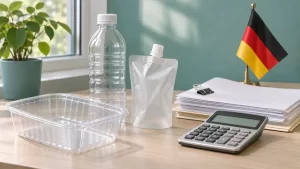
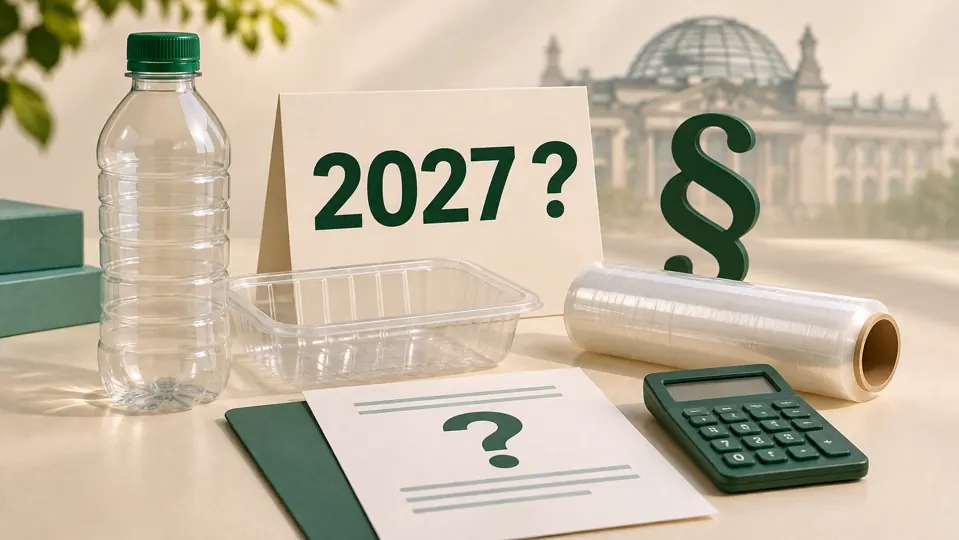
AI-generated concept illustration of the political debate; not a depiction of an adopted tax law.
Contact
Questions about packaging, battery or electrical equipment compliance? We look forward to hearing from you.
Frankfurter Str. 70–72
65760 Eschborn, Germany