Germany’s ecodesign law took effect in its main parts on 1 November 2026. It strengthens national enforcement of European product requirements. Specified infringements can attract fines of up to EUR 100,000, including breaches of the covered software and firmware update rules. However, a smartphone that merely feels slower after an update is not automatically unlawful.
What the ecodesign law says about updates
The German ecodesign law links the existing European product rules with the new framework under Regulation (EU) 2024/1781. Manufacturers, authorised representatives and importers must meet the requirements applicable to their products. Every provision does not automatically apply to every electrical device.
Article 40(5) restricts updates that worsen covered product performance beyond permitted limits. Such a reduction requires the customer’s explicit consent before the update. Even with consent, the product must still meet the ecodesign requirements applicable when it was placed on the market. Relevant test methods and product-specific rules therefore matter more than a subjective impression of slower operation.
Fines and public procurement
For specified infringements, the ecodesign law provides for fines of up to EUR 100,000. That ceiling is not an automatic penalty for every update complaint. Other infringements carry lower ceilings, so the precise statutory provision matters.
Exclusion from public procurement is also conditional. Section 20 refers to a final fine of at least EUR 7,500 for certain listed infringements. Contracting authorities must consider proportionality. Exclusion may last no more than three years from the date the fine becomes final; it is not automatic.
Smartphones and tablets: updates and spare parts
The product-specific requirements under Regulation (EU) 2023/1670 have applied since 20 June 2025. Businesses should check the following points for covered models:
- Updates: Rules on making operating system updates available extend for at least five years after the model is no longer placed on the market. This does not promise unlimited new operating system versions.
- Spare parts: Specified parts, including batteries and displays, must generally remain available for at least seven years after that model-end date. Access for professional repairers and end users depends on the part and applicable conditions.
- Delivery: Specified spare parts generally have a five-working-day delivery limit in the first five years and a ten-working-day limit in the next two years after the model-end date.
- Labelling: The accompanying Regulation (EU) 2023/1669 governs energy labels for covered smartphones and slate tablets, including information on battery endurance and repairability.
These periods do not start with each individual purchase. A buyer of remaining stock may therefore have a shorter support period left.
What manufacturers and retailers should check
Manufacturers and importers should review update testing, consent records, spare-parts supply arrangements and conformity documentation. Retailers must also implement the applicable information and energy-label requirements correctly in online listings.
WEEE, battery and packaging obligations remain separate where they apply to the product and the business’s role. An energy label replaces neither a required stiftung ear registration nor packaging compliance scheme participation.
ECOPV-EU supports businesses with WEEE, battery and packaging compliance in Germany and the EU. This article provides general information and does not constitute legal advice.
Sources: German ÖkodesignG, particularly Sections 17, 18 and 20; Regulations (EU) 2024/1781, 2023/1670 and 2023/1669; European Commission guidance on mobile devices. Checked on 5 November 2026.
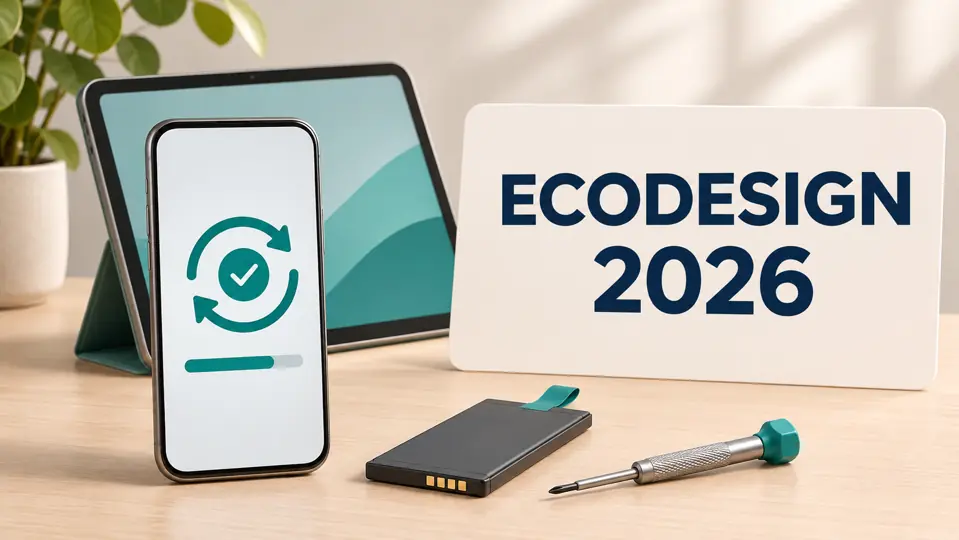
AI-generated concept illustration of updates and repairability; not an official energy label.
Contact
Questions about packaging, battery or electrical equipment compliance? We look forward to hearing from you.
Frankfurter Str. 70–72
65760 Eschborn, Germany