
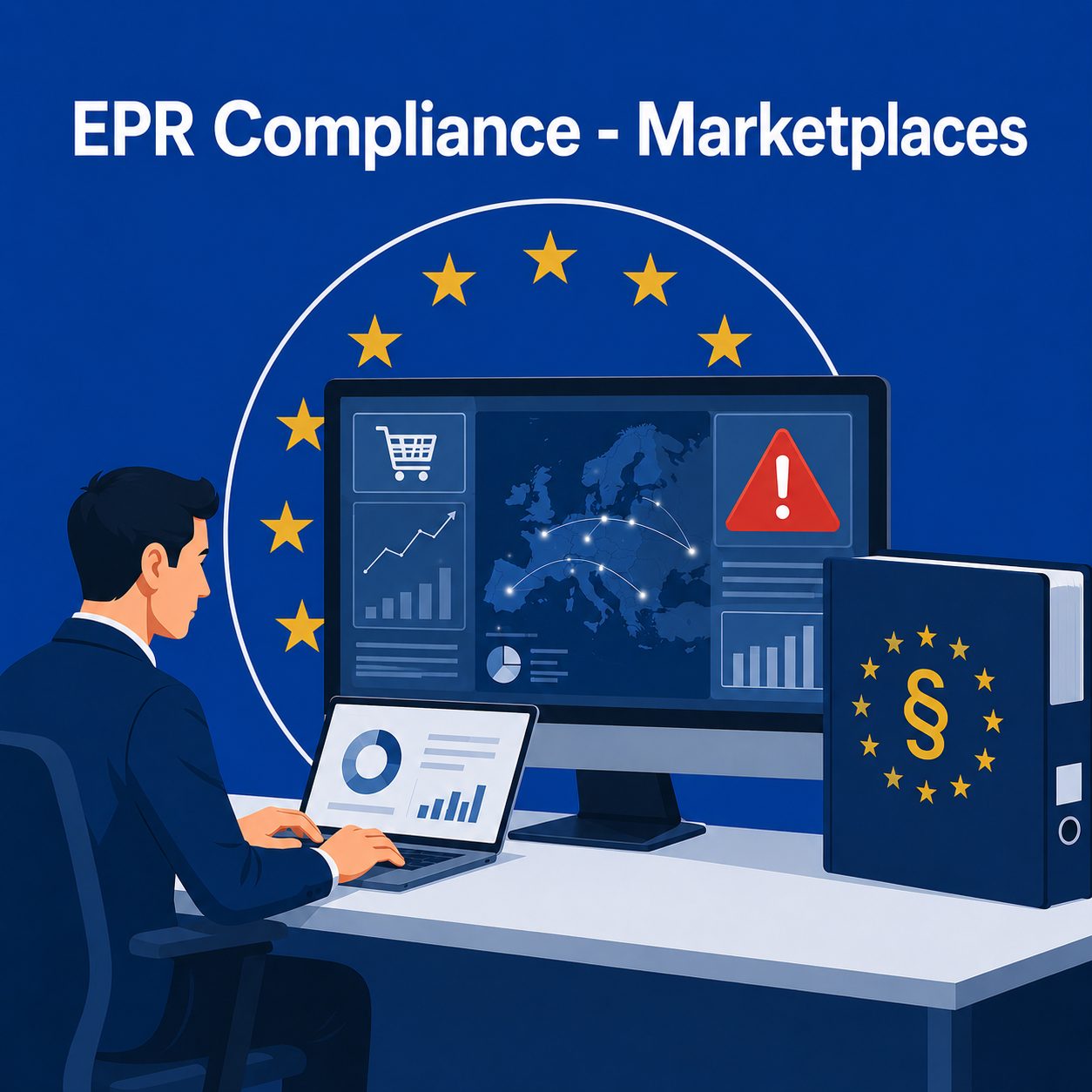
Online marketplaces such as Amazon, eBay, and Zalando no longer act as passive intermediaries. With the entry into force of the new EU Packaging Regulation (PPWR) on August 12, 2026, and the Market Surveillance Regulation, the regulatory framework in Europe will undergo a fundamental overhaul.
Platforms Subject to Verification Requirements
Platform operators will become central control authorities within the EPR (Extended Producer Responsibility) system and must validate the compliance of third-party sellers.
- Mandatory Registration: Sellers must provide proof of valid registration numbers (e.g., LUCID in Germany, IDU in France).
- Hosting ban: Without this proof, marketplaces may no longer list offers.
- EU-wide harmonization: The verification requirement will apply across the entire EU single market starting in August 2026.
Fully Automated API Verification
Online marketplaces use automated systems for efficient merchant verification:
- Real-time verification: Interfaces cross-check merchant data and brand names directly against national registries.
- Immediate suspension: Listings are automatically deactivated in the event of discrepancies or a missing EPR number.
Liability of Fulfillment Service Providers (FSPs)
Logistics providers are directly held liable under the PPWR and the Market Surveillance Regulation:
- Liable Parties: If an online retailer outside the EU sells goods in the EU and has not designated a legal EU importer or authorized representative, the fulfillment service provider (FSP) is liable.
- Pre-shipment verification requirement: FSPs are required to validate the manufacturer’s EPR registration in the destination country.
- Technical blocks: Modern warehouse systems operated by logistics providers automatically block label printing in cases of non-compliance.
The Economics of “Pay on Behalf”
Marketplaces offer “Pay on Behalf” services to handle administrative tasks for international sellers.
- Mandatory Individual Registration: Under the PPWR, all retailers are required to provide their own registration number (ERN).
- Limited Service: Platforms only remit eco-contributions but do not replace the manufacturer’s legal responsibility.
Conclusion
EPR compliance has evolved from a minor administrative issue into a fundamental prerequisite for access to the European market.
Starting in August 2026, compliance requirements for platforms will increase so drastically that, in practice, an automated API connection to ERP systems is often the only economically viable way to minimize liability risks without operational trade-offs.
Questions about EPR compliance? Send us a message!
 www.ecopv-eu.com/en/contact/ |
  E-Mail: info@ecopv-eu.com
 Supported over 20,000 customers with EPR compliance
Rated 5.0 on Google
Contact
We look forward to your message!