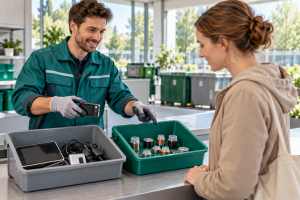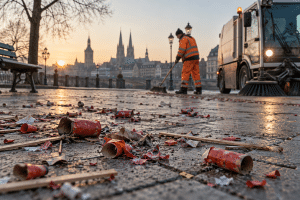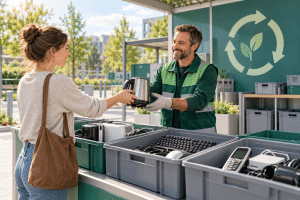
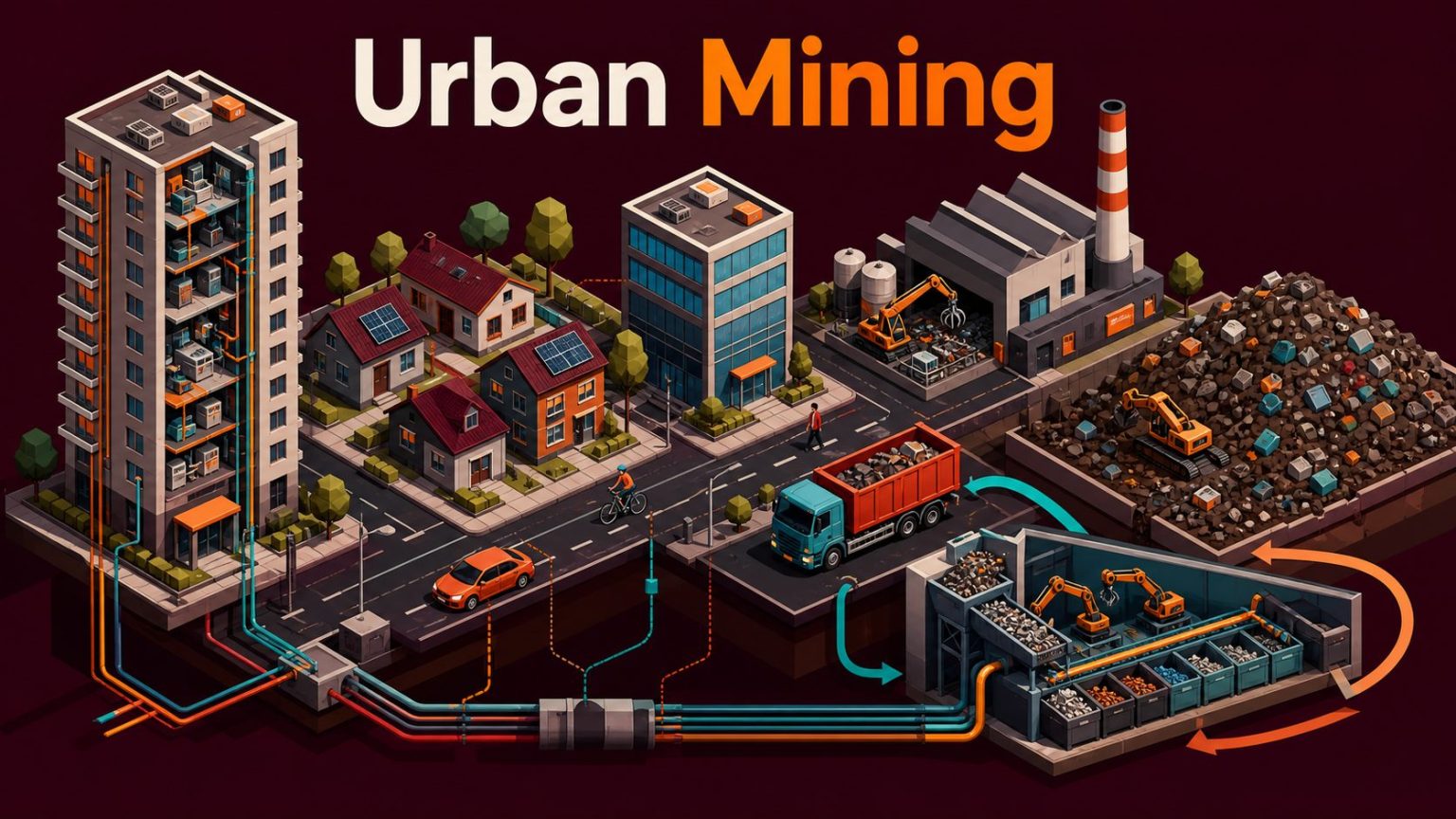
We live in a world where raw materials are becoming scarcer, more expensive, and more geopolitically sensitive. At the same time, enormous quantities of materials – which we have often viewed merely as waste or “stock” – are stored right in the heart of our cities, infrastructure, and buildings. This is precisely where urban mining comes in: the systematic recovery of raw materials from the anthropogenic stockpile.
Urban mining goes beyond traditional recycling. According to the Federal Environment Agency, it encompasses the integrated management of the anthropogenic stockpile to extract secondary raw materials from durable goods (buildings, infrastructure, vehicles, electrical appliances) as well as from landfills. In doing so, urban mining does not merely focus on end-of-life recovery but identifies and quantifies resource potentials already during the usage phase to enable long-term raw material security.
The process of urban mining involves four steps:
- Searching (Prospecting): First, existing resources are systematically inventoried and assessed, often using digital cadastral maps and material passports.
- Investigating (Exploration): On-site, engineering firms and experts examine the type, quantity, and quality of materials, as well as potential contaminants, to accurately determine the value of the deposit.
- Extraction (Extraction): Specialized demolition companies professionally dismantle buildings or infrastructure. In the process, the various materials are cleanly separated rather than simply torn down.
- Processing (Recycling): The recycling industry cleans and sorts the materials in facilities. This produces secondary raw materials that can be used by industry for new products.
Why is this important?
Primary raw materials from nature are not available in unlimited quantities. Their extraction consumes a lot of energy and often harms the environment. For Germany and Europe, dependence on imports also poses a major risk. Recovering materials from cities strengthens domestic supply security and reduces reliance on global supply chains.
Using local secondary raw materials shortens transport routes, reduces material costs, and creates new domestic value. This is how the circular economy becomes a reality: materials are not lost at the end of their useful life, but are recycled into new products.
The benefits at a glance:
- Protecting nature: Less extraction of new raw materials.
- Greater independence: Less need for imports from abroad.
- Climate protection: Lower environmental impact through efficient recycling.
- A secure industry: Raw materials are available locally.
- New jobs: Economic growth driven by specialized demolition and processing companies.
The significance in numbers
Every person is indirectly part of an enormous stock of materials tied up in buildings, infrastructure, and products. We must count everything that surrounds us on a permanent basis: From the proportion of concrete in our homes to the public road network and utility lines, all the way to vehicles and household appliances, this individual “material backpack” adds up to a massive personal inventory.
- Metals: In Germany, approximately 14 tons of metal are used per capita. The total value of this stock is estimated at approximately 650 billion euros.
- Mineral raw materials: At around 317 tons per person, they represent the most voluminous category (primarily in buildings and roads). Their total value in stock amounts to about 350 billion euros. This includes materials such as concrete, sand, and rock.
- Plastics & wood: In addition, there are over 3 tons of plastic and 4 tons of wood per resident. These stocks represent a combined value of around 150 billion euros.
In total, around 1.3 billion tons of materials are used annually in Germany. A large portion of this remains bound up in buildings, roads, and products for a long time. The total stockpile of raw materials in Germany already exceeds 50 billion tons. Since this stockpile grows by about 10 tons per resident each year, it becomes clear: Our cities are not merely places of consumption, but rather vast reservoirs of raw materials for the future.
Conclusion
Urban mining is a crucial key to a future in which we use raw materials sparingly. It combines modern technology with climate protection and makes our industry less vulnerable to crises. Those who start today to accurately document the materials in buildings and products are already securing access to the raw materials of tomorrow. This is what makes a true circular economy possible.
Contact us for comprehensive compliance consulting on electrical appliances, batteries, packaging, and PV panels – and subscribe to our newsletter to stay up to date on laws and trends.
 www.ecopv-eu.com/en/contact/ |
  E-Mail: info@ecopv-eu.com
 Supported over 20,000 customers with EPR compliance
Rated 5.0 on Google