
France’s textile EPR scheme includes a malus for ultra fast fashion. An arrêté of 20 October 2026, published on 21 October and effective from 22 October, embeds the measure in the specifications for producer responsibility organisations. The malus itself has applied since 1 September 2026 under an earlier arrêté of 24 August. It is an increase in EPR contributions, rather than a blanket administrative fine on every clothing sale.
Textile EPR: Which products are covered?
The current fee schedule covers the clothing categories listed in the arrêté. Footwear and household linen belong to France’s wider REP TLC scheme, but are not included in this malus schedule. A low price alone does not determine liability: the product’s calculated D score is decisive.
The calculation gives equal weight to two indices: range breadth G and repair incentive R. According to ADEME, the repair incentive considers both average repair costs relative to the selling price and the availability of a repair service. D is therefore not a simple average of a model count and a price ratio. The formula is D = 0.67 + 0.78 × (0.5 × G + 0.5 × R). A score of D ≤ 0.8 triggers the malus; detailed calculation follows the ministry’s methodology.
What amounts apply through 2030?
The schedule rises in stages. The following examples are in euros per affected product, in the order 2026/2027, 2028, 2029 and from 2030:
- T-shirt or polo: EUR 2.00 / 2.50 / 3.00 / 3.50.
- Jeans: EUR 9.00 / 11.75 / 14.50 / 17.25.
- Coat or jacket: EUR 12.00 / 14.50 / 17.00 / 19.50.
Across the listed categories, the range is EUR 0.50–12 in 2026/2027 and EUR 2–19.50 from 2030. Distinguish the statutory ceiling from the actual product schedule. Under the law of 8 July 2026, the producer responsibility organisation must limit the amount to 50% of the selling price excluding VAT when the producer submits a reasoned request. Businesses should not budget for this limitation as an automatic discount.
Other ultra fast fashion rules
The law also provides for an advertising ban from 1 January 2027. The French business administration explains these additional measures. Classification and implementing rules for advertising should be assessed separately from the textile EPR malus calculation already in operation.
What manufacturers and retailers should do now
- Review product data: Keep traceable records of range breadth, repair costs and available repair services.
- Organise textile EPR: Check Refashion registration, volume reporting and the applicable contribution schedule.
- Clarify responsibility: For marketplace sales, identify the statutory producer and allocate costs contractually. A contract cannot change the legal role.
ECOPV-EU supports manufacturers and retailers with textile EPR registration in France. This article provides general information and does not constitute legal advice.
Sources: Légifrance, arrêtés of 24 August and 20 October 2026 and law of 8 July 2026; ADEME, updated 29 October 2026; Service Public Entreprendre. Checked on 3 November 2026.
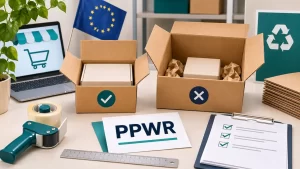
AI-generated concept illustration of textile EPR in France; not an official certification mark.
Contact
Questions about packaging, battery or electrical equipment compliance? We look forward to hearing from you.
Frankfurter Str. 70–72
65760 Eschborn, Germany