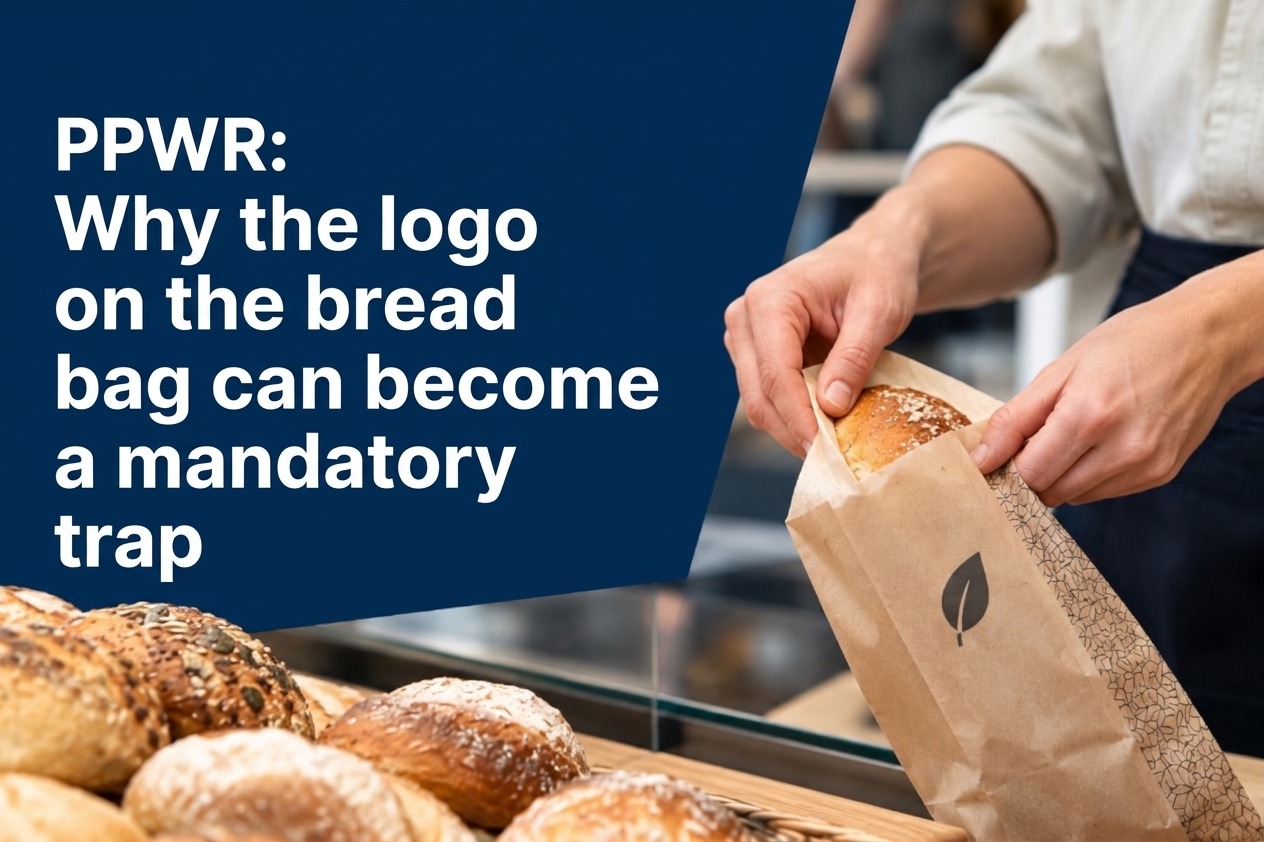
Many bakeries and retailers are lulled into a false sense of security regarding the new EU Packaging Regulation (PPWR), arguing, “We purchase our pre-printed bread bags from a supplier.”
This can be a serious mistake. As soon as a company’s own logo or private label is affixed to the packaging, the company is legally considered the producer and bears full responsibility for compliance.
In practice, this means an obligation for material transparency
• Obligation to provide proof of PFAS compliance: As of August 12, 2026, strict limits will apply to harmful PFAS compounds (“forever chemicals”) in food-contact packaging. Businesses must be able to provide written PFAS compliance certificates from their suppliers. Without this technical documentation, the packaging is not marketable.
• Detailed record-keeping: The exact packaging quantities, weights, and material compositions (e.g., paper type, coatings, viewing windows) must be fully documented.
Important Exception for Microenterprises
The PPWR provides relief for very small craft businesses. If a business meets the criteria for a microenterprise (fewer than 10 employees and a maximum of 2 million euros in revenue) and purchases branded bags from a supplier based in Germany, the role of the manufacturer (conformity assessment and technical documentation) is legally transferred to that supplier.
Important Information Regarding Purchases from Abroad
The exception for micro-enterprises applies only if the branded packaging is sourced from a supplier based in the same Member State. Even if a micro-enterprise sources its bags independently from another EU country or imports them directly from a non-EU third country, it is liable as the producer without exception.
Does every single bag have to be serialized?
No. The PPWR does not require a sequential, unique serial number for each individual paper bag. In practice, the required traceability and labeling of material composition are achieved through lot numbers or specific QR codes on the packaging units (e.g., the outer carton) to make recycling data digitally accessible.
Conclusion
Simply purchasing products through suppliers does not automatically exempt a company from the new environmental obligations. Anyone using a private label must carefully analyze their role in the supply chain and actively manage compliance data.
Contact us for comprehensive compliance consulting on electrical equipment, batteries, packaging, and PV panels – and subscribe to our newsletter to stay up to date on laws and trends.
 www.ecopv-eu.com/en/contact/ |
 E-Mail: info@ecopv-eu.com
 Supported over 20,000 customers with EPR compliance
Rated 5.0 on Google
Contact
We look forward to your message!